The Porsche GT3 occupies a unique position in the sports car world. It's a factory race car that you can drive to the grocery store, a naturally aspirated screamer in an age of turbocharging, and one of the few modern cars where the driving experience genuinely improves the more you learn about maintaining it properly.
At Repasi Motorwerks, we've worked on GT3s across every generation—from the original 996.1 that started it all through the current 992 with its swan-neck rear wing. This guide distills what we've learned from thousands of hours maintaining, inspecting, and preparing these cars for both street and track duty.
Whether you've just taken delivery of your first GT3 or you're a seasoned owner considering your next track day, this guide covers the maintenance fundamentals, track preparation essentials, and long-term care strategies that protect both performance and value.
GT3 Generations: A Technical Overview
Understanding which generation you own—or are considering—is the foundation of proper ownership. Each GT3 iteration brought meaningful changes to the engine, chassis, and technology.
996 GT3 (1999-2005): Where It All Began
The original GT3 established the formula. Based on the 996 platform with the Mezger flat-six engine, these cars are increasingly sought after by collectors who value mechanical purity.
- 996.1 GT3 (1999-2001): 3.6-liter Mezger, 360 hp. Not officially sold in the US. Manual transmission only.
- 996.2 GT3 (2004-2005): 3.6-liter Mezger, 381 hp. The first US-market GT3. Manual only.
Key ownership note: The Mezger engine in 996 GT3s does not suffer from the IMS bearing and bore scoring issues that plague standard 996 models. This is a fundamentally different engine design with a dry-sump oiling system and racing pedigree.
997 GT3 (2007-2013): The Golden Era
Many enthusiasts consider the 997-generation GT3 the sweet spot of the lineup—the last analog GT3 before electronic steering, with a refined Mezger engine.
- 997.1 GT3 (2007-2009): 3.6-liter Mezger, 415 hp. Manual only. Introduced center-lock wheels as an option.
- 997.2 GT3 (2010-2013): 3.8-liter Mezger, 435 hp. Manual only. Revised front fascia and improved aerodynamics.
Key ownership note: The 997 GT3 is the last generation to use the race-bred Mezger engine. The 997.2 in particular represents the most refined version of this legendary powerplant.
991 GT3 (2013-2019): PDK and Power
The 991 generation marked two major shifts: the switch from the Mezger to the 9A1-derived engine, and the introduction of PDK as the sole transmission option (initially).
- 991.1 GT3 (2013-2016): 3.8-liter 9A1-derived, 475 hp. PDK only. Rear-axle steering introduced.
- 991.2 GT3 (2017-2019): 4.0-liter 9A1-derived, 500 hp, 0-60 in 3.4 seconds, 198 mph top speed. Manual transmission returned as an option.
Key ownership note: Early 991.1 GT3 models experienced engine failures due to connecting rod bolt issues. Porsche issued a recall and replaced affected engines. Verify recall compliance on any 991.1 GT3 purchase.
992 GT3 (2021-Present): Technology Meets Tradition
The current GT3 combines the most advanced chassis Porsche has ever built with a naturally aspirated 4.0-liter flat-six that revs to 9,000 rpm.
- 992 GT3 (2021-present): 4.0-liter flat-six, 510 hp, 0-60 in 3.2-3.4 seconds, 199 mph top speed. Available in PDK or 6-speed manual.
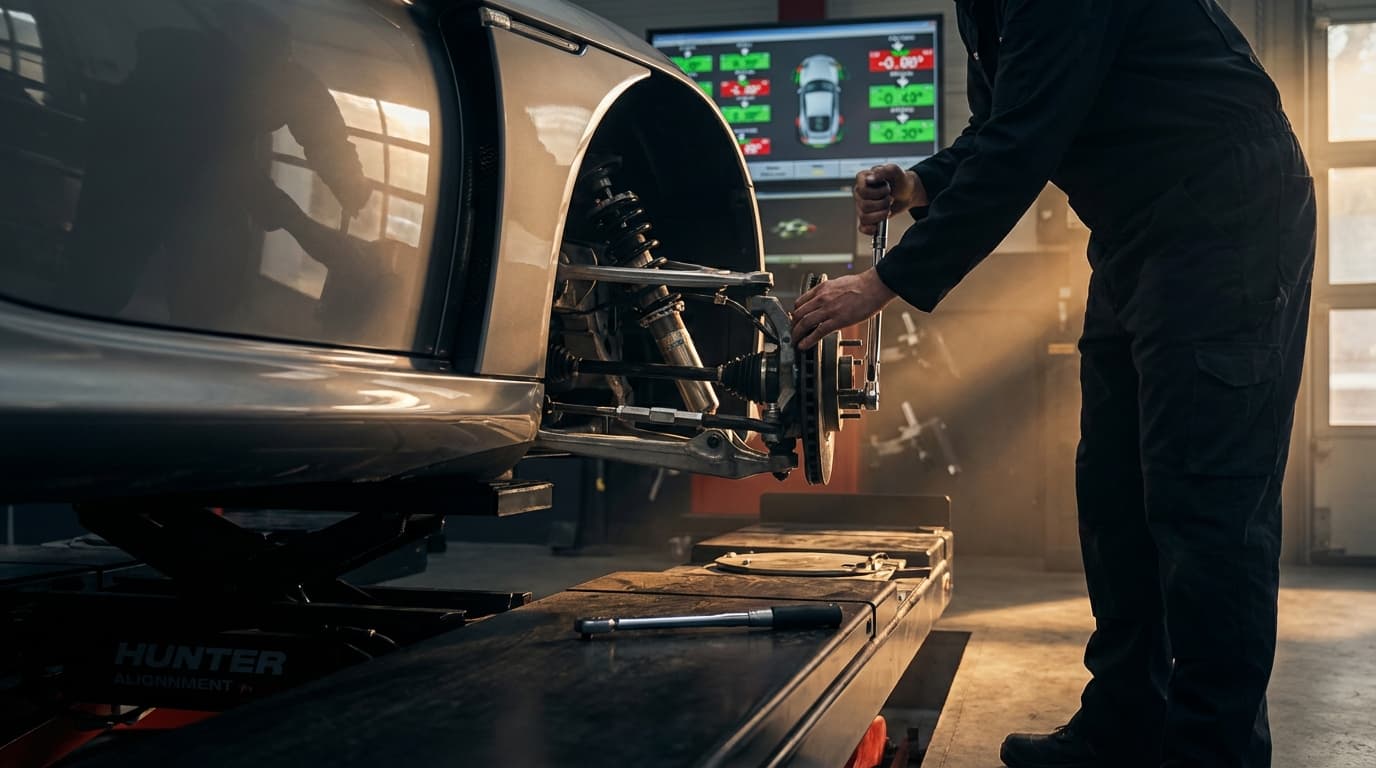
Key ownership note: The 992's double-wishbone front suspension (derived from the 911 RSR race car) represents a fundamental improvement in front-end precision over the previous MacPherson strut design.
Maintenance Schedules by Use Case
GT3 maintenance isn't one-size-fits-all. A car that sees occasional canyon drives needs different attention than one that does monthly track days.
Street-Driven GT3: Standard Schedule
| Interval | Service Items |
|---|---|
| Every 10,000 miles / 1 year | Oil and filter change, brake fluid flush, multi-point inspection |
| Every 20,000 miles / 2 years | Spark plugs, air filter, cabin filter, PDK fluid service |
| Every 40,000 miles / 4 years | Coolant flush, complete brake system inspection, suspension check |
| Every 60,000 miles | Major service: valve adjustment check, all fluids, comprehensive inspection |
Track-Driven GT3: Accelerated Schedule
If you track your GT3 regularly (more than 4-5 events per year), expect:
- Oil changes every 5,000 miles or after every 3-4 track days
- Brake fluid flush before every track season and mid-season
- Brake pad inspection after every track weekend
- Tire rotation and inspection monthly during track season
- Coolant system pressure test annually
- PDK fluid service every 15,000 miles (track use accelerates fluid degradation)
- Alignment check at least twice per year
Fluids and Specifications
Using correct fluids is non-negotiable. GT3 engines run at higher temperatures and RPMs than standard 911s, and the wrong oil or coolant can cause premature wear.
- Engine oil: Porsche-approved 0W-40 or 5W-50 (consult your specific generation's requirements)
- Brake fluid: DOT 4 racing specification for track use; standard DOT 4 for street only
- Coolant: Porsche factory coolant with proper distilled water ratio
- PDK fluid: Porsche-specific ATF (critical—generic ATF can damage the PDK unit)
- Manual transmission fluid: Porsche MTF (manual GT3 models)
Track Day Preparation: The Repasi Approach
Preparing a GT3 for track duty goes beyond checking the oil level. A thorough pre-track inspection can prevent both mechanical failures and costly damage.
Pre-Track Inspection Checklist
Engine and drivetrain:
- Oil level and condition
- Coolant level and system pressure test
- All belts for wear and tension
- Check for oil or coolant leaks under high-boost conditions
Brakes — the most critical system:
- Pad thickness measurement (all four corners)
- Rotor condition and thickness measurement
- Brake line inspection for chafing or damage
- Caliper slide pin lubrication
- Brake fluid condition (moisture content test)
Suspension and chassis:
- Alignment verification (track alignment may differ from street settings)
- Damper function test
- Ball joint and tie rod end inspection
- Wheel bearing play check
- Lug torque verification
Tires:
- Tread depth measurement (all four corners)
- Sidewall inspection for damage
- Tire pressure set to track specification
- Tire age check (tires over 4-5 years old should not be tracked regardless of tread)
Safety equipment:
- Harness date codes (if equipped)
- Fire extinguisher charge and date
- Tow hook accessibility
For a detailed pre-event walkthrough, see our GT3 Track Day Checklist.
Track vs Street Alignment
One of the most common mistakes we see is running track alignment settings on the street (and vice versa).
Street alignment prioritizes even tire wear, comfortable ride, and predictable handling in varied conditions. Track alignment prioritizes maximum grip at the expense of tire wear, with more negative camber and slightly more aggressive toe settings.
If you track your GT3 regularly, consider investing in a second set of wheels mounted with track tires and having the car re-aligned for track days. Or accept the compromise of a mild track alignment that's still livable on the street (roughly -1.5° to -2.0° front camber).
Common Ownership Mistakes
After years of working on GT3s, we've identified the mistakes that cost owners the most money and compromise performance.
Mistake 1: Ignoring the Brake Fluid
Brake fluid is hygroscopic—it absorbs moisture from the air over time. Moisture in the fluid lowers the boiling point, which means brake fade happens sooner under hard use. For tracked GT3s, old brake fluid is genuinely dangerous. We recommend flushing brake fluid at least annually, and before every track season.
Mistake 2: Cheap Oil Changes
A GT3 oil change done wrong—wrong oil specification, overfilled or underfilled, drain plug over-torqued—can cause issues that cost far more than the savings from a bargain service. These engines are high-performance, high-RPM units that rely on precise oiling for reliability.
Mistake 3: Skipping the Pre-Purchase Inspection
Whether buying a 996 GT3 or a 992, a thorough pre-purchase inspection by a GT3 specialist is essential. We've saved buyers tens of thousands of dollars by catching issues that weren't visible in photos or mentioned by sellers. See our PPI Checklist for what to look for.
Mistake 4: Dealer-Only Mentality for Out-of-Warranty Cars
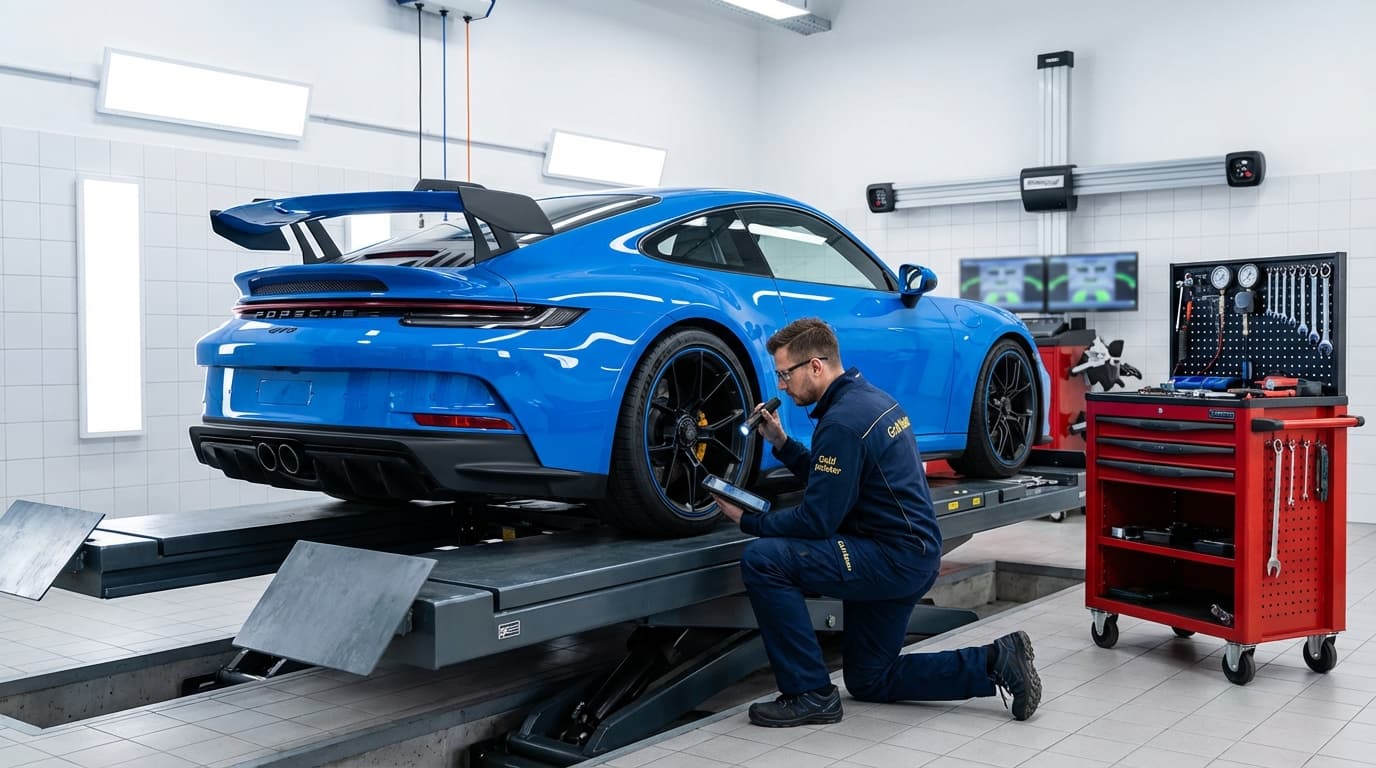
Once your GT3 is out of warranty, a quality independent Porsche specialist with Gold Meister certification and PIWIS diagnostic equipment provides the same level of expertise at 30-50% lower cost. This matters especially for major services that can run into the thousands.
Mistake 5: Neglecting Track Prep
Running a GT3 on track without proper preparation isn't just risky for the car—it's risky for the driver and everyone else on circuit. Brakes, tires, fluids, and fasteners all need verification before high-speed driving.
Cost Expectations: What GT3 Ownership Actually Costs
We believe in transparency about costs. Here's what GT3 owners should budget annually.
Street Use Only
| Item | Annual Cost |
|---|---|
| Routine maintenance (oil, filters, inspections) | $2,000-$3,500 |
| Tires (every 15,000-20,000 miles, prorated) | $800-$1,500 |
| Brakes (pads and rotors, prorated over life) | $500-$1,000 |
| Insurance | $3,000-$8,000 |
| Total | $6,300-$14,000 |
Regular Track Use (6+ Events/Year)
| Item | Annual Cost |
|---|---|
| Routine maintenance + track prep | $3,500-$6,000 |
| Track tires (2-3 sets per season) | $4,000-$8,000 |
| Brake pads (2-4 sets per season) | $2,000-$4,000 |
| Brake rotors (prorated) | $1,000-$2,000 |
| Insurance (higher with track endorsement) | $5,000-$12,000 |
| Track fees and entry | $3,000-$6,000 |
| Total | $18,500-$38,000 |
For a more detailed breakdown, see our GT3 Annual Ownership Cost analysis.
Engine Deep Dive: Mezger vs 9A1
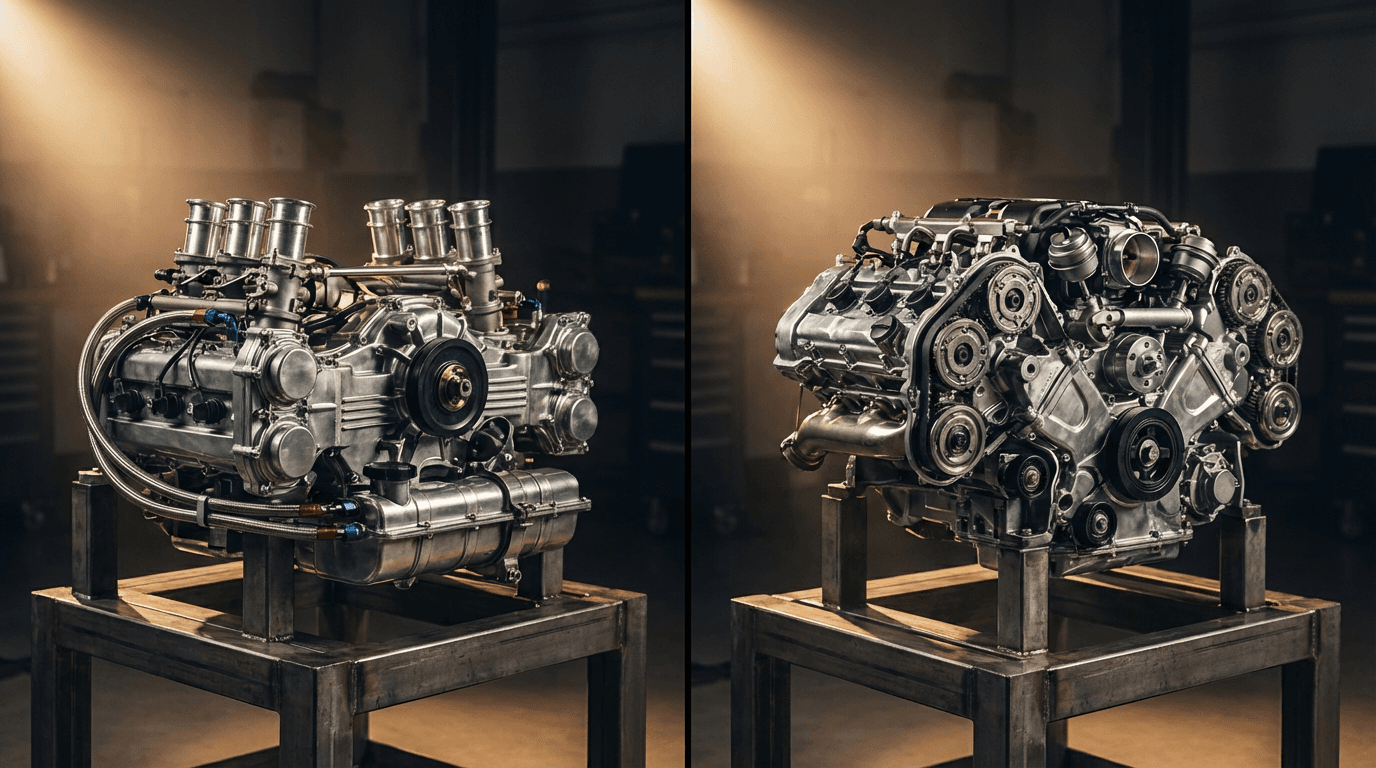
The engine conversation is one of the most debated topics in GT3 ownership. The Mezger (996/997) and 9A1-derived (991/992) engines are fundamentally different designs with different maintenance profiles and characters.
Read our full technical comparison in GT3 Mezger vs 9A1 Engine: What Every Owner Should Know.
The short version: Both engines are reliable when maintained properly. The Mezger has legendary status and a unique mechanical character. The 9A1-derived engines make more power, rev higher, and benefit from modern engineering. Neither is "better"—they're different expressions of the GT3 philosophy.
Long-Term Value Preservation
GT3s have historically held value well, and certain variants have appreciated significantly. Here's how to protect your investment:
- Maintain meticulous records — every service, every receipt, every invoice
- Use OEM or proven quality parts — cut-rate components diminish both reliability and resale value
- Address issues immediately — small problems become expensive problems
- Store properly — climate-controlled, with battery tender, on flat-spot preventers
- Choose your specialist wisely — documented service at a respected shop adds to the car's provenance
Related GT3 Resources
- GT3 Service Guide: Maintenance, Costs & What to Expect
- 992 GT3 vs 991 GT3 Comparison
- GT3 RS Engine Rebuild: Cost & Timeline
- GT2 RS Service & Maintenance Guide
- GT2 RS Reliability: Common Issues & Prevention
- GT3 Service Intervals & Schedule
- Porsche GT Maintenance Checklist
Schedule Your GT3 Service
Whether your GT3 needs routine maintenance, track preparation, or a pre-purchase inspection, Repasi Motorwerks has the expertise and equipment to do it right. We service GT3s from across the country—many owners ship their cars to our Connecticut facility.