The Porsche 918 Spyder represents a technological achievement that hasn't been surpassed by its maker. Combining a 4.6-liter V8 derived from the RS Spyder racing program with dual electric motors for a combined 887 horsepower, the 918 set benchmarks that still stand today—a 6:57 Nurburgring lap time, 2.5-second 0-60 sprints (Weissach Package), and a top speed of 214 mph.
With only 918 units produced between 2013 and 2015, ownership carries both privilege and responsibility. At Repasi Motorwerks, we've maintained, inspected, and serviced 918 Spyders since they first entered private hands. This guide shares what we've learned about keeping these hybrid hypercars running at their extraordinary best.
918 Spyder: Specifications and Variants
Before discussing maintenance, let's establish the technical baseline.
Standard 918 Spyder
- Engine: 4.6-liter naturally aspirated V8 (608 hp at 8,700 rpm)
- Electric motors: Two — front axle (129 hp) and rear axle (156 hp)
- Combined output: 887 hp
- Transmission: 7-speed PDK
- 0-60 mph: 2.6 seconds
- Top speed: 214 mph (on V8 alone), 210 mph (combined)
- Electric-only range: Approximately 12 miles
- Curb weight: 3,692 lbs
- Production: 918 units
- MSRP (new): $845,000 base
- Current values: $1.6M-$2.0M+
Weissach Package
The Weissach Package was a $84,000 option that reduced weight by approximately 90 lbs through:
- Magnesium wheels
- Carbon fiber roof panel and mirrors
- Lighter front and rear axle carriers
- Weight-optimized interior components
Weissach 0-60: 2.5 seconds Weissach curb weight: 3,602 lbs Current Weissach values: $2.0M-$2.5M+
The Hybrid System: What Owners Must Understand
The 918's hybrid system is the most complex aspect of its maintenance profile. Unlike a Toyota Prius, this is a performance hybrid system with liquid-cooled lithium-ion batteries, high-voltage electric motors, and multiple cooling circuits that all require specialized attention.
Battery Health and Monitoring
The 918's battery pack is a liquid-cooled lithium-ion unit that provides both electric driving capability and performance boost. Battery health directly affects performance, electric range, and vehicle value.
What we monitor:
- State of health (SOH) percentage — accessible through PIWIS diagnostics
- Individual cell voltage balance — uneven cells indicate potential issues
- Cooling system function — proper coolant flow prevents thermal degradation
- Charge/discharge patterns — assessed through data logs
Factors that affect battery longevity:
- Storage state of charge: The battery should be stored at 40-60% charge, never fully charged or fully depleted for extended periods
- Temperature exposure: Extreme heat accelerates battery degradation; climate-controlled storage is essential
- Charge cycling frequency: Regular use actually helps battery health more than extended dormancy
- Cooling system maintenance: The battery's liquid cooling circuit must be maintained independently from the V8's cooling system
Battery replacement cost: If the battery pack requires replacement, expect costs of $50,000-$100,000+ depending on availability. This is why preventive care and proper storage are so critical.
High-Voltage Safety
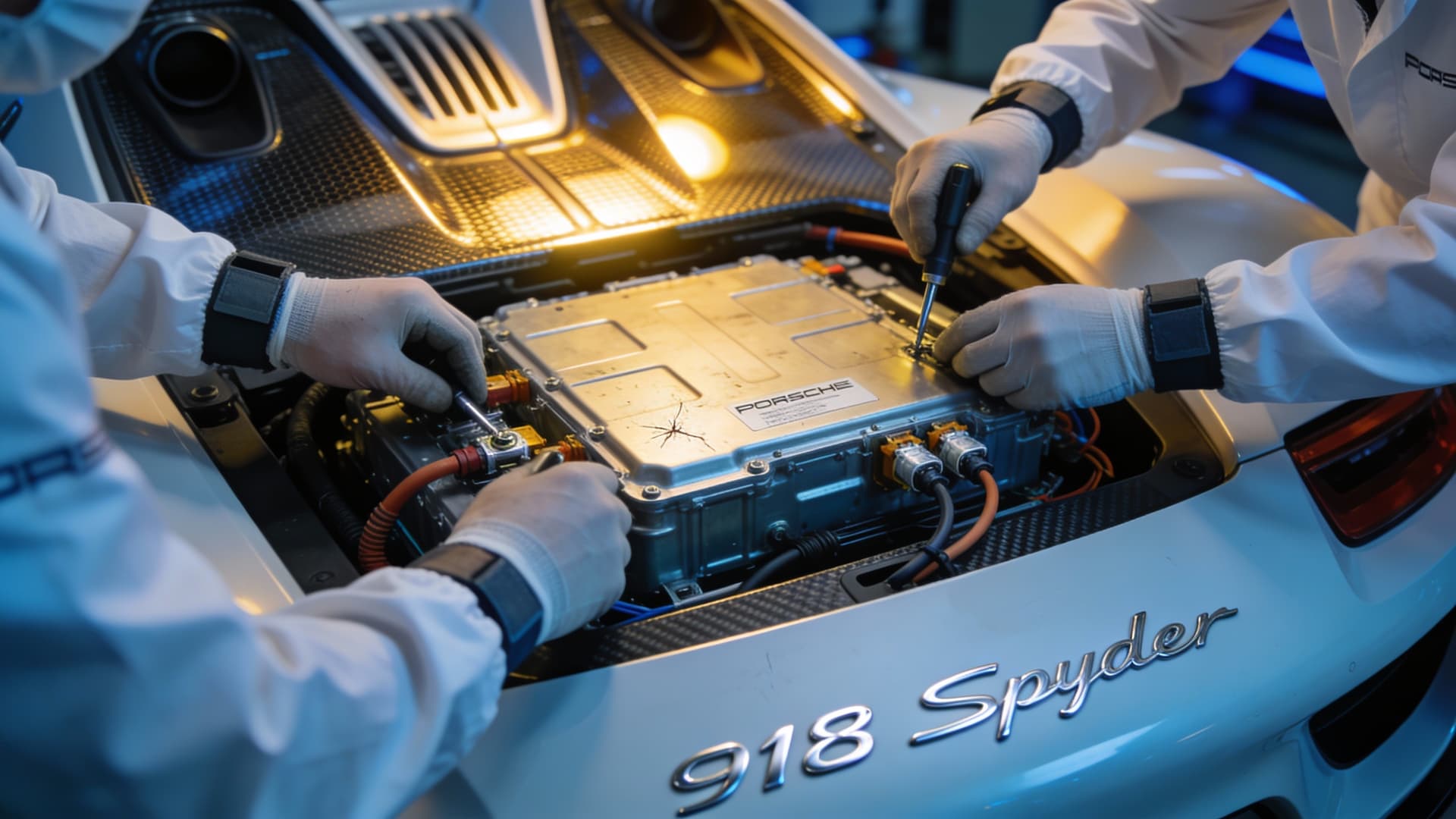
Working on the 918's hybrid system requires specialized training, equipment, and procedures. The high-voltage system operates at over 300 volts—enough to be lethal. This is not a car for a general mechanic, even an otherwise competent one.
At Repasi Motorwerks, our technicians are trained in high-voltage hybrid system procedures and have the proper insulated tooling and personal protective equipment required for 918 service.
V8 Engine Maintenance
The 4.6-liter V8 is derived from the RS Spyder race engine. Like its racing ancestor, it demands precise maintenance.
Service Intervals
| Interval | Service Items |
|---|---|
| Every 10,000 miles / 1 year | Oil and filter, brake fluid flush, hybrid system diagnostic scan, multi-point inspection |
| Every 20,000 miles / 2 years | Spark plugs (16 — dual ignition system), air filters, cabin filter, PDK fluid service |
| Every 40,000 miles / 4 years | Coolant flush (V8 and hybrid circuits), complete brake system service, suspension inspection |
| Annual (regardless of mileage) | Battery health assessment, e-motor cooling system check, all fluid levels |
Engine-Specific Concerns
- High-RPM design: The V8 revs to 9,150 rpm. Proper oil specification and change intervals are critical.
- Dry-sump oiling: Ensures oil supply at extreme g-forces but requires proper level checking procedure.
- Dual ignition: 16 spark plugs (two per cylinder) — all must be replaced as a set.
- Exhaust system: The top-exit exhaust routing creates heat management considerations for surrounding components.
Electric Motor Care
The 918 uses two electric motors — one on the front axle (e-machine) and one integrated with the rear PDK transmission.
Maintenance requirements:
- Cooling circuit fluid level and condition checks at every service
- E-motor bearing condition assessment (listen for unusual sounds)
- High-voltage connector inspection for corrosion or damage
- Power electronics module thermal paste condition (long-term)
The electric motors themselves are remarkably reliable when the cooling system is properly maintained. Most e-motor issues we've seen trace back to cooling system neglect rather than motor failure.
Annual Service: What to Expect
A comprehensive annual service on a 918 Spyder takes approximately 8-12 hours and includes:
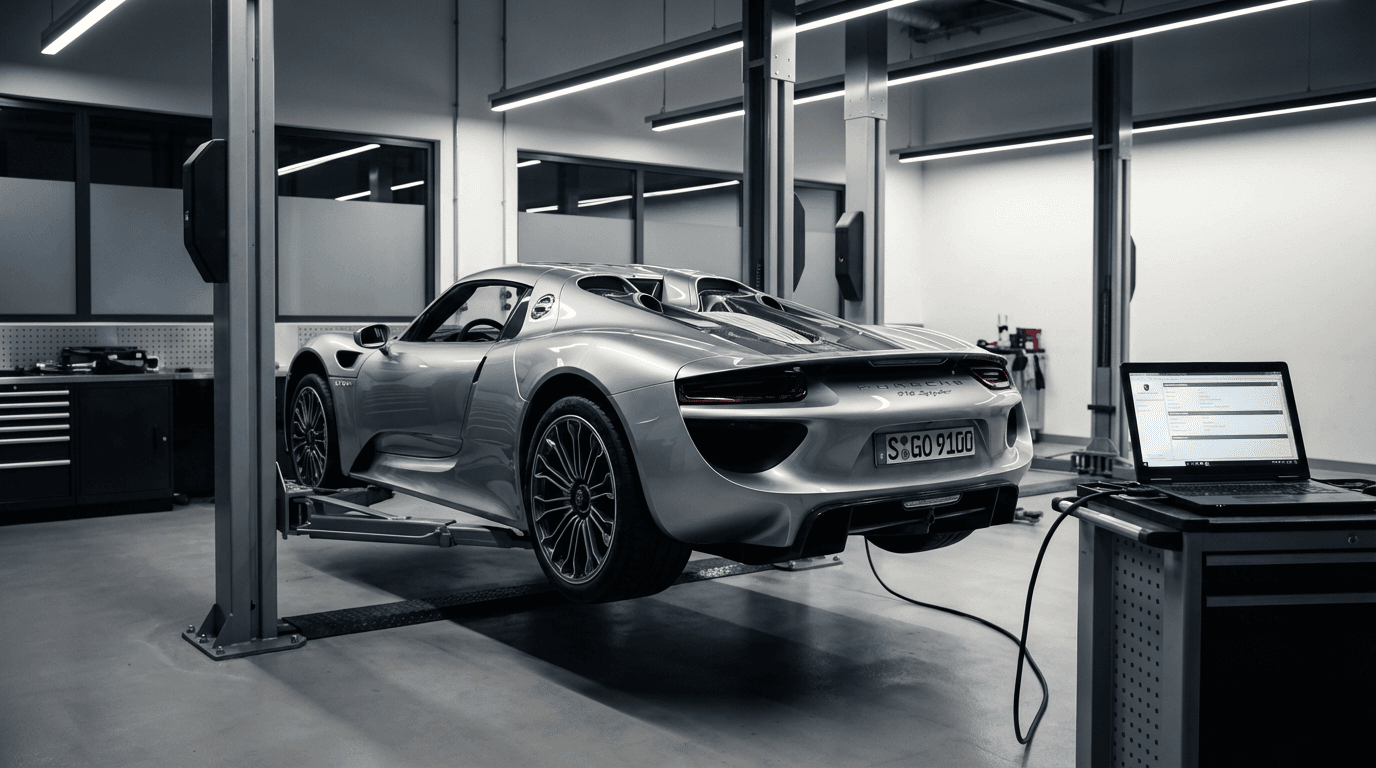
- Complete diagnostic scan — PIWIS reading of all systems including hybrid-specific modules
- Engine service — oil and filter with factory-spec fluids
- Hybrid system assessment — battery health, e-motor status, high-voltage system check
- Brake system — fluid flush, pad measurement, rotor inspection
- Cooling systems — all three circuits (V8, hybrid battery, e-motor) checked for level, condition, and leaks
- Suspension and chassis — check all components, torque critical fasteners
- Visual inspection — underbody, carbon fiber components, bodywork
- Road test — verify all systems operating correctly in all drive modes
Annual service cost: $20,000-$50,000 depending on scope and any issues discovered. This range reflects the reality of maintaining a mid-seven-figure hybrid hypercar with specialized parts and procedures.
Storage Procedures for Hybrid Systems
Proper storage is especially critical for the 918 due to its hybrid system. Standard car storage procedures are insufficient.
For detailed storage procedures, see our guide: 918 Spyder Storage & Seasonal Care.
Critical storage requirements:
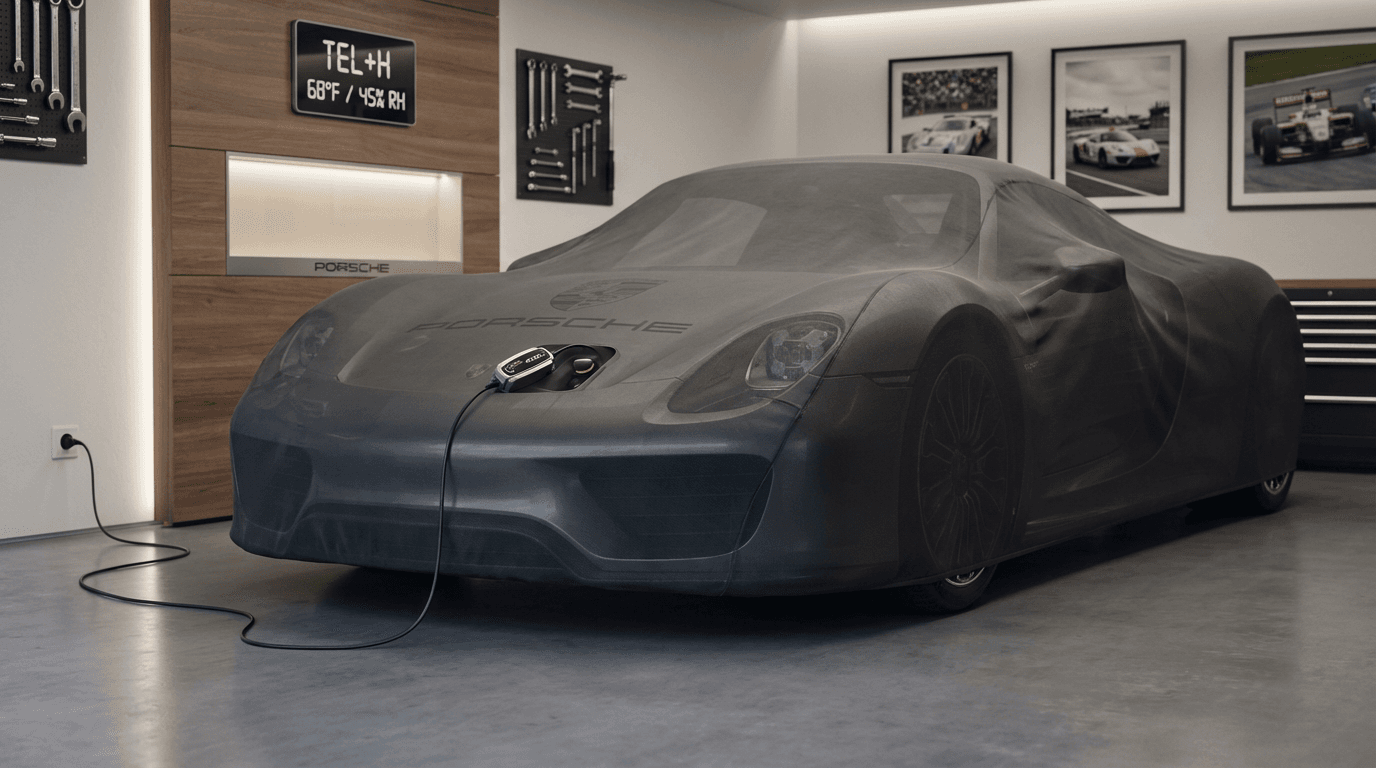
- Battery charge management: Maintain 40-60% state of charge during storage. The car should be brought to operating temperature and driven briefly every 4-6 weeks during long-term storage.
- Trickle charging: A proper battery tender for the 12V auxiliary system prevents the hybrid system from entering deep sleep modes that can require dealer-level intervention to resolve.
- Climate-controlled environment: Battery degradation accelerates significantly above 85°F. Ideal storage temperature is 50-70°F.
- Cooling system integrity: Even in storage, the cooling system must retain proper pressure. A slow leak that might be acceptable on a standard car can cause thermal damage to hybrid components.
Common Concerns and FAQs
"Will the battery need replacing soon?"
Battery replacement concerns are the most common question we hear from 918 owners and prospective buyers. The reality: most 918 batteries are holding up well when the cars have been properly maintained and stored. We've seen cars with 80-90%+ battery health at 10+ years of age when storage and maintenance protocols have been followed.
"How much does a 918 inspection cost?"
A pre-purchase inspection on a 918 takes approximately 6-8 hours and costs $3,000-$5,000 depending on scope. Given the car's value, this is essential insurance for any purchase.
"Can any Porsche dealer service a 918?"
Technically, only Porsche-certified 918 service centers can perform warranty work. However, for out-of-warranty cars, experienced independent specialists with proper PIWIS equipment and hybrid training can handle routine and even complex maintenance—often with more personal attention and shorter wait times than dealer service centers.
Long-Term Value Preservation
The 918 is already a blue-chip collector car. Protecting its value means:
- Complete service records from recognized specialists
- Battery health documentation — the single most important metric for future buyers
- Proper storage when not in regular use
- Original components — retain all original parts, even when upgrading
- Mileage awareness — while driving is encouraged, significant mileage affects value more on the 918 than many other collectibles
Related 918 Spyder Resources
- 918 Spyder Storage & Seasonal Care
- 918 Spyder Weissach Package Guide
- 918 Spyder Annual Maintenance Cost
- 918 Spyder Common Problems
- 918 Spyder Battery Replacement Cost
- 918 vs LaFerrari vs P1 Comparison
- 918 Spyder Performance: 0-60 & Top Speed
- 918 Spyder Service & Maintenance Guide
- Carrera GT vs 918 Spyder Ownership Comparison
Schedule 918 Spyder Service
Repasi Motorwerks is one of the few independent facilities equipped and experienced to service the 918 Spyder. From routine annual maintenance to complex hybrid system diagnostics, our team provides the specialized attention these extraordinary cars require.