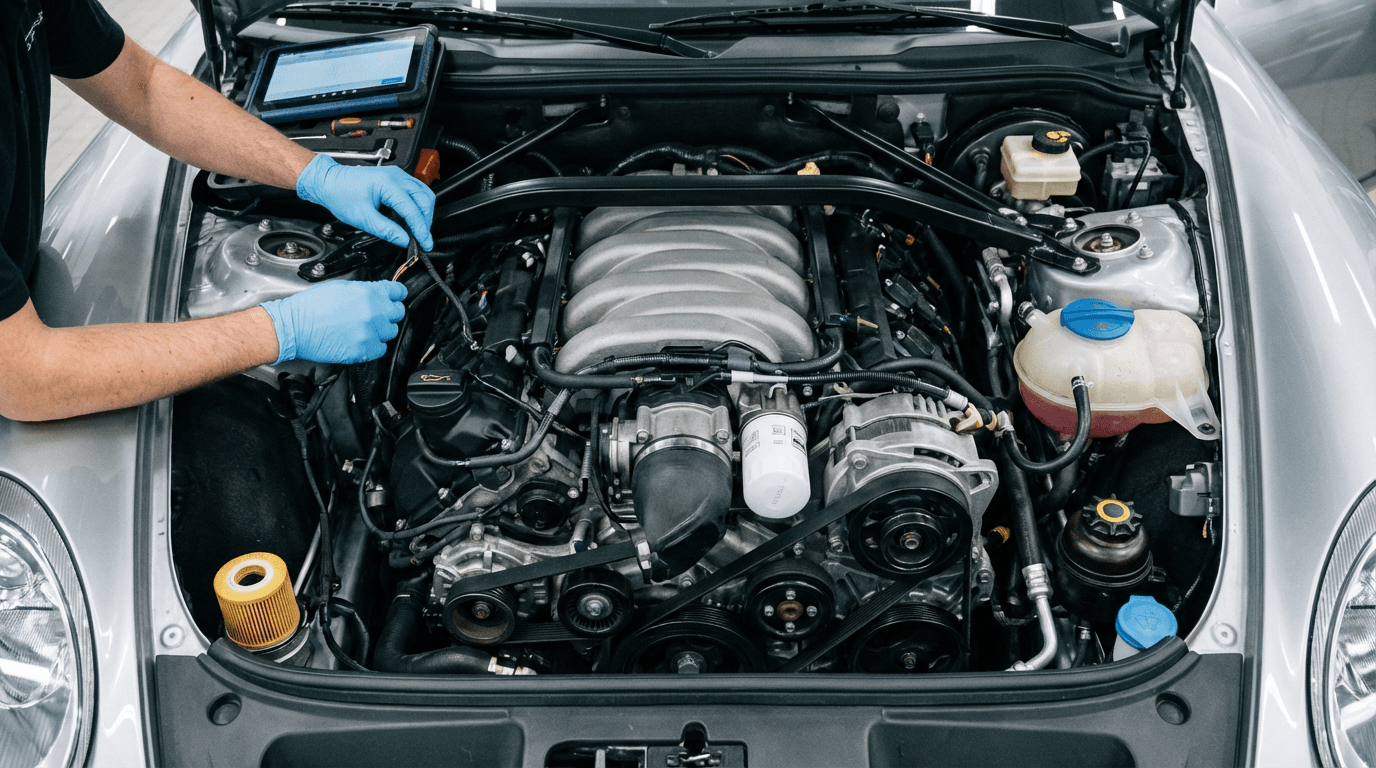
Whether your Porsche has covered 15,000 miles or 1,500 in the past year, an annual service inspection catches developing issues before they become expensive problems. This checklist covers every item we inspect during an annual service, organized by system. Use it as a guide for what to expect from your specialist, or as a reference for items you can check yourself between professional services.
Engine and Drivetrain
1. Engine Oil Level and Condition Check the dipstick (or electronic level on newer models) for correct level and oil color. Dark, gritty, or metallic-flecked oil indicates overdue service or internal wear. See our guide on why Porsche oil changes cost more than typical vehicles.
2. Coolant Level and Condition Verify the coolant level in the expansion tank is between the min/max marks when cold. Check for discoloration (rust-colored coolant indicates internal corrosion) and ensure the correct Porsche-specification coolant is in use.
3. Transmission Fluid Level (Where Accessible) Not all Porsche models have easily accessible transmission fluid checks. PDK-equipped cars require PIWIS for level verification. Manual transmission fluid should be checked for correct level and metallic contamination.
4. Brake Fluid Condition Test the moisture content of the brake fluid. If it exceeds 2% or has not been flushed in the last 2 years, schedule a replacement. This is especially critical in Connecticut's humid climate.
5. Power Steering Fluid (Hydraulic Systems) Older Porsches with hydraulic power steering should have the fluid level and condition checked. Newer models with electric power steering skip this item.
6. Drive Belt Inspection Inspect the serpentine belt for cracks, glazing, fraying, or misalignment. Most belts should be replaced every 40,000-60,000 miles regardless of appearance, as the internal cords degrade before visible damage appears.
7. Coolant Hoses Squeeze all accessible coolant hoses to check for soft spots, swelling, or hardening. Pay particular attention to the expansion tank connections and any plastic fittings, which become brittle with age.
8. Oil Leak Inspection With the car on a lift, inspect the entire engine and transmission for oil seepage. Common leak points include valve cover gaskets, cam chain housing covers, rear main seal, and oil cooler lines. Early detection prevents damage to belts and hoses that contact oil.
Brake System
9. Brake Pad Thickness Measure pad thickness at all four corners. Porsche brake pads should be replaced when they reach 3mm of remaining friction material. Uneven wear front-to-rear or side-to-side indicates caliper issues or alignment problems.
10. Brake Rotor Condition Check for scoring, lipping, heat-checking (surface cracks), and measure rotor thickness against the minimum specification stamped on the rotor hat. On PCCB-equipped cars, inspect the ceramic surface for chipping or delamination.
11. Brake Line and Hose Inspection Inspect all flexible brake hoses for cracking, swelling, or chafing. Check hard brake lines for corrosion, especially the underbody lines that are exposed to Connecticut road salt.
12. Parking Brake Function Test the parking brake on an incline. Electronic parking brakes should engage and release without unusual noise or warning messages. Mechanical parking brakes should hold firmly with moderate lever force.
Suspension and Steering
13. Shock Absorber/Damper Inspection Check for fluid leaks at each damper. Push each corner of the car and release; it should return to ride height with no more than one bounce. On PASM-equipped cars, this test should be performed in both Normal and Sport modes.
14. Control Arm Bushings Inspect all control arm bushings for cracking, tearing, or excessive play. Worn bushings cause vague steering, uneven tire wear, and clunking over bumps. This is especially common on Porsches over 80,000 miles.
15. Tie Rod Ends and Ball Joints Check for play by grasping each wheel at 9 and 3 o'clock (for tie rods) and 12 and 6 o'clock (for ball joints) and rocking. Any perceptible play indicates replacement is needed.
16. Wheel Bearing Check Spin each wheel while listening for grinding or humming. A failing wheel bearing produces a sound that changes with vehicle speed and sometimes with steering direction.
17. Alignment Visual Check Inspect tire wear patterns for signs of misalignment. Feathering, cupping, or uneven edge wear all indicate alignment issues. We recommend a full alignment check annually, especially on cars with N-rated tires where maximum tire life matters.
Electrical System
18. Battery Health Test Load-test the battery and measure resting voltage. A healthy Porsche battery should show 12.4-12.8 volts at rest and hold above 9.6 volts under load. Batteries older than 4-5 years should be tested more critically. Remember that battery replacement requires PIWIS registration on all modern Porsches.
19. Exterior Lighting Check all headlights, taillights, brake lights, turn signals, fog lights, reverse lights, and license plate lights. LED units rarely fail but should still be verified. Xenon/bi-xenon bulbs dim over time and should be replaced in pairs.
20. TPMS Function Verify that all four tire pressure monitoring sensors report correctly. Sensor batteries last approximately 7-10 years and cannot be replaced individually; the entire sensor must be replaced.
Body and Undercarriage
21. Underbody Inspection Inspect the underbody for damage from road debris, corrosion, and loose or damaged aero panels. Connecticut's frost-heaved roads and winter debris are hard on Porsche underbodies, especially the low-hanging front spoiler and side skirt extensions.
22. Exhaust System Inspection Check for rust, loose connections, damaged hangers, and exhaust leaks. Listen for any change in exhaust note that could indicate a developing leak.
23. Door Seals and Weather Stripping Inspect all door, trunk, and frunk seals for cracking, compression set, or detachment. Worn seals cause wind noise and can allow water into the cabin or trunk.
24. Windshield and Glass Inspect for chips, cracks, and delamination. Small chips can be repaired; cracks that extend into the driver's field of vision require replacement. Check wiper blade condition and washer fluid level.
Tires and Wheels
25. Tire Condition Assessment Measure tread depth at multiple points across each tire. Check sidewalls for bulging, cracking, or damage. Verify tire age using the DOT date code. Tires older than 6 years should be replaced regardless of remaining tread. Check our tire guide for Porsche-specific considerations.
26. Wheel Condition Inspect wheels for curb damage, cracks, and corrosion (especially on machined-face wheels). Check lug bolts for proper torque with a torque wrench (most Porsches specify 118-130 ft-lbs depending on model).
What You Can DIY vs. What Needs a Specialist
Comfortable for Most Owners:
- Items 1, 2 (fluid level checks)
- Item 4 (visual fluid color check, not moisture testing)
- Items 19, 20, 23, 24 (exterior visual checks)
- Item 25, 26 (tire and wheel visual inspection)
Requires a Lift and Some Experience:
- Items 6, 7, 8 (belt, hose, and leak inspection)
- Items 9, 10, 11 (brake component inspection)
- Items 21, 22 (underbody inspection)
Requires Professional Equipment:
- Items 3, 4 (accurate fluid testing)
- Items 13-16 (suspension component assessment)
- Item 17 (precision alignment check)
- Item 18 (battery load test and PIWIS registration)
Even if you perform your own checks, an annual professional inspection on a lift catches what a driveway check cannot. Many of these items are included in our standard scheduled maintenance service.
Seasonal Considerations for Connecticut
For Porsches driven year-round in Connecticut:
- Spring: Full inspection plus recommissioning items if the car was stored
- Summer: Mid-season tire and brake check before heavy driving season
- Fall: Pre-storage preparation for winter-stored cars, including fuel stabilizer, battery tender connection, and tire pressure adjustment
- Winter: Monthly check on stored vehicles (battery tender function, tire pressure, rodent evidence)
For year-round drivers, the biggest Connecticut-specific concern is underbody corrosion from road salt. Washing the underbody after winter drives is the best prevention. If you notice any new rattles, clunks, or handling changes after winter, schedule an inspection promptly. Catching salt-induced corrosion early on brake lines, suspension components, and exhaust systems prevents safety-critical failures.
Use this checklist as a conversation starter with your service provider. A thorough annual inspection takes 1-2 hours on a lift and is the foundation of the maintenance schedule that keeps your Porsche reliable and enjoyable for years to come.
Ready to schedule your Porsche service? Contact Repasi Motorwerks or call (203) 257-0987.