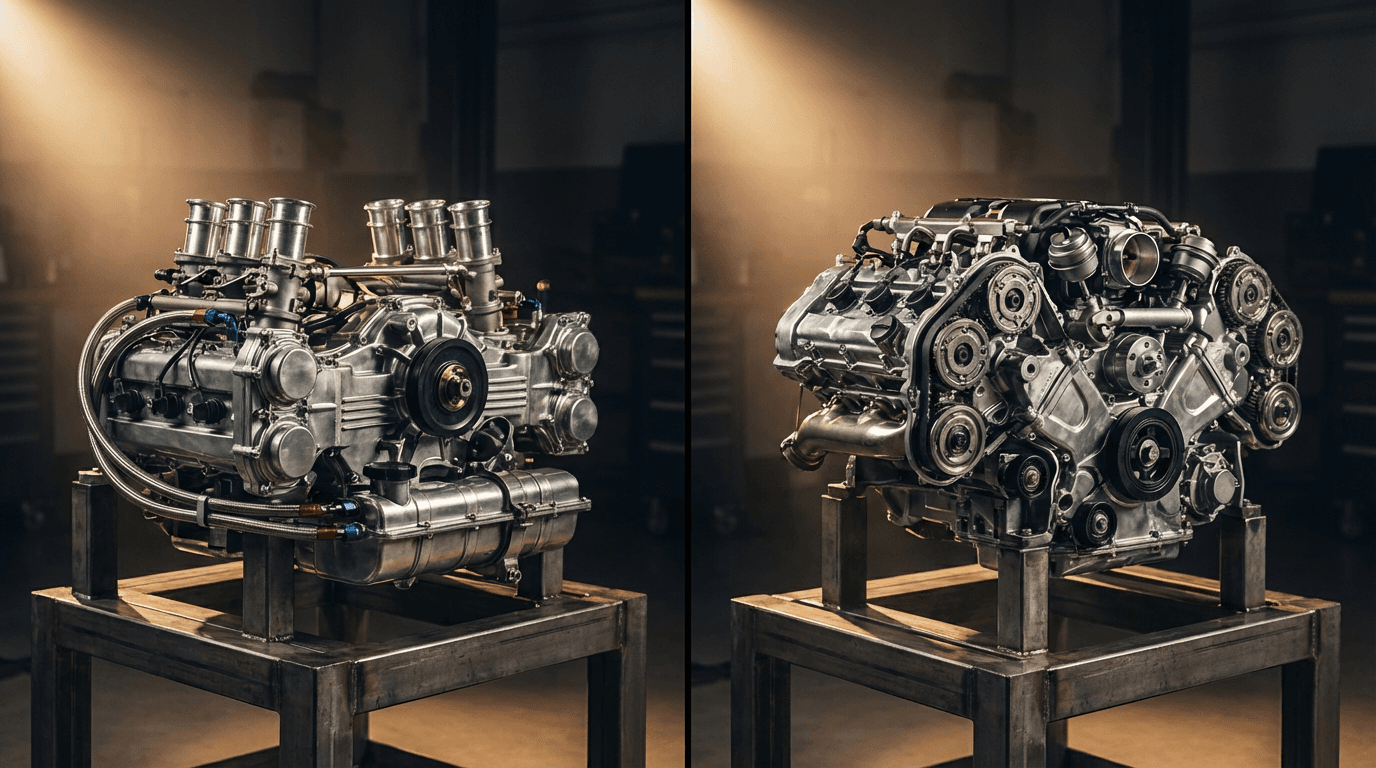
No conversation about GT3 ownership goes very long without reaching the engine question: Mezger or 9A1? It's a debate that generates strong opinions, occasional misinformation, and genuine passion from both camps.
At Repasi Motorwerks, we work on GT3s powered by both engine families regularly. We've rebuilt Mezger engines, diagnosed 9A1 issues, and maintained both types through hundreds of thousands of cumulative miles. This comparison is based on our hands-on experience, not internet speculation.
For context on the broader GT3 ownership experience, see our comprehensive GT3 Owner's Guide.
The Mezger: A Racing Legend
History and Design
The Mezger engine is named for Hans Mezger, the Porsche engineer responsible for some of the most successful racing engines in history. His flat-six design traces its lineage directly to the engines that powered Porsche's Le Mans victories.
Key design characteristics:
- Separate crankcase halves (racing design)
- Dry-sump oiling system
- Individual throttle bodies per cylinder
- Forged internals throughout
- Chain-driven camshafts with timing chains at the flywheel end
GT3 applications:
- 996 GT3: 3.6-liter, 360/381 hp
- 997.1 GT3: 3.6-liter, 415 hp
- 997.2 GT3: 3.8-liter, 435 hp
Mezger Maintenance Profile
The Mezger is remarkably robust when maintained correctly. Its racing heritage means it was designed to handle sustained high-RPM operation.
Routine maintenance:
- Oil and filter every 10,000 miles (or annually)
- Valve adjustment check every 30,000 miles
- Timing chain and tensioner inspection at major service intervals
- Air-oil separator (AOS) replacement — a known wear item
Common issues:
- Intermediate shaft (IMS) bearing — this is NOT a concern on Mezger engines (it affects standard 996/997 M96/M97 engines only)
- AOS failure causing oil consumption — replacement is straightforward
- Rear main seal leaks at higher mileage
- Exhaust manifold studs can corrode and break in salt-belt cars
Rebuild costs: A complete Mezger rebuild typically runs $25,000-$40,000 depending on the condition of the core engine and the specification of the rebuild.
Sound Character
The Mezger's sound is often described as "mechanical" and "raw." At high RPM, the individual throttle bodies create an induction howl that many consider the defining Porsche sound. The 997.2's 3.8-liter version is particularly celebrated for its soundtrack — a metallic, urgent wail that builds with RPM in a way that feels directly connected to the engine's internal machinery.
The 9A1: Modern Engineering
History and Design
When Porsche moved to the 991-generation GT3, they replaced the Mezger with an engine derived from the standard 911's 9A1 engine family. This was controversial but had engineering rationale: the 9A1 platform offered a path to higher displacement, better emissions compliance, and modern manufacturing efficiency.
Key design characteristics:
- Integrated crankcase (monoblock design)
- Wet-sump oiling (with track-ready baffling and oil management)
- Direct fuel injection (991.2 and later)
- Variable valve timing (VarioCam Plus)
- Higher redline capability (8,250 rpm 991.1, 9,000 rpm 991.2/992)
GT3 applications:
- 991.1 GT3: 3.8-liter, 475 hp (8,250 rpm redline)
- 991.2 GT3: 4.0-liter, 500 hp (9,000 rpm redline)
- 992 GT3: 4.0-liter, 510 hp (9,000 rpm redline)
9A1 Maintenance Profile
The 9A1-derived GT3 engines benefit from modern engineering but have their own specific maintenance requirements.
Routine maintenance:
- Oil and filter every 10,000 miles (or annually) — uses more oil per fill than Mezger
- No valve adjustment required (hydraulic lash adjusters)
- Direct injection components (991.2+) require attention to carbon buildup on intake valves
- Coolant system more complex with additional circuits
Common issues:
- 991.1 connecting rod bolt recall — Porsche recalled all 991.1 GT3 and GT3 RS engines produced before a specific date due to a manufacturing defect. Verify recall compliance on any purchase.
- Intake valve carbon buildup (direct injection models) — can be addressed with walnut blasting at ~40,000-mile intervals
- Coolant pipe leaks at higher mileage
- IMS bearing is NOT a concern on 9A1 engines (different design entirely)
Rebuild costs: A 9A1-derived GT3 engine rebuild typically runs $30,000-$50,000. The higher cost reflects greater complexity and more expensive components (direct injection, variable timing).
Sound Character
The 9A1 engines, particularly the 4.0-liter versions in the 991.2 and 992, produce what many describe as a "cleaner" and "sharper" sound. The 9,000 RPM redline creates an experience that's more high-frequency and intense than the Mezger. The 992 GT3 in particular, with its individual throttle bodies (reintroduced from the 911 GT3 Cup), produces a spectacular intake sound that approaches the Mezger's character while delivering distinctly modern power.
Head-to-Head Comparison
| Category | Mezger (996/997) | 9A1-Derived (991/992) |
|---|---|---|
| Architecture | Separate case halves, racing design | Integrated crankcase, modern design |
| Oiling | Dry sump | Wet sump with track baffling |
| Fuel delivery | Port injection | Port (991.1), Direct (991.2+) |
| Peak power | 360-435 hp | 475-510 hp |
| Redline | 8,400 rpm | 8,250-9,000 rpm |
| Valve adjustment | Required (manual lash) | Not required (hydraulic) |
| IMS concern | None | None |
| Sound character | Mechanical, raw | Clean, sharp, higher frequency |
| Oil capacity | ~9 quarts | ~10-11 quarts |
| Rebuild cost | $25,000-$40,000 | $30,000-$50,000 |
Reliability: Both Are Excellent
Setting aside the 991.1 connecting rod bolt recall (a manufacturing defect, not a design flaw), both engine families are remarkably reliable when maintained properly.
Mezger longevity: We've seen Mezger engines exceed 100,000 miles without rebuild, particularly in cars that were properly maintained and not heavily tracked.
9A1 longevity: The 9A1-derived engines are still relatively young (the oldest 991.1 GT3 engines are only about 13 years old), but early indications suggest similar or better longevity to the Mezger, with the caveat that direct injection models need periodic intake valve cleaning.
Our perspective: Neither engine is inherently "unreliable." Both respond well to proper maintenance and suffer from neglect. The most common cause of engine failure in either family is inadequate oil maintenance or overheating due to cooling system neglect — problems that proper ownership prevents.
Value Trajectories
The Mezger carries a significant premium in the collector market, driven by:
- Limited production numbers
- Racing pedigree and heritage
- Analog driving experience (manual-only in most configurations)
- Sound character that's become iconic
997.2 GT3 values in particular have increased substantially and are expected to continue appreciating as the "last Mezger GT3."
The 991 and 992 GT3s hold value well but haven't yet shown the same collector premium. The 991.2 GT3 (first 4.0-liter with manual option) may develop stronger collector interest over time.
Which Is Right for You?
Choose the Mezger if you:
- Value mechanical simplicity and analog character
- Want a racing-derived engine with proven long-term reliability
- Are buying for long-term appreciation potential
- Prioritize sound and feel over outright performance numbers
Choose the 9A1 if you:
- Want the fastest, most capable GT3 on track
- Prefer modern features (rear-axle steering, PDK, traction management)
- Plan to use the car as a daily driver as well as occasional track car
- Value the 9,000 RPM experience of the 4.0-liter engines
Our take: There's no wrong answer. Both engine families deliver an extraordinary driving experience. The best GT3 is the one you'll actually drive and maintain properly.
Related Resources
- GT3 Owner's Guide: Maintenance, Track Prep & Long-Term Care
- 992 GT3 vs 991 GT3 Comparison
- GT3 RS Engine Rebuild: Cost & Timeline
- How Much Does GT3 Ownership Really Cost?
Engine Service at Repasi Motorwerks
Whether your GT3 runs the legendary Mezger or the modern 9A1, our Gold Meister technicians have the experience and equipment to maintain it properly. From routine oil services to complete engine rebuilds, we service GT3 engines from across the country.