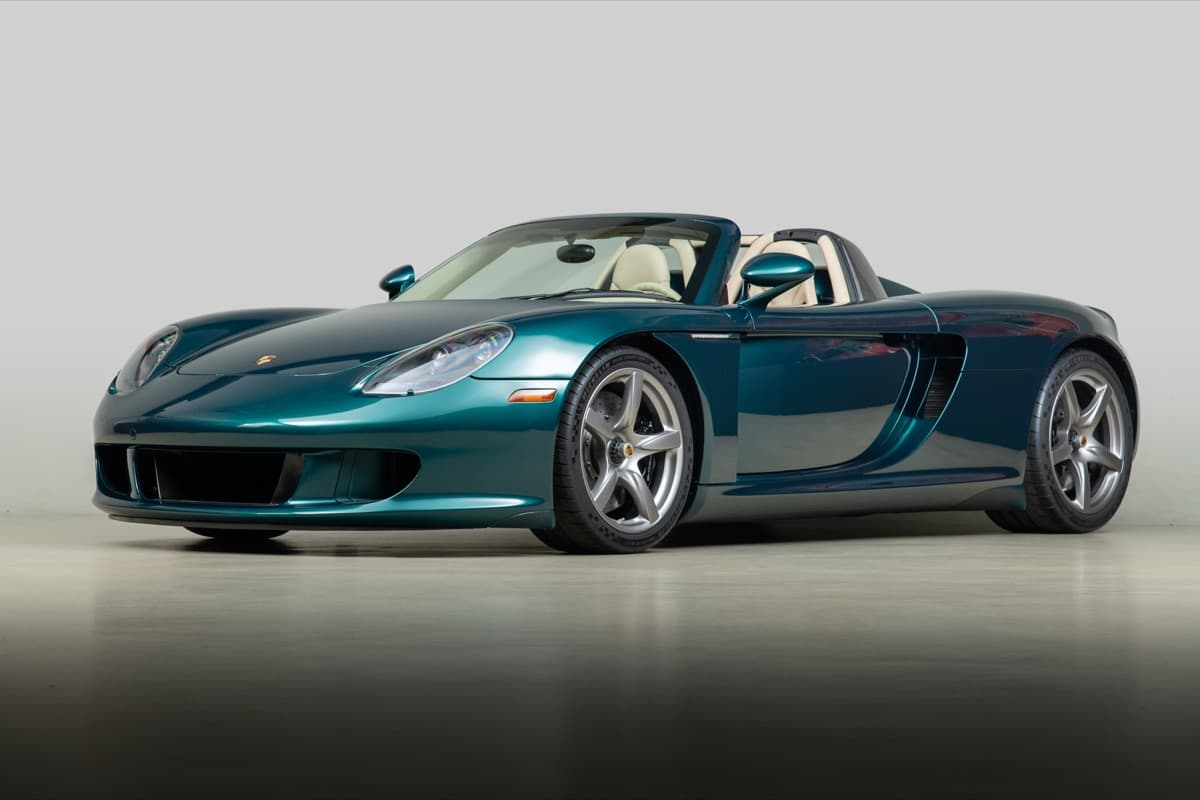
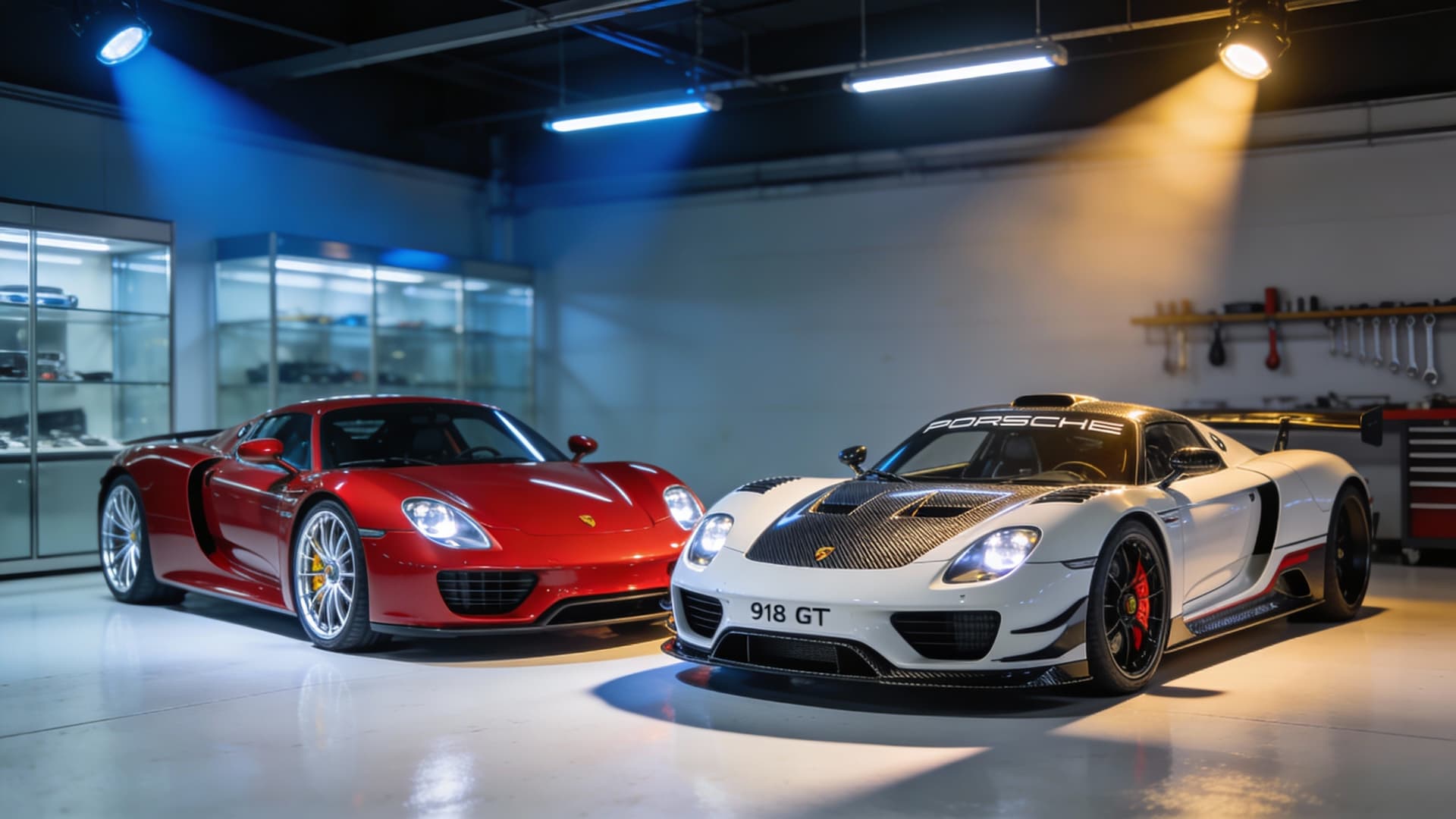
Porsche built two hypercars, separated by a decade of technological revolution. The Carrera GT emerged in 2004 as perhaps the final statement of analog supercar purity—a naturally aspirated V10, a manual transmission, and a driving experience that rewarded skill while punishing complacency. The 918 Spyder arrived in 2013 to announce the hybrid hypercar era, combining a high-revving V8 with electric motors to produce performance the Carrera GT couldn't match while remaining surprisingly approachable.
At our facility, we service both regularly. This perspective—watching these cars come through our shop, understanding what each demands and what each delivers—informs everything that follows. Explore our Carrera GT resource center and 918 Spyder Ownership Guide for model-specific deep dives.
Fundamental Character
Before discussing costs or specifications, the philosophical differences between these cars deserve attention. They shape every aspect of the ownership experience.
The Carrera GT was never designed for casual driving. Every input matters. The ceramic clutch engages abruptly, punishing imprecise throttle coordination. The rear-weight bias rewards smoothness and punishes aggression applied incorrectly. The V10 demands that you use its full range to extract the performance it offers. Driving this car well requires learning its particular language and speaking it fluently.
The 918 Spyder takes a fundamentally different approach. Its electric motors fill torque gaps that would otherwise require careful gear selection. The PDK transmission handles shifts with precision no human can match. Launch control delivers savage acceleration without demanding driver technique. The car makes its extraordinary performance accessible rather than reserved for the highly skilled.
Neither approach is superior. They represent different philosophies about what a hypercar should be. Your preference depends on what you want from the experience.
Specifications in Context
Raw numbers favor the 918 Spyder almost universally. Its combined output of 887 horsepower from the V8 and electric motors substantially exceeds the Carrera GT's 605 horsepower. It accelerates to sixty mph in 2.5 seconds versus the Carrera GT's 3.5 seconds—a full second of difference at these speeds represents an enormous gap. Top speed stretches to 214 mph versus 205.
The 918 weighs considerably more at 3,715 pounds versus 2,755—nearly a thousand pounds of battery and electric motors—yet the hybrid system's instant torque masks this weight penalty effectively. On track, the 918 is faster around virtually any circuit despite the mass.
Production numbers differ as well. Porsche built 1,270 Carrera GTs over three years. Only 918 918 Spyders exist—a number selected for obvious reasons. The 918 also offered a Weissach Package that removed roughly ninety pounds through more aggressive use of carbon fiber and magnesium, creating a subset of cars that commands premium pricing today.
Market Values
Both cars have established themselves as significant collectibles, though their markets have evolved differently.
The Carrera GT peaked around 2016-2017 when strong examples pushed past three million dollars. Prices moderated somewhat before stabilizing. Today, concours-quality examples with under three thousand miles still command .8 to .5 million or more. Excellent examples in the three to eight thousand mile range trade between .0 and .8 million. Higher mileage cars—if there is such a thing for a Carrera GT—remain well above a million dollars.
Color and specification matter enormously. Original paint, factory options like the fitted luggage set, complete documentation, and service history from qualified specialists all support premium pricing.
The 918 Spyder market has proven remarkably strong. Standard 918s typically trade between .6 and .0 million. Weissach Package cars command .0 to .5 million. Ultra-low-mileage examples and cars with special specifications can reach toward three million. The hybrid technology that some initially questioned has become a selling point as the 918's role in defining the modern hypercar segment gains historical recognition.
What Ownership Actually Costs
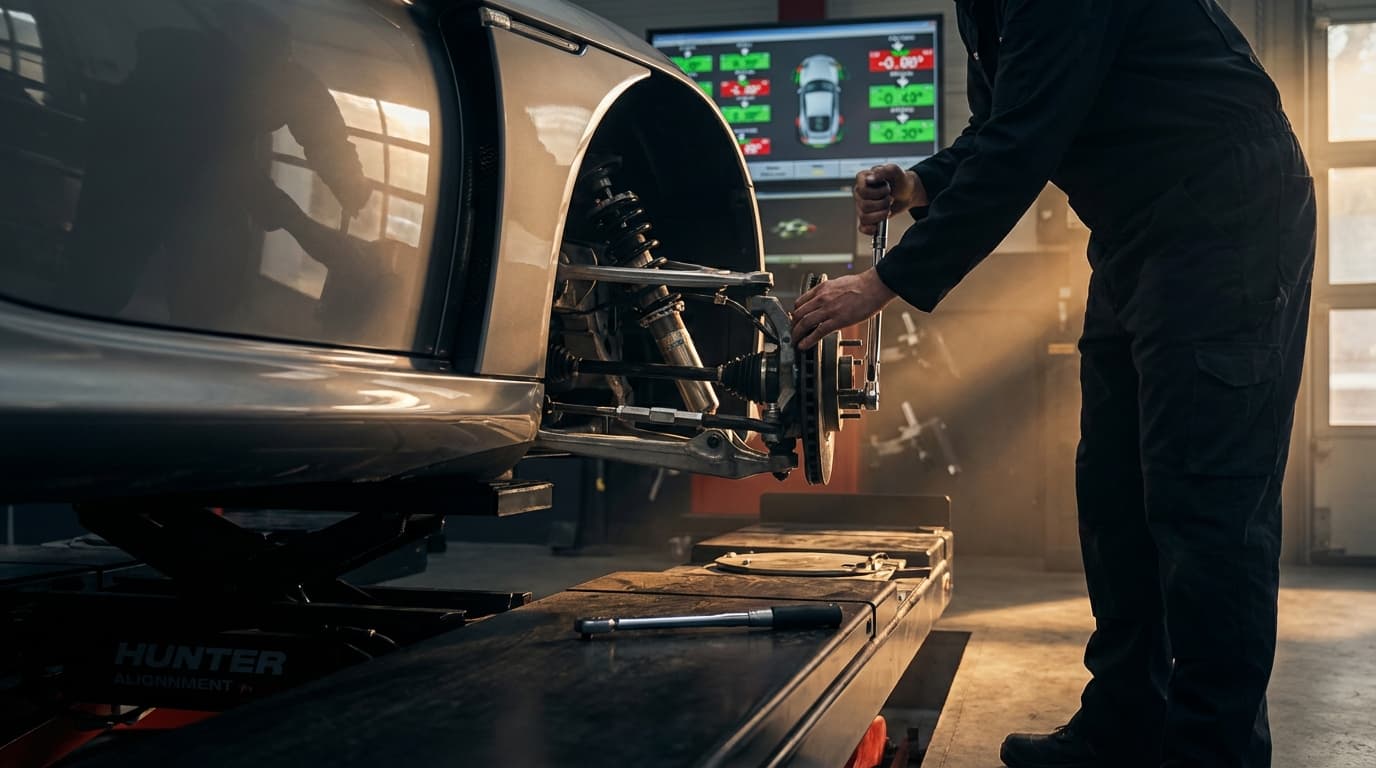
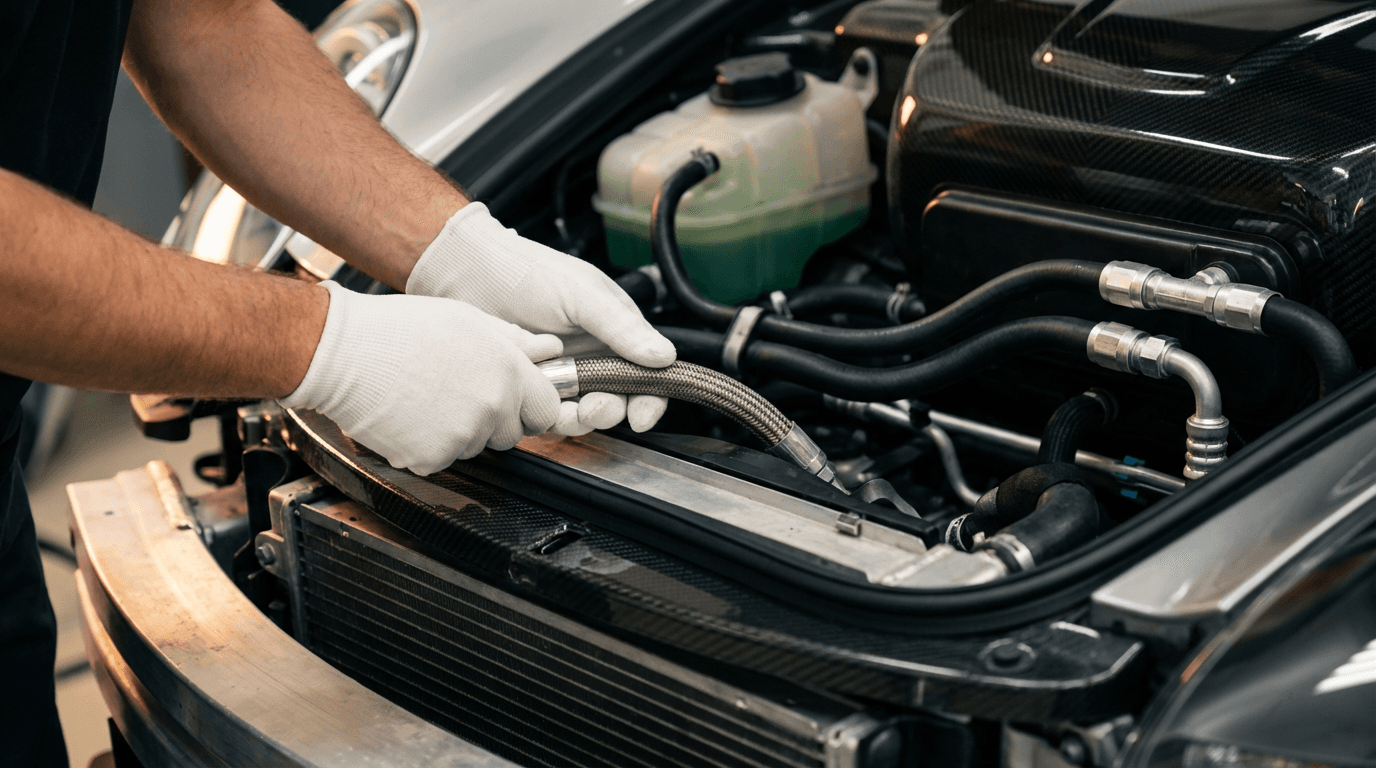
This is where our direct experience provides perspective that speculation cannot. We service both cars regularly and understand what each actually requires.
The Carrera GT is mechanically simpler but relies on components designed specifically for a 1,270-unit production run. Annual oil service runs fifteen hundred to twenty-five hundred dollars. Brake fluid service adds four to six hundred. A complete annual inspection, appropriate for a car of this significance, typically runs three to five thousand dollars. Major service every four years costs ten to eighteen thousand depending on what the car needs.
The clutch replacement deserves specific discussion because it defines Carrera GT ownership anxiety. When needed, expect sixteen to twenty-seven thousand dollars depending on whether the flywheel requires attention. The good news: with proper technique, clutches routinely last twenty thousand miles or more. The car teaches you to drive it correctly, and drivers who learn preserve their clutches. Drivers who don't learn face earlier replacement.
The 918 Spyder's hybrid complexity drives higher routine costs. Annual comprehensive service runs eight to fifteen thousand dollars—this is simply what these systems require. E-machine fluid service adds two to four thousand at appropriate intervals. Major service every four years reaches twenty to forty thousand depending on what's needed. Battery conditioning runs three to six thousand. Hybrid system diagnostics add fifteen hundred to three thousand for thorough evaluation.
The 918's PDK transmission requires periodic service as well. The carbon ceramic brakes, while durable, eventually need attention on cars that see track use. Nothing about this car is inexpensive to maintain, but nothing about it was inexpensive to engineer.
Living with Each Car
Daily experience matters at least as much as service costs for cars people actually drive.
The Carrera GT announces itself from ignition. The V10 produces one of the most glorious sounds in automotive history—a sound that digital successors cannot replicate. The manual transmission requires deliberate, precise inputs. The car communicates constantly through the steering, the seat, the pedals. Driving well demands attention. Driving poorly becomes immediately obvious.
We've worked with owners who find the Carrera GT challenging enough to be stressful, and others who wouldn't trade it for any car at any price. The key is understanding what you're buying: an uncompromising driver's machine that offers connection to the road no modern car can match.
The 918 Spyder proves that advanced technology can enhance rather than diminish driving engagement. Launch control delivers brutal acceleration without requiring perfect technique. The hybrid system provides instant torque from rest. Electric-only mode allows silent departures that won't wake neighbors. The PDK handles traffic without the attention that manual gearboxes demand.
Track days reveal the 918's true capabilities. It's genuinely faster than the Carrera GT around virtually any circuit—faster enough that the difference is obvious rather than marginal. The technology that makes it approachable on the street makes it devastatingly effective at speed.
The Choice
This decision ultimately comes down to what you want from hypercar ownership.
The Carrera GT offers an experience that cannot be replicated. The V10 sound, the manual transmission, the analog character—these define a moment in automotive history that will not return. The car demands your full attention and rewards driving skill with feedback no modern car provides. Collectibility potential remains exceptional because what the Carrera GT offers exists nowhere else.
The 918 Spyder offers more accessible performance, greater daily usability, and cutting-edge technology that represents its own moment in history. Track capability exceeds the Carrera GT despite the weight penalty. The hybrid hypercar experience it provides defined the segment that followed.
Neither choice is wrong. They're different answers to different questions about what matters most.
Considering either hypercar, or need service for one you own? Contact Repasi Motorwerks in Stratford, Connecticut. Our experience with both platforms allows us to provide the specialized expertise these cars deserve.