Every spring in Connecticut, thousands of Porsches emerge from winter storage. The excitement to get back on the road is understandable, but rushing the recommissioning process leads to avoidable problems. A car that has sat for 3-5 months needs specific attention before it is ready for spirited driving. Here is the complete recommissioning protocol we follow at our shop and recommend to every owner.
Before You Start the Engine
Resist the urge to simply turn the key and go. Several checks should happen before the engine fires for the first time.
Battery Assessment
If the car was on a quality battery tender (CTEK or similar), the battery should be at full charge. Disconnect the tender and measure resting voltage with a multimeter:
- 12.6V or higher: Battery is fully charged and healthy
- 12.4-12.6V: Acceptable but marginal; monitor closely
- Below 12.4V: Battery has likely sulfated from insufficient charging and may need replacement
If the car was stored without a tender, the battery is almost certainly dead or damaged. Modern Porsches have significant parasitic draw from alarm systems, keyless entry modules, and control module standby power. A 911 can drain a healthy battery in 4-6 weeks without a tender.
For battery replacement, remember that all modern Porsches require PIWIS registration of the new battery so the charging system calibrates correctly. This is not optional. An unregistered battery will be overcharged, shortening its life significantly. Our battery service includes full PIWIS coding.
Visual Inspection Under the Hood
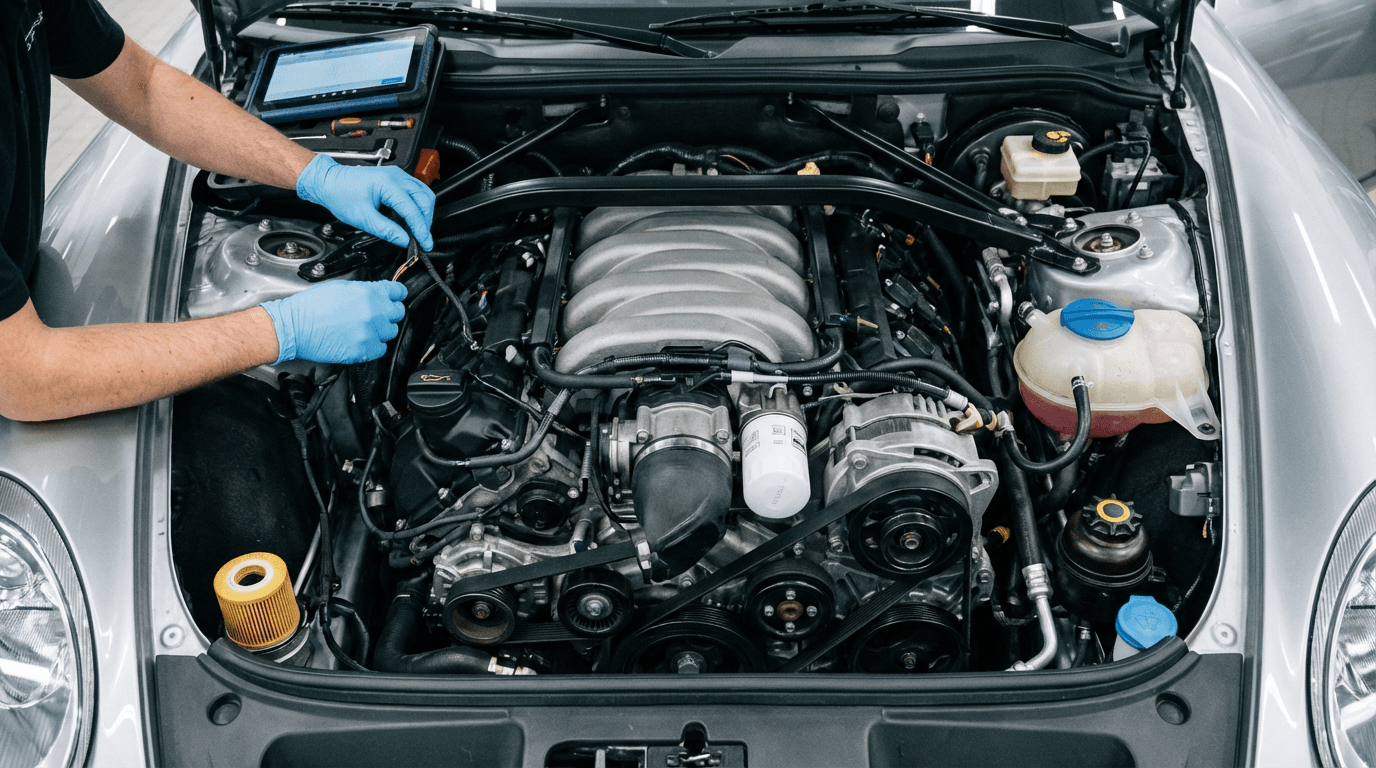
Before starting, open the engine cover and frunk and look for:
- Rodent activity (chewed wires, nesting material, droppings). Mice love the warm, sheltered engine bay of a stored Porsche. Wiring harness damage from rodents is one of the most expensive storage-related repairs.
- Fluid leaks that may have developed during storage. Seals that were marginally seeping before storage often leak more when they dry out over winter.
- Loose hoses or connections. Rubber hoses contract in cold temperatures and may have loosened from their fittings.
- Corrosion on battery terminals, ground straps, or exposed electrical connections.
Fluid Level Checks
With the car still off, check:
- Engine oil level (dipstick or electronic)
- Coolant level (expansion tank)
- Brake fluid level and color (reservoir cap)
- Power steering fluid (if hydraulic system)
- Windshield washer fluid
First Start Procedure
With the pre-start checks complete, start the engine. Do not rev it or drive immediately. Let it idle for 5-10 minutes while you observe:
- Oil pressure: The oil pressure gauge should climb to normal operating range within a few seconds. If pressure is slow to build, shut off immediately and investigate.
- Warning lights: All warning lights should illuminate during the self-test and then extinguish. Note any that remain on.
- Unusual sounds: Listen for abnormal noises. A brief dry rattle on startup is common (oil draining from the hydraulic chain tensioner during storage) and should quiet within a few seconds. Persistent noises need investigation.
- Exhaust: A puff of white smoke on first start is normal (condensation in the exhaust). Blue smoke indicates oil passing piston rings. Black smoke suggests an overly rich condition that should clear quickly.
- Idle quality: After reaching operating temperature, the idle should be smooth and steady. Rough idle or hunting (fluctuating RPM) may indicate stale fuel or a failing sensor.
Brake Inspection
Brakes are the highest-priority safety item after winter storage. Moisture, temperature cycling, and inactivity combine to create several issues:
Surface Rust on Rotors
All iron brake rotors develop surface rust during storage. On a properly stored car, this is a thin orange film that wears off within a few gentle stops. However, if the storage environment was damp, the rust can be heavier and may have pitted the rotor surface.
After the first drive, inspect the rotors through the wheel spokes. If the rust has cleared to a smooth, uniform surface, the rotors are fine. If you see pitting, uneven rust patterns, or feel pulsation during braking, the rotors may need resurfacing or replacement.
Brake Pad Condition
Brake pads can bond lightly to rusted rotors during long storage. The first few stops may produce a grabbing sensation or scraping noise. This usually clears within the first mile of driving. If it persists, the pads should be removed and inspected.
More importantly, brake fluid that sat for months has continued absorbing moisture. If the fluid was not fresh before storage, it is likely overdue for a flush now. We recommend including a brake fluid flush in every spring recommissioning.
Parking Brake Inspection
If the parking brake was engaged during storage (which we recommend against for this reason), the pads or shoes may have bonded to the drum or rotor. Release the parking brake and test that the car rolls freely. Any dragging sensation warrants immediate inspection.
Tire Assessment
Tires are the second critical safety area after a storage period.
Flat Spots
Tires develop flat spots when they sit in one position for months under the weight of the vehicle. Modern tires are more resistant to permanent flat-spotting than older designs, but you will likely feel a mild vibration for the first few miles of driving.
If the vibration persists after 10-15 miles of driving, the flat spots may be semi-permanent. This is more likely if:
- The tires were underinflated during storage
- Storage temperatures were very cold
- The tires are older (5+ years from manufacture date)
Persistent flat-spotting usually requires tire replacement. Check our N-rated tire guide for Porsche-specific recommendations.
Tire Pressure
Tires lose approximately 1-2 PSI per month in storage. After 4-5 months, your tires may be 5-10 PSI low. Inflate to the door placard specification before driving. Low tire pressure on the first drive causes excessive sidewall flex, heat buildup, and accelerated wear.
Tire Age and Condition
Check the DOT date code on each tire. If your tires are approaching or exceeding 6 years from manufacture, spring recommissioning is the ideal time to replace them. Also inspect sidewalls for cracking (dry rot) that may have developed during the dry winter storage period.
The Recommissioning Test Drive
With all checks complete, take a methodical first drive:
Phase 1: Parking Lot / Low Speed (0-15 mph)
- Test brakes gently at very low speed
- Listen for unusual noises from suspension, drivetrain, and brakes
- Verify steering feel (should be direct with no looseness or vibration)
- Check all gauges and instrument readings
Phase 2: Residential Streets (15-35 mph)
- Gradually increase braking effort to confirm full braking function
- Test turn signals, headlights, and wipers
- Verify the transmission shifts smoothly through all gears
- Listen for any wind noise that could indicate a loose seal or trim piece
Phase 3: Highway Speed (50-70 mph)
- Assess ride quality for any new vibrations
- Verify cruise control operation
- Check for tracking (car should drive straight without pulling)
- Monitor all temperatures and gauges at sustained speed
Phase 4: Return and Re-inspect
- After 15-20 miles, return and let the car cool
- Re-check fluid levels (especially engine oil)
- Look under the car for any new drips or leaks
- Verify tire pressures after they have warmed up (adjust as needed)
Common Post-Storage Issues
Here are the most frequent problems we see during spring recommissioning:
- Dead or weak battery: By far the most common. Solution: charge, test, replace if necessary with PIWIS-registered battery.
- Stale fuel causing rough running: Fuel degrades over time, especially ethanol-blended fuel. If fuel stabilizer was not added before storage, a tank of fresh premium fuel usually resolves mild symptoms. Severely degraded fuel may require draining.
- Sticky brake calipers: Caliper pistons that sat in one position all winter may not retract fully, causing dragging. Usually resolves with a few moderate-to-firm stops. Persistent dragging requires caliper service.
- TPMS warnings: Sensors may report low pressure or may need to be re-learned after a battery disconnect. PIWIS handles sensor re-learning efficiently.
- Rodent damage: Wiring chew damage can cause a cascade of warning lights. A thorough under-hood inspection before first start is the best defense.
Professional vs. DIY Recommissioning
Many of the checks above are within reach of a mechanically inclined owner. However, we recommend a professional recommissioning at least every other year, or annually if the car is older or higher-mileage. A professional service adds:
- Lift inspection of the entire undercarriage
- PIWIS system scan to identify any stored fault codes
- Brake fluid moisture testing with a refractometer
- Battery load testing (not just voltage measurement)
- Comprehensive annual checklist items
Combining your spring recommissioning with your annual scheduled maintenance is efficient and cost-effective. The car is already on the lift, and many items overlap.
Your Porsche spent the winter waiting patiently. A proper recommissioning ensures your first spring drive is safe, enjoyable, and sets the car up for the rest of the driving season.
Ready to schedule your Porsche service? Contact Repasi Motorwerks or call (203) 257-0987.