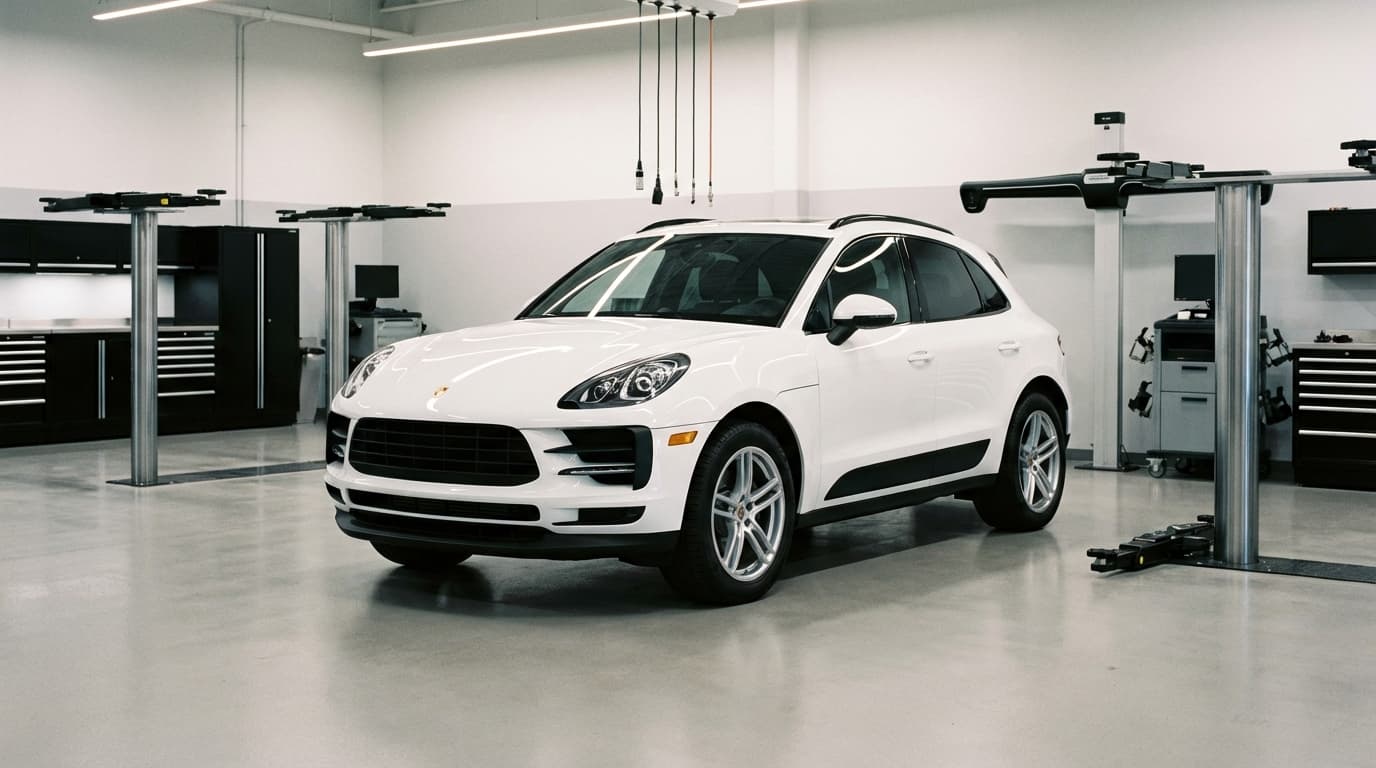
The Porsche Macan has become one of the best-selling Porsches ever, and for good reason. It combines genuine sports car dynamics with everyday practicality. Keeping it running at its best requires understanding its specific maintenance needs, which differ meaningfully between the four-cylinder and V6 models, and between the PDK and ZF transmissions.
Macan Service Schedule Overview
Porsche uses a flexible service interval system on the Macan, with the dashboard calculating service needs based on driving conditions. However, the baseline intervals are straightforward:
- Minor Service: Every 10,000 miles or 12 months
- Major Service: Every 40,000 miles or 4 years
- Brake Fluid: Every 2 years regardless of mileage
- Transmission Fluid: Every 60,000 miles (despite "lifetime" designation)
- Coolant: Every 4 years or 40,000 miles
These intervals apply across all Macan variants, though the specific procedures and costs vary by engine and transmission.
Minor Service Details (Every 10,000 Miles)
Every Macan minor service includes:
- Engine oil and filter change: The 2.0T four-cylinder takes approximately 5.7 quarts, while the V6 models (Macan S, GTS, Turbo) take 8.5-9 quarts. All use Porsche-approved oil meeting the C30 specification on newer models. Understanding oil specifications matters because using the wrong oil can damage the particulate filter on post-2019 models.
- Cabin air filter inspection: Replace annually in Connecticut due to pollen and leaf debris.
- Brake pad and rotor inspection: Measure pad thickness and check rotors for scoring or uneven wear.
- Tire inspection: Check tread depth, wear pattern, and tire age. N-rated tires are recommended but not strictly required on the Macan.
- Multi-point visual inspection: Belts, hoses, underbody, suspension components, and all fluid levels.
Cost: $350-$550 at an independent specialist, $600-$900 at a Porsche dealer.
Major Service Details (Every 40,000 Miles)
The major service adds these items to the minor service:
- Spark plug replacement: Four on the 2.0T, six on V6 models. Iridium plugs last well to 40,000 miles but should not be stretched further.
- Engine air filter replacement
- Brake fluid flush: Uses DOT 4 specification fluid.
- Drive belt inspection and replacement: The serpentine belt should be replaced at 40,000-60,000 miles depending on condition.
- Coolant service: Complete flush and refill with Porsche-specification coolant.
Cost: $1,200-$2,000 at an independent, $2,200-$3,500 at a dealer.
PDK vs. ZF 8-Speed: Transmission Differences
This is one of the most important distinctions in Macan maintenance. The Macan uses two entirely different transmissions depending on the model:
PDK (7-Speed Dual-Clutch) - Base Macan and Macan S (certain years)
The PDK transmission is Porsche's dual-clutch system, shared with the 911 and other sports models. It requires:
- Fluid change every 60,000 miles (Porsche says "lifetime" but this is wrong for long-term health)
- PIWIS-guided fill procedure for correct fluid level
- Dual-mass flywheel inspection at high mileage
- Cost for service: $500-$800 at an independent
ZF 8HP (8-Speed Torque Converter) - Macan Turbo and some Macan S models
The ZF 8-speed is a conventional torque converter automatic. It requires:
- Fluid and filter change every 60,000 miles
- Pan gasket replacement during service
- Torque converter flush for complete fluid exchange
- Cost for service: $600-$900 at an independent
Both transmissions respond dramatically to regular fluid service. We see clear differences in shift quality and longevity between cars that receive regular transmission service and those running original fluid at 80,000+ miles.
Four-Cylinder Macan: Carbon Buildup
The 2.0-liter turbocharged four-cylinder in the base Macan is a direct-injection engine derived from the Audi/VW EA888 family. Like all port-injectionless turbocharged engines, it is prone to carbon buildup on the intake valves.
What happens: Without fuel washing over the intake valves (as in port injection), carbon deposits accumulate over time. By 50,000-70,000 miles, buildup can cause rough idle, misfires, reduced power, and poor fuel economy.
The fix: Walnut shell blasting of the intake valves. This involves removing the intake manifold, sealing off each cylinder, and using compressed air to blast crushed walnut shells against the carbon deposits. It is non-invasive and highly effective.
Cost: $800-$1,200 at an independent specialist.
Prevention: There is no guaranteed prevention, but using quality fuel (Top Tier gasoline), avoiding excessive short trips, and allowing the engine to reach full operating temperature on every drive all help slow the process. Some owners add a catch can to reduce oil vapor recirculation into the intake.
V6 Macan Models: S, GTS, and Turbo
The V6 Macan models use versions of the 3.0-liter and 3.6-liter twin-turbo V6 engines. These are robust powerplants with their own specific maintenance considerations:
- Turbo coolant lines: The turbocharger coolant and oil feed lines should be inspected at every major service. Leaks from these lines can damage turbochargers quickly.
- Turbo wastegate actuators: On higher-mileage Turbo models, wastegate actuator bushings can wear, causing a rattle under light load. Not catastrophic but annoying and worth addressing. Cost: $1,000-$2,000.
- Oil consumption: Some V6 Macan engines exhibit oil consumption of up to 1 quart per 5,000 miles. This is considered within Porsche's acceptable range, though it is worth monitoring. Excessive consumption beyond this warrants investigation.
Transfer Case and Differential Service
Like the Cayenne, the Macan's all-wheel-drive system requires periodic attention:
- Transfer case fluid: Change every 40,000-60,000 miles. Cost: $200-$350.
- Front differential fluid: Same interval as transfer case. Cost: $150-$250.
- Rear differential fluid (with PTV Plus): The optional Porsche Torque Vectoring Plus system uses an electronically controlled rear differential that requires specific fluid. Cost: $250-$400.
Skipping these services leads to premature gear wear and eventual whining or clunking from the drivetrain. The fluid is cheap; the repairs are not.
Macan Maintenance Cost Summary
| Service | Base Macan | Macan S/GTS | Macan Turbo |
|---|---|---|---|
| Annual oil service | $300-$450 | $400-$550 | $450-$600 |
| Major service (40K) | $1,200-$1,800 | $1,500-$2,200 | $1,800-$2,500 |
| Brake fluid flush | $150-$250 | $150-$250 | $150-$250 |
| Transmission service | $500-$800 | $600-$900 | $600-$900 |
| Annual budget | $1,500-$2,500 | $2,000-$3,500 | $2,500-$4,000 |
These figures assume an independent specialist. Dealer costs run 40-60% higher. The dealer vs. independent comparison is especially relevant for Macan owners, where the savings over a typical ownership period can amount to several thousand dollars.
When Professional Service Is Essential
Some Macan services are genuinely DIY-friendly: oil changes, cabin filters, and brake pad replacements are straightforward for mechanically inclined owners. However, several procedures require PIWIS diagnostics and specialist knowledge:
- Transmission fluid fill (requires PIWIS to monitor temperature and set correct level)
- Battery replacement (requires PIWIS registration)
- Brake pad replacement on cars with electric parking brake (requires PIWIS to retract calipers)
- Any suspension work on PASM-equipped cars (requires recalibration)
The Macan is an excellent vehicle that rewards consistent maintenance. Follow the schedule outlined in the 911 maintenance guide philosophy: stick to intervals, use the right fluids, and address small issues before they become large ones.
Ready to schedule your Porsche service? Contact Repasi Motorwerks or call (203) 257-0987.