Every modern Porsche contains 30 or more electronic control modules that manage everything from engine timing to seat memory positions. When something goes wrong, or when routine service requires electronic procedures, the diagnostic tool used determines whether the problem gets solved or merely masked. Porsche's factory diagnostic system, PIWIS III (Porsche Integrated Workshop Information System), is not just a code reader. It is the only tool that provides complete access to every system in your Porsche.
What PIWIS III Actually Does
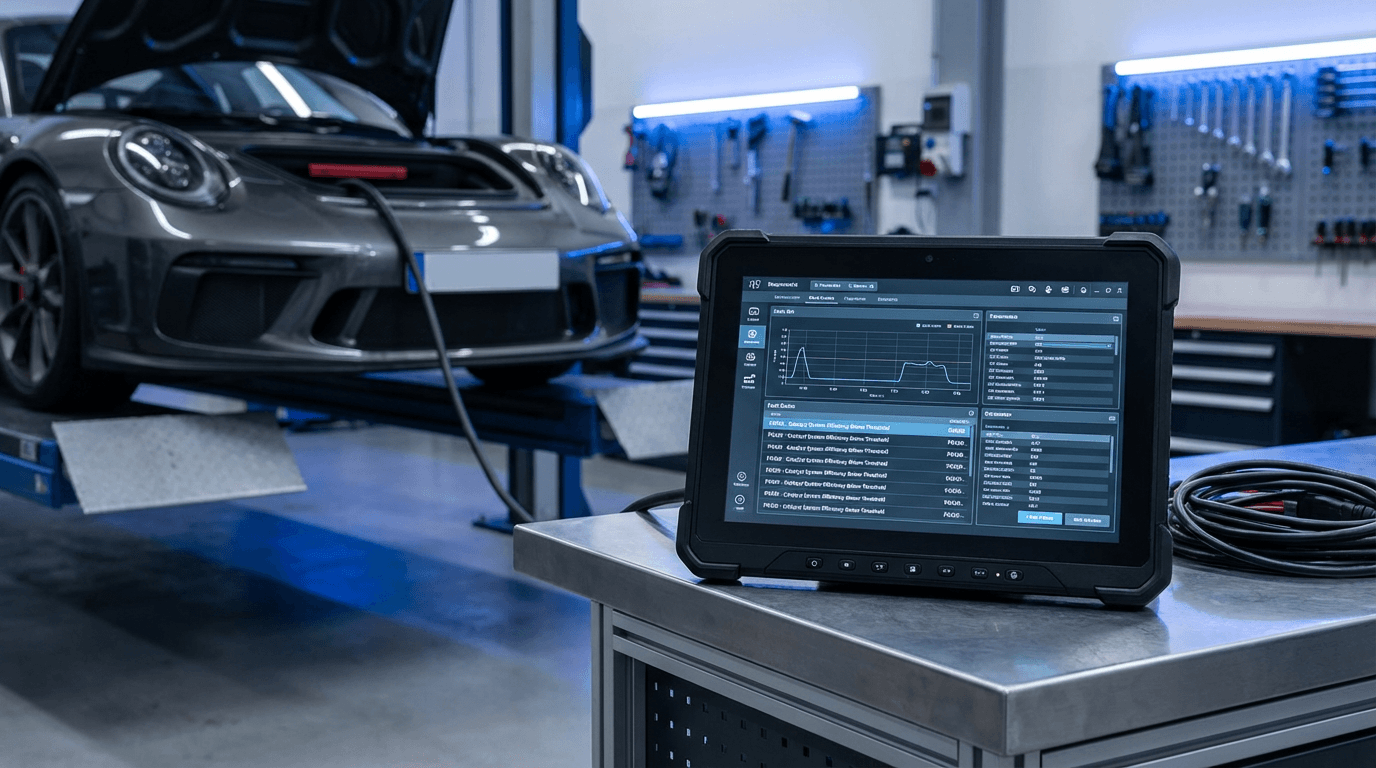
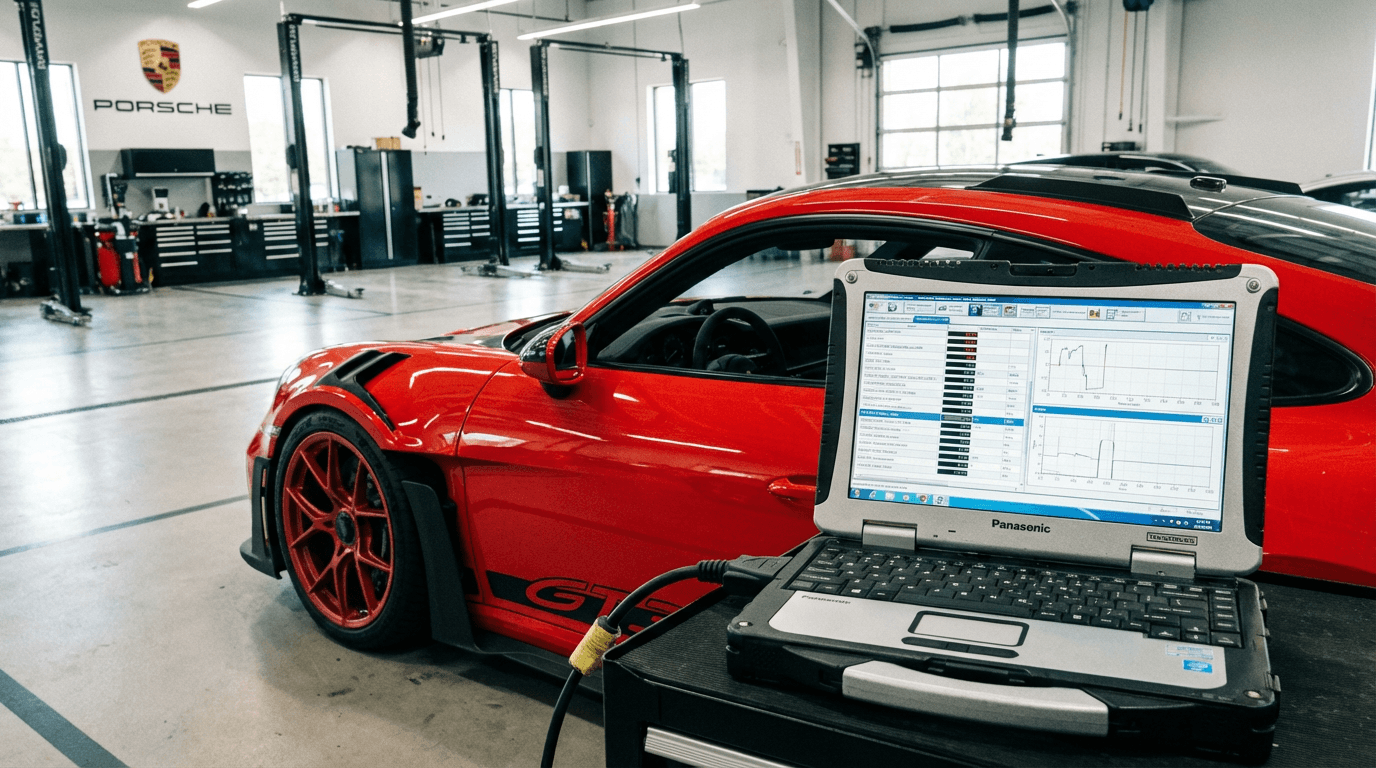
PIWIS III is Porsche's dealer-level diagnostic platform, running on dedicated Panasonic Toughbook hardware with a direct ethernet connection to the vehicle's diagnostic port. It provides:
Complete Module Access A generic OBD-II scanner accesses the engine control module and possibly the transmission module. PIWIS III accesses every module in the vehicle:
- Engine management (DME/EME)
- Transmission control (PDK, Tiptronic, manual clutch management)
- ABS/PSM stability management
- PASM adaptive suspension
- PDCC dynamic chassis control
- Rear-axle steering
- TPMS tire pressure monitoring
- Air conditioning and climate control
- Instrument cluster
- Central gateway module
- Keyless entry and immobilizer
- Seat memory modules (driver and passenger)
- Park assist and camera systems
- Adaptive cruise control and radar
- Battery management system
- Hybrid system management (E-Hybrid models)
- And 15+ additional modules depending on equipment level
Guided Fault Finding Beyond simply reading fault codes, PIWIS III provides guided diagnostic procedures that walk the technician through a logical fault-finding process. When a code is present, PIWIS provides the likely causes in order of probability, the specific tests to perform, and the expected results at each step. This prevents the "parts cannon" approach where components are replaced based on guesswork.
Coding and Configuration Many Porsche functions require electronic coding. PIWIS handles:
- Battery registration (required after every battery replacement so the charging system adjusts to the new battery's characteristics)
- Key programming (adding or replacing key fobs)
- Module replacement coding (when a control module is replaced, it must be coded to the specific vehicle)
- Feature activation and deactivation
- Regional configuration changes
Software Updates Porsche regularly releases software updates for control modules that fix bugs, improve performance, or address recalls. PIWIS III connects to Porsche's central server to download and install these updates. Many driveability issues are resolved with a software update that only PIWIS can perform.
What Generic OBD-II Scanners Miss
A generic OBD-II scanner, even an expensive professional unit, has fundamental limitations when used on a Porsche:
Limited Module Access: OBD-II scanners typically access only engine, transmission, and ABS modules. The other 25+ modules in a modern Porsche are invisible to them.
Generic Code Definitions: When a generic scanner reads a Porsche-specific fault code, it provides a generic description that may be misleading. Porsche-specific codes have detailed descriptions and diagnostic paths in PIWIS that do not exist in generic databases.
No Bidirectional Control: PIWIS can command individual components to activate for testing purposes. For example, it can command each fuel injector to fire individually, each ABS valve to cycle, or each damper to adjust. Generic scanners cannot do this.
No Adaptation Values: PIWIS reads and resets adaptation values that tell you how the engine has compensated over time. These values reveal developing problems before they trigger a fault code. A generic scanner cannot access this data.
No Service Procedures: Many routine service tasks require PIWIS, including PDK fluid level setting, brake fluid bleed procedures with ABS module cycling, and electronic parking brake retraction for brake pad replacement.
Real-World Example: The Misdiagnosed Check Engine Light
We frequently see cars that have been to general repair shops for check engine light diagnosis without resolution. A common scenario:
A 991 Carrera comes in with a persistent check engine light. The previous shop read a code for "catalytic converter efficiency below threshold" and quoted $4,000 for catalytic converter replacement. With PIWIS III, we access the full fault memory, including freeze frame data showing the exact conditions when the fault occurred. We read the oxygen sensor adaptation values, which show the rear sensors are reading within specification but the front sensor's response time has degraded. The actual issue is a $300 oxygen sensor, not a $4,000 catalytic converter.
This type of misdiagnosis is common without PIWIS because generic scanners see the symptom code but cannot access the detailed data that identifies the root cause.
When Your Porsche Needs PIWIS
Some situations where PIWIS is required, not optional:
- Battery replacement: The new battery must be registered so the charging system adjusts its voltage and current targets. Without registration, the new battery can be overcharged, shortening its life dramatically.
- PDK transmission service: Correct fluid level requires real-time temperature monitoring through PIWIS.
- Brake pad replacement (electronic parking brake): The calipers must be retracted via PIWIS on cars with electronic parking brakes.
- Any module replacement: New modules need to be coded to the vehicle.
- Suspension calibration: After any alignment work on PASM-equipped cars, the system benefits from recalibration.
- Air conditioning service: The climate control module manages compressor clutch cycling, and some diagnostic procedures require PIWIS to command the compressor.
- Post-repair verification: After any significant repair, PIWIS is used to clear all fault codes, perform a complete system scan, and verify the repair resolved all related issues.
PIWIS and Pre-Purchase Inspections
During a pre-purchase inspection, PIWIS is indispensable. A complete module scan reveals:
- Hidden fault codes: Previous owners or dealers may clear engine codes, but PIWIS shows the complete fault history across all modules.
- Mileage verification: PIWIS reads stored mileage values across multiple modules, making odometer fraud detectable.
- Repair history clues: Module replacement dates and coding changes provide a technical history that supplements the paper service records.
- Pending issues: Adaptation values that are near their limits indicate developing problems that have not yet triggered a fault code.
Any PPI on a modern Porsche that does not include a full PIWIS scan is incomplete. It is one of the primary tools we use during every inspection.
The Cost Question
PIWIS III is expensive. The hardware, licensing, and ongoing subscription fees cost $10,000-$15,000 annually. This is one reason not every independent shop invests in it, and it is a key factor in choosing a qualified Porsche specialist.
When evaluating shops for your Porsche, asking whether they have current PIWIS III capability (not just a previous-generation PIWIS II or aftermarket clone) is one of the most important questions. The answer tells you whether they can properly diagnose, service, and maintain your vehicle or whether they are working with limited visibility into your car's systems.
A shop with PIWIS III sees everything. A shop without it is guessing at what it cannot see. For a car as sophisticated as a modern Porsche, the difference matters.
Ready to schedule your Porsche service? Contact Repasi Motorwerks or call (203) 257-0987.