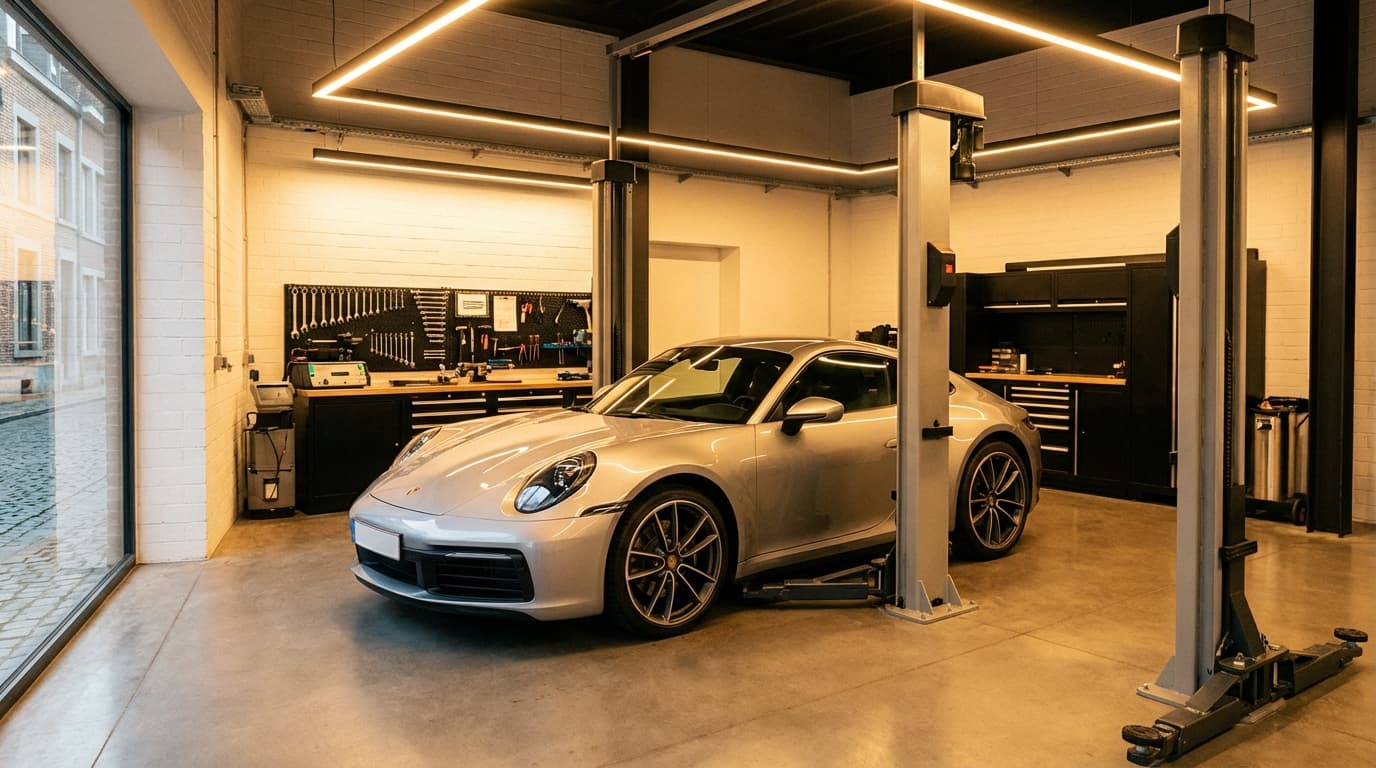
Every Porsche 911 deserves proper maintenance, but the schedule varies more than most owners realize. After 15 years of working exclusively on Porsches, I have seen what happens when maintenance is deferred and what a well-maintained 911 looks like at 100,000 miles and beyond. This guide covers every generation from the 996 through the current 992, with the real-world intervals, costs, and generation-specific items you need to know.
Understanding Porsche Service Intervals
Porsche divides maintenance into minor and major services. Minor services occur every 10,000 miles or 12 months, whichever comes first. Major services fall at 40,000-mile intervals (some generations at 30,000 or 60,000 miles depending on the item). There are also time-based items like brake fluid that need attention regardless of mileage.
The factory schedule is a starting point. If you track your car, live in a harsh climate, or do primarily short trips, you should shorten these intervals. Connecticut winters are especially hard on Porsches that sit for months at a time, which is why we recommend a thorough annual service checklist even if the car has barely moved.
996 Generation (1999-2004)
The 996 is the most maintenance-sensitive modern 911, primarily because of the IMS bearing issue on early cars. Here is what the schedule looks like:
Minor Service (Every 10,000 Miles / 12 Months)
- Engine oil and filter change (8-9 quarts of Mobil 1 0W-40 or equivalent meeting A40 spec)
- Cabin air filter inspection/replacement
- Brake inspection (pad thickness, rotor condition, caliper function)
- Tire inspection and pressure adjustment
- Visual inspection of belts, hoses, and fluid levels
- Reset service indicator
Major Service (Every 40,000 Miles)
- Everything in the minor service
- Spark plug replacement (six plugs, platinum or iridium)
- Air filter element replacement
- Brake fluid flush (also recommended every 2 years)
- Coolant flush and refill with Porsche-spec coolant
- Drive belt replacement (serpentine belt)
- Transmission fluid change (manual gearbox)
996-Specific Items
- IMS Bearing: The single most critical item on any 996 or early 997. The intermediate shaft bearing can fail catastrophically, destroying the engine. We recommend replacing it with a ceramic hybrid bearing at any major service opportunity if it has not been done. Cost: $2,500-$4,000 depending on whether it is done standalone or during clutch service.
- Rear Main Seal (RMS): These frequently leak on the 996. Best addressed during clutch replacement. Cost: $300-$500 for the seal, labor is shared with clutch work.
- Coolant Pipes: The plastic coolant distribution pipes become brittle and crack. Replace with aluminum aftermarket versions at the 60,000-80,000 mile mark. Cost: $1,200-$2,000.
Annual maintenance costs for a 996 typically run $2,000-$4,000 at an independent specialist, or $3,500-$6,000 at a Porsche dealer.
997 Generation (2005-2012)
The 997 refined the 996 platform significantly. Early 997.1 cars still carry the IMS risk (though reduced with improved bearing designs after 2006). The 997.2 (2009+) introduced the DFI engine and eliminated the IMS bearing entirely.
Minor Service (Every 10,000 Miles / 12 Months)
- Engine oil and filter change (8.5-9 quarts, A40 spec oil)
- Cabin and engine air filter inspection
- Brake system inspection
- Tire condition and pressure check
- All fluid level checks
- Service indicator reset
Major Service (Every 40,000 Miles)
- Complete minor service items
- Spark plug replacement
- Drive belt replacement
- Brake fluid flush
- Coolant system service
- Manual transmission fluid (if equipped)
997-Specific Items
- IMS Bearing (997.1 only): Same concern as the 996. The 997.1 used a smaller single-row bearing that is actually more failure-prone than the 996 dual-row unit. Replacement is strongly recommended.
- Bore Scoring (997.1): The Lokasil cylinder linings on 997.1 engines can develop scoring, especially on cars that are cold-started and driven hard before reaching operating temperature. Listen for a ticking or light knocking sound on cold start.
- Water Pump (997.2): The DFI engines use an electric water pump that has a finite lifespan. Budget for replacement around 60,000-80,000 miles. Cost: $1,500-$2,200.
Annual costs at an independent: $1,800-$3,500. Dealer pricing runs $3,000-$5,500.
991 Generation (2012-2019)
The 991 brought the 911 into the modern era with electric power steering, a seven-speed manual option, and eventually the turbocharged 991.2 engines across the entire lineup.
Minor Service (Every 10,000 Miles / 12 Months)
- Engine oil and filter change (approximately 10 quarts on turbo models, A40 spec)
- Cabin air filter replacement
- Brake inspection
- Tire inspection and rotation (if applicable to your stagger setup)
- Multi-point inspection of underbody, suspension, and drivetrain
- Service indicator reset via PIWIS diagnostic system
Major Service (Every 40,000 Miles)
- Full minor service
- Spark plug replacement (now iridium, longer life)
- Engine air filter replacement
- Brake fluid flush
- Coolant service
- PDK transmission service (if equipped, recommended at 60,000 miles despite Porsche's "lifetime fill" claim)
991-Specific Items
- Coolant Transfer Pipe (991.2 Turbo): The plastic coolant transfer pipe running beneath the intake manifold is a known failure point. Replacement before failure prevents catastrophic overheating. Cost: $2,000-$3,500.
- Water Pump (991.2): Like the 997.2, electric water pumps have a finite lifespan. Plan for replacement in the 60,000-80,000 mile range.
- PDK Mechatronic Unit: While generally reliable, the mechatronic unit can develop issues on high-mileage cars. Regular PDK fluid changes help extend its life dramatically.
Annual costs at an independent: $1,500-$3,000. Dealer pricing: $2,800-$5,000.
992 Generation (2020-Present)
The current 992 generation benefits from the most refined version of the twin-turbo flat-six, improved PDK calibration, and advanced driver assistance systems that require specialized diagnostic equipment for service.
Minor Service (Every 10,000 Miles / 12 Months)
- Engine oil and filter change (10 quarts, C30 spec oil on base models, A40 on GT cars)
- Cabin air filter
- Brake inspection including electronic parking brake function check
- Tire inspection and TPMS verification
- Complete multi-point inspection
- Service indicator reset (requires PIWIS III)
Major Service (Every 40,000 Miles)
- Complete minor service
- Spark plug replacement
- Engine air filter
- Brake fluid flush
- Coolant service
- PDK service at 60,000 miles
- Gasoline particulate filter inspection (where equipped)
992-Specific Items
- Battery Management: The 992 relies heavily on its battery management system. A failing battery causes a cascade of warning lights and system faults. Battery replacement requires PIWIS registration.
- PPF and Gasoline Particulate Filter: Cars driven primarily in city traffic may need particulate filter attention sooner than highway-driven examples.
- Active Suspension: Cars with PASM Sport, rear-axle steering, or PDCC require specialized alignment and calibration equipment. Our Hunter alignment rack handles all 992 configurations.
Annual costs at an independent: $1,500-$2,800. Dealer pricing: $2,500-$4,500.
Dealer vs. Independent Specialist: Cost Comparison
One of the most common questions we hear is whether it is worth servicing a 911 at a Porsche dealership versus an independent specialist. Here is a realistic cost comparison:
| Service Item | Dealer Cost | Independent Cost |
|---|---|---|
| Minor Service (oil, filter, inspection) | $600-$900 | $350-$550 |
| Major Service (40K) | $2,000-$3,500 | $1,200-$2,200 |
| Brake Fluid Flush | $250-$400 | $150-$250 |
| Spark Plugs | $500-$800 | $300-$500 |
| PDK Service | $800-$1,200 | $500-$800 |
The Magnuson-Moss Warranty Act protects your right to service your Porsche at an independent shop without voiding your factory warranty, provided OEM-equivalent parts and procedures are used. We use genuine Porsche parts and follow factory service procedures on every car that comes through our shop.
When to Choose a Specialist
Not all independent shops are equal. For a Porsche 911, you want a shop that meets certain criteria: Gold Meister certification, factory diagnostic equipment like PIWIS III, experience with your specific generation, and transparent pricing.
The 911 is a precision machine, and it rewards owners who maintain it properly. A well-maintained 911 at 150,000 miles will drive better than a neglected example at 50,000 miles. Follow the schedule, address generation-specific items proactively, and find a specialist you trust.
Seasonal Considerations for Connecticut Owners
If you store your 911 for the winter, do not skip the spring recommissioning process. Sitting for months creates its own maintenance needs: flat-spotted tires, degraded brake rotors, stale fuel, and battery drain. A proper recommissioning inspection catches these issues before they become problems on the road.
For year-round drivers, Connecticut's road salt and freeze-thaw cycles accelerate underbody corrosion. We recommend an annual underbody inspection and washing the undercarriage regularly during winter months. N-rated tires designed for your specific 911 variant make a significant difference in wet and cold weather traction.
Cost of Ownership: What to Budget
Here is what to expect annually for each generation, assuming average driving of 8,000-12,000 miles per year:
| Generation | Annual Budget (Independent) | Annual Budget (Dealer) |
|---|---|---|
| 996 | $2,000-$4,000 | $3,500-$6,000 |
| 997 | $1,800-$3,500 | $3,000-$5,500 |
| 991 | $1,500-$3,000 | $2,800-$5,000 |
| 992 | $1,500-$2,800 | $2,500-$4,500 |
These figures cover routine maintenance. Budget an additional reserve for unexpected items, especially on older generations. A 996 or 997 with deferred maintenance can easily require $10,000-$15,000 to bring current.
The bottom line: a Porsche 911 is not cheap to maintain, but it is predictable when you follow the schedule. Understanding why Porsche oil changes cost more and what goes into each service helps you budget accurately and avoid surprises.
Ready to schedule your Porsche service? Contact Repasi Motorwerks or call (203) 257-0987.