Brake fluid is the single most neglected maintenance item on Porsche vehicles. It is also one of the most safety-critical. Porsche specifies a 2-year replacement interval for good reason, and in Connecticut's humid climate, this interval is generous rather than conservative. Here is everything you need to know about brake fluid service on your Porsche.
Why Brake Fluid Degrades
Brake fluid is hygroscopic, meaning it absorbs moisture from the atmosphere through microscopic pores in brake hoses, reservoir seals, and caliper seals. This is not a defect; it is a physical property of all glycol-based brake fluids (DOT 3, DOT 4, and DOT 5.1).
Fresh DOT 4 brake fluid has a dry boiling point of approximately 446 degrees Fahrenheit (230 degrees Celsius). As the fluid absorbs moisture, that boiling point drops:
- 1% moisture content: Boiling point drops to approximately 369 degrees F
- 2% moisture content: Approximately 329 degrees F
- 3% moisture content: Approximately 293 degrees F
At 3% moisture, your brake fluid can boil under aggressive braking on a warm day, let alone on a track. When brake fluid boils, vapor bubbles form in the lines, creating a compressible gas pocket. The result is a brake pedal that goes to the floor with drastically reduced stopping power. This is brake fade in its most dangerous form.
Connecticut's Humidity Factor
Brake fluid moisture absorption is directly related to ambient humidity. Connecticut averages 70-80% relative humidity during the summer months, with periods exceeding 90%. This accelerates fluid degradation compared to drier climates.
A Porsche driven year-round in Connecticut will reach 2% moisture content in approximately 18-20 months. A car stored for Connecticut winters without a proper storage protocol may actually absorb moisture faster because the brake system is static and temperature cycling causes condensation within the lines.
This is why we recommend flushing brake fluid as part of every spring recommissioning if the car has been sitting through winter, regardless of when the last flush was performed.
DOT 4 vs. DOT 5.1: Which Specification?
Porsche specifies DOT 4 brake fluid for all production vehicles. However, there are important distinctions within DOT 4:
Standard DOT 4
- Dry boiling point: 446 degrees F (230 degrees C)
- Wet boiling point: 311 degrees F (155 degrees C)
- Suitable for street-driven Porsches on the standard maintenance schedule
DOT 4 Racing / High-Performance
- Dry boiling point: 572+ degrees F (300+ degrees C)
- Wet boiling point: 392+ degrees F (200+ degrees C)
- Recommended for track-driven Porsches and any car with PCCB brakes
DOT 5.1
- Dry boiling point: 500+ degrees F (260+ degrees C)
- Wet boiling point: 356 degrees F (180 degrees C)
- Glycol-based (compatible with DOT 4 systems, unlike silicone-based DOT 5)
- Good all-around upgrade for spirited street driving
Important: DOT 5 (silicone-based) is NOT compatible with any Porsche ABS/PSM system. Never use DOT 5 in any Porsche.
We use Porsche-approved DOT 4 for routine service and ATE Type 200 or Motul RBF 660 for track-driven cars. The specific fluid matters less than the freshness; a fresh fill of standard DOT 4 outperforms a two-year-old fill of racing fluid every time.
The Flush Procedure
A proper brake fluid flush is not simply adding new fluid to the reservoir. The process involves:
- Reservoir drain and clean: Remove all old fluid from the master cylinder reservoir and clean any sediment.
- Pressure or vacuum bleed: Using either a pressure bleeder or vacuum extractor, push fresh fluid through all four brake circuits until the fluid emerging from each caliper bleed nipple is clear and free of air bubbles.
- Bleed sequence: Porsches follow a specific bleed order, typically starting at the caliper farthest from the master cylinder (right rear) and working forward.
- ABS module bleed: On cars equipped with PSM (Porsche Stability Management), the ABS module contains fluid that must also be purged. This requires cycling the ABS pump, which on newer Porsches requires PIWIS diagnostics.
- Pedal feel verification: After bleeding, the brake pedal should be firm and high. Any sponginess indicates trapped air that must be resolved before the car is driven.
The ABS module bleed step is what separates a proper Porsche brake fluid flush from a basic bleed. Without cycling the ABS pump, old fluid remains trapped in the modulator and valve body, undermining the entire service.
Track Car Considerations
If you drive your Porsche on track, brake fluid management becomes significantly more demanding:
- Pre-event flush: Fresh fluid before every track weekend if you are running DOT 4. High-performance fluid (RBF 660 or similar) can last 2-3 track days before needing replacement.
- Post-event inspection: Check fluid color after each track session. Dark or discolored fluid indicates it reached temperatures close to its boiling point.
- Pad bedding fluid contamination: New brake pads off-gas during bedding, and some of this gas can migrate into the fluid. This is another reason to flush after installing new pads and completing the bedding process.
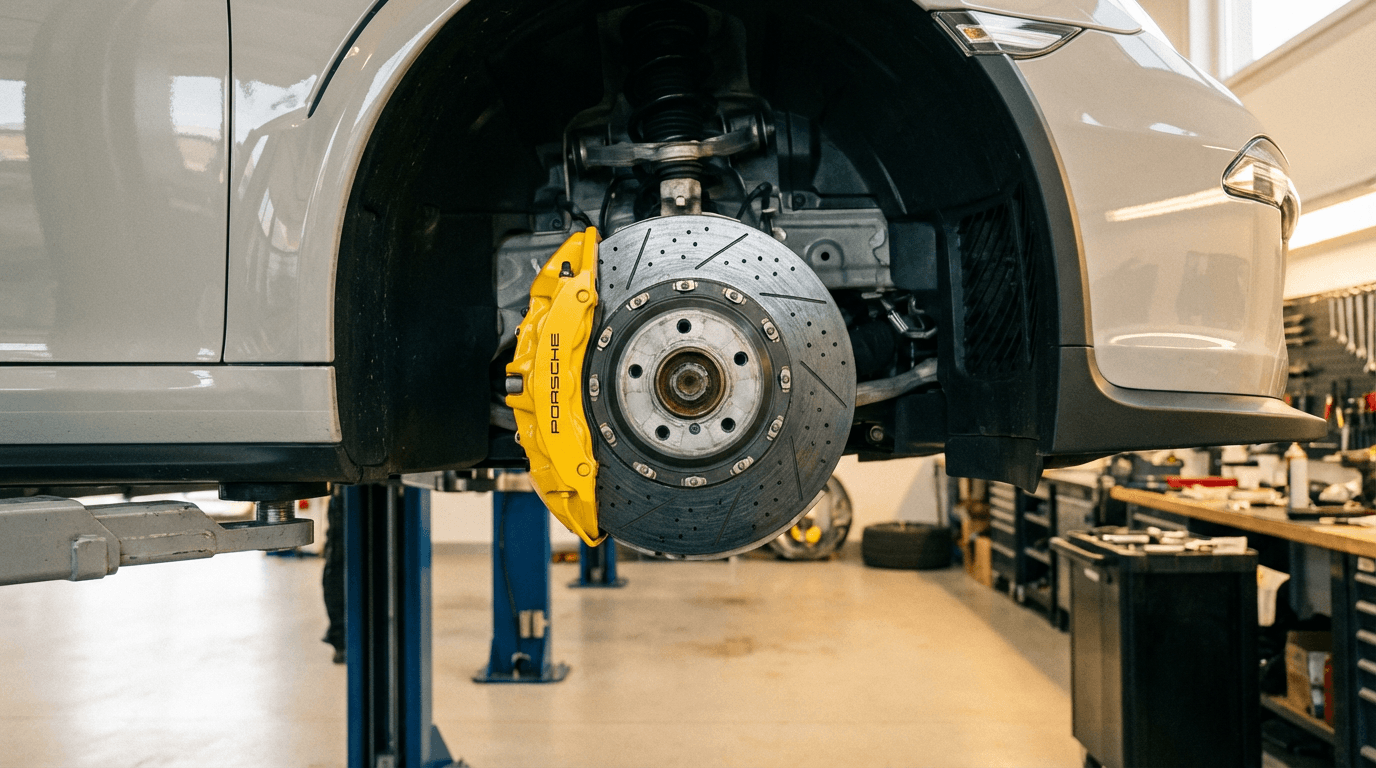
- PCCB-specific fluid: Cars with Porsche Ceramic Composite Brakes generate less heat transfer to the fluid (the ceramic rotors absorb less heat into the hub), but the fluid still degrades through hygroscopic absorption and should be flushed on the same interval.
Cost of Brake Fluid Flush
| Service | Independent Cost | Dealer Cost |
|---|---|---|
| Standard 4-wheel flush | $150-$250 | $250-$400 |
| Flush with ABS module bleed | $200-$300 | $350-$500 |
| Track prep with racing fluid | $250-$400 | $400-$600 |
This is one of the most affordable maintenance items on any Porsche, yet it directly affects your safety. There is no good reason to defer it.
Signs Your Brake Fluid Needs Attention
Beyond the time-based interval, watch for these indicators:
- Spongy or soft brake pedal: The most obvious sign of moisture contamination or air in the lines.
- Brake pedal travel increasing over time: Gradual change that many drivers do not notice because it happens slowly.
- Dark or cloudy fluid: Fresh DOT 4 is clear to light amber. Dark brown or cloudy fluid has absorbed significant moisture.
- ABS or PSM warning lights: In some cases, moisture-contaminated fluid causes erratic sensor readings that trigger stability control warnings.
A brake fluid test strip or refractometer can measure moisture content precisely. We check fluid condition during every annual service and pre-purchase inspection.
Brake fluid is cheap. Brake failure is not. Flush it every two years, use the correct specification, and make sure the ABS module is included in the service. Your Porsche's braking system is engineered for extraordinary performance, but only when every component, including the fluid, is in proper condition.
Ready to schedule your Porsche service? Contact Repasi Motorwerks or call (203) 257-0987.