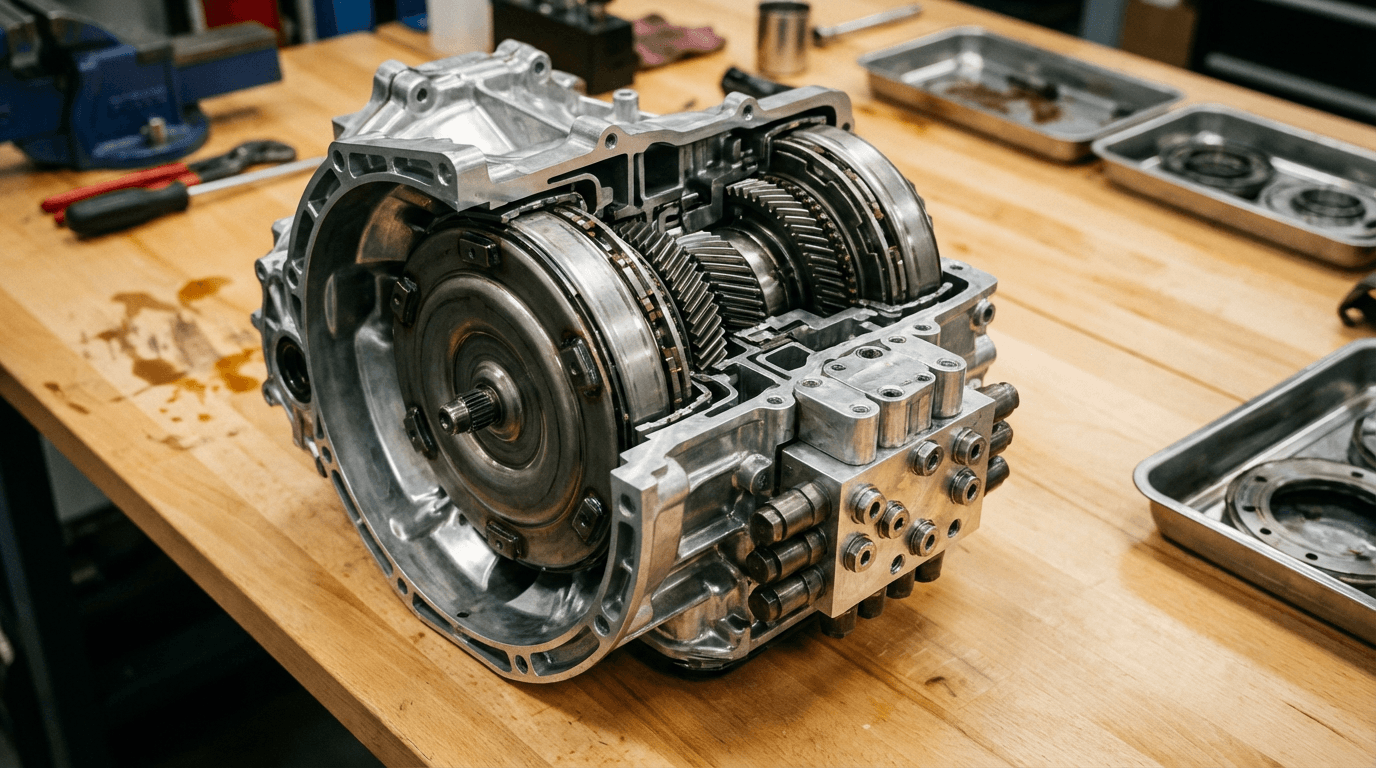
Porsche designates the fluid in its PDK (Porsche Doppelkupplung) dual-clutch transmission as a "lifetime fill," meaning they do not include a fluid change in the standard maintenance schedule. After servicing hundreds of PDK-equipped Porsches, I can tell you with certainty that this designation is optimistic at best and harmful at worst. Here is what every PDK owner needs to know.
What "Lifetime" Actually Means
When Porsche says "lifetime," they are defining lifetime as the expected useful life of the transmission under normal driving conditions within the warranty period. They are not saying the fluid never degrades. It absolutely does.
PDK transmission fluid performs multiple critical functions:
- Lubricates the dual-clutch packs and internal gears
- Provides hydraulic pressure for clutch engagement and gear selection
- Cools internal components through heat transfer
- Protects synchronizers and bearings from wear
Over time and miles, the fluid breaks down. Metal particles from normal clutch and gear wear contaminate it. Heat cycles degrade its viscosity and additive package. The result is fluid that no longer performs as designed.
When to Service Your PDK
Our recommendation, based on extensive experience across 997, 991, 992, Cayenne, and Macan PDK units:
- Street-driven cars: Every 60,000 miles or 6 years, whichever comes first
- Track-driven cars: Every 30,000 miles or 3 years
- High-performance models (GT3, GT4, Turbo S): Every 40,000 miles or 4 years
These intervals keep the fluid well within its effective operating range and prevent the gradual degradation that leads to expensive mechatronic and clutch pack failures.
Symptoms of Degraded PDK Fluid
Fluid degradation is gradual, which is why many owners do not notice until the symptoms become significant:
- Harsh low-speed shifts: The most common early sign. Shifts from 1st to 2nd and 2nd to 3rd at low speeds become noticeably rougher.
- Delayed engagement from a stop: A slight hesitation when pulling away from a standstill, especially noticeable in stop-and-go traffic.
- Shudder during slow-speed maneuvers: A vibration or shudder when parking or during tight low-speed turns.
- Increased shift times: The PDK loses some of its legendary shift speed. Enthusiast drivers notice this before most owners.
- Transmission temperature warnings: On track or in heavy traffic during hot weather, degraded fluid loses cooling efficiency faster.
If you are experiencing any of these symptoms, a fluid service is the first step. In the majority of cases, fresh fluid resolves these issues completely.
The PIWIS Fill Procedure
This is where PDK service differs from a typical transmission fluid change and why it cannot be properly done at a general repair shop. The PDK requires a precise fill procedure controlled by Porsche's PIWIS diagnostic system.
The process:
- Drain: The old fluid is drained through the drain plug. On most models, 4-5 quarts come out of the roughly 7-quart total capacity. A pan drop (removing the pan to access the filter) gets more out.
- Filter replacement: On models with a serviceable filter (most 991 and 992 applications), the filter element is replaced.
- Refill: Fresh Porsche-approved PDK fluid is added.
- PIWIS temperature monitoring: Here is the critical step. The PIWIS system monitors transmission fluid temperature in real-time. The technician must bring the fluid to a precise temperature window (typically 35-45 degrees Celsius) and then check the level through an overflow procedure.
- Level verification: At the correct temperature, fluid is added or removed until it just begins to overflow from the level check port. Too much fluid is as bad as too little in a PDK.
- Adaptation reset: The PIWIS system resets the transmission's adaptive shift parameters, allowing the mechatronic unit to recalibrate its clutch engagement points for the fresh fluid.
Without PIWIS III, steps 4-6 simply cannot be performed correctly. A generic OBD-II scanner cannot monitor PDK fluid temperature or reset adaptive parameters.
What We See Inside PDK Transmissions
When we drain PDK fluid at 60,000 miles, the fluid is noticeably darker than fresh fluid and has a metallic sheen from suspended wear particles. This is normal wear, and the fluid change removes these contaminants.
When we see cars at 100,000+ miles that have never had a fluid change, the fluid is often black, smells burnt, and contains visible metal particles. At this point, a fluid change helps but may not fully restore shift quality because the contaminated fluid has already accelerated wear on the clutch packs and mechatronic seals.
The worst cases we see are PDK units that fail catastrophically, requiring a $10,000-$18,000 rebuild or replacement. In nearly every case, the owner confirms the fluid was never changed. The correlation between fluid neglect and PDK failure is strong and consistent.
Cost of PDK Service
| Service Level | Independent Cost | Dealer Cost |
|---|---|---|
| Fluid drain and fill only | $400-$600 | $700-$1,000 |
| Fluid, filter, and pan gasket | $500-$800 | $900-$1,300 |
| Full service with adaptation reset | $600-$900 | $1,000-$1,500 |
Compare these costs to a PDK rebuild ($10,000-$18,000) or replacement ($15,000-$25,000), and the value of preventive service becomes clear.
PDK vs. Manual vs. ZF: Which Transmission Do You Have?
Not all Porsche transmissions are PDK. Here is how to identify yours:
- PDK (7-Speed Dual-Clutch): Standard on most 911, Cayman/Boxster, and some Macan models. Gear selector has a stiff, mechanical feel with D, N, R positions.
- Manual (6 or 7-Speed): Available on 911, Cayman/Boxster, and the last naturally aspirated GT cars. Obviously identified by the clutch pedal.
- ZF 8HP (8-Speed Torque Converter): Used in the Cayenne, some Macan models, and the Panamera. Gear selector has a smoother, more traditional automatic feel.
Each transmission has different service requirements, but all benefit from regular fluid service. The ZF 8-speed actually has a replaceable filter and is arguably easier to service than the PDK, though it too is designated "lifetime fill."
The Bottom Line
PDK fluid service is one of the highest-return maintenance items on any Porsche. It is relatively inexpensive, it noticeably improves shift quality, and it dramatically extends the life of a transmission that costs more to rebuild than many entire cars.
Include it in your maintenance schedule, find a shop with PIWIS capability, and do not accept "lifetime fill" as an excuse to skip service. Your PDK will thank you with another 100,000 miles of perfect shifts.
Ready to schedule your Porsche service? Contact Repasi Motorwerks or call (203) 257-0987.