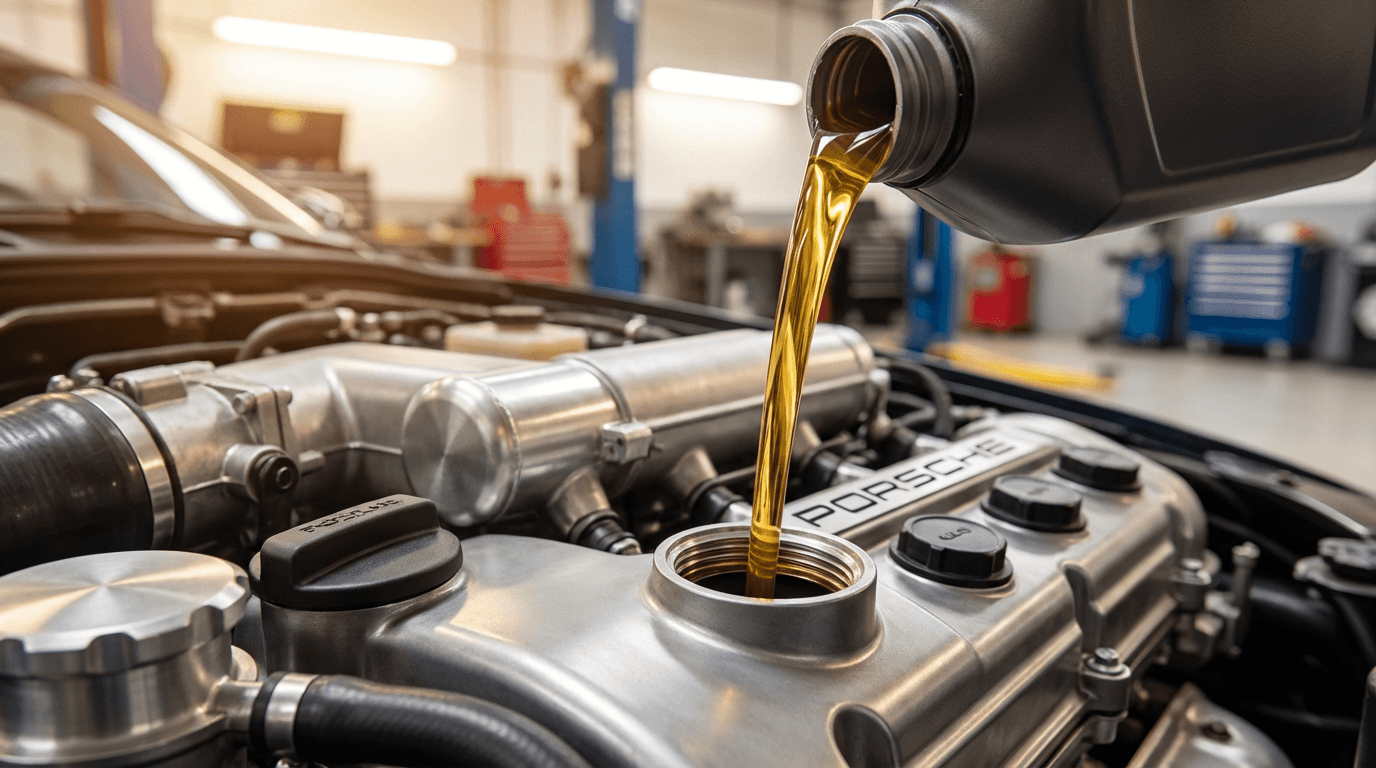
The most common reaction from new Porsche owners at their first oil change is sticker shock. When you are used to paying $50-$80 for an oil change on a regular car, seeing a $350-$600 bill for a Porsche feels extreme. But when you understand what goes into a Porsche oil change, the cost is not only justified but actually reasonable for what you are getting.
Oil Capacity: 8-10 Quarts vs. 4-5
The most straightforward cost driver is volume. A typical passenger car takes 4-5 quarts of oil. Porsche engines take significantly more:
- Porsche 911 (all modern generations): 8.5-10 quarts depending on model and whether it is a dry-sump or integrated dry-sump system
- Cayenne V6: 8.5 quarts
- Cayenne V8/Turbo: 9-10 quarts
- Macan 2.0T: 5.7 quarts (the exception)
- Macan V6: 8.5 quarts
- Cayman/Boxster: 7.5-9 quarts
- GT3/GT3 RS: 10+ quarts (full dry-sump)
At $12-$18 per quart for quality synthetic meeting Porsche specifications, the oil alone costs $90-$180. That is before the filter, labor, or anything else.
Why Dry-Sump Systems Need More Oil
Most 911 variants and all GT models use a dry-sump lubrication system rather than the conventional wet-sump found in typical cars. Understanding this system explains both the oil capacity and the service procedure.
In a wet-sump engine, oil sits in a pan at the bottom of the engine and is picked up by a single pump. In a dry-sump system, oil is stored in a separate reservoir and circulated by multiple scavenge pumps that pull oil from the crankcase and return it to the reservoir. The benefits are significant:
- Consistent oil supply during high-G cornering: Oil cannot slosh away from the pickup
- Lower engine center of gravity: The engine sits lower without a deep oil pan
- Better oil cooling: Separate reservoir allows more efficient heat dissipation
- Reduced windage losses: Less oil mist in the crankcase improves power output
The trade-off is a larger total oil volume in the system (oil in the tank, the lines, the scavenge pumps, and the engine itself) and a more involved drain procedure that requires draining from multiple points.
Oil Specification: A40 vs. C30
Not all synthetic oil meets Porsche requirements. Porsche approves oils under specific standards, and using the wrong one can damage your engine:
A40 Specification (Porsche A40)
- Required for all naturally aspirated flat-six engines, GT cars, and older models
- Higher HTHS (High-Temperature High-Shear) viscosity for better protection under extreme conditions
- Common approved oils: Mobil 1 0W-40, Pennzoil Platinum Euro 0W-40
- Typically SAE 0W-40 or 5W-40 viscosity grades
C30 Specification (Porsche C30)
- Required for newer turbocharged engines with gasoline particulate filters (GPF)
- Lower ash content to protect the particulate filter
- Slightly thinner HTHS viscosity to meet emissions requirements
- Common approved oils: Mobil 1 ESP 0W-30, Castrol Edge 0W-30
- Typically SAE 0W-30 viscosity grade
Why this matters: Using an A40 oil in a C30 engine will clog the gasoline particulate filter over time, leading to an expensive replacement. Using a C30 oil in an A40 engine may not provide adequate wear protection under track conditions. Using a non-approved synthetic, even if it meets the viscosity grade, may lack the additive package Porsche requires.
We stock both specifications and verify the correct one for every car that comes through our oil change service.
OEM Filter Requirements
The Porsche oil filter is not a $5 spin-on canister. Most modern Porsches use a cartridge-style filter element that sits inside an aluminum housing. The OEM filter:
- Uses media rated for the extended 10,000-mile interval
- Includes the correct bypass valve rating
- Fits precisely within the housing without leak potential
- Costs $20-$45 depending on the model
Aftermarket filters are available at lower prices, but we use genuine Porsche filters exclusively. The cost difference is $10-$20, and the risk of using an inadequately rated filter on a car worth $60,000-$200,000+ is simply not worth it.
The Full Service: What You Are Paying For
Here is the actual cost breakdown for a typical 911 oil change at an independent specialist:
| Item | Cost |
|---|---|
| Synthetic oil (9 quarts at $14/qt) | $126 |
| OEM oil filter | $35 |
| Drain plug sealing washer | $3 |
| Labor (0.5-0.8 hours) | $75-$120 |
| Multi-point inspection | Included |
| Fluid level checks | Included |
| Tire pressure check | Included |
| Total | $239-$284 |
At a Porsche dealer, the same service runs $450-$700 because of higher labor rates ($200-$280/hour vs. $140-$180/hour at a quality independent) and marked-up parts.
Our oil change service includes a comprehensive visual inspection of the entire vehicle because the car is already on the lift. This catches issues early and is included in the service price.
Oil Change Interval: Is 10,000 Miles Too Long?
Porsche specifies 10,000-mile or 12-month oil change intervals. For most street-driven Porsches, this is appropriate with quality synthetic oil. However, we recommend shorter intervals in these situations:
- Track use: Change oil within 1,000 miles after any track day, or before if the oil has been in service for more than 6,000 miles
- Short trip driving: Frequent cold starts without reaching full operating temperature cause fuel dilution and moisture contamination. Consider 7,500-mile intervals.
- Turbocharged models in hot climates: Turbo oil temperatures run higher, accelerating breakdown. 7,500 miles is a safer interval.
- Air-cooled Porsches: Older air-cooled engines generally need oil changes every 3,000-5,000 miles due to different oil demands and higher operating temperatures.
What Happens When Oil Changes Are Deferred
We regularly see cars that have gone 15,000-20,000 miles between oil changes. The consequences are predictable:
- Sludge formation: Degraded oil thickens and leaves deposits on internal surfaces, restricting oil passages
- Increased wear: Worn additive packages cannot protect bearing surfaces, cam lobes, and cylinder walls
- Oil consumption increase: Degraded oil leaves deposits on piston rings, reducing their ability to scrape oil from cylinder walls
- Catalytic converter and GPF damage: Burnt oil contaminates exhaust aftertreatment systems
On high-value cars, these consequences are expensive to remediate. A $350 oil change is trivial compared to a $15,000+ engine rebuild.
The Bottom Line
A Porsche oil change costs more because of higher oil volume, stricter specifications, and quality parts. It is one of the most fundamental items on your maintenance schedule and one of the cheapest forms of insurance for your engine. Do not defer it, do not use the wrong oil, and find a specialist who understands your specific model's requirements.
For your annual service or standalone oil change, we are here to keep your Porsche running as Porsche intended.
Ready to schedule your Porsche service? Contact Repasi Motorwerks or call (203) 257-0987.