Every modern Porsche is a network of interconnected computers. The engine management system alone runs millions of lines of code. The suspension, brakes, transmission, infotainment, HVAC, and dozens of other systems each have their own control modules, all communicating through a digital network.
When something goes wrong—or when routine maintenance requires system interaction—the diagnostic tool you connect to matters enormously. PIWIS (Porsche Integrated Workshop Information System) is Porsche's factory diagnostic platform, and it provides capabilities that no generic scanner can match.
At Repasi Motorwerks, PIWIS diagnostics is central to everything we do. This article explains what PIWIS is, why it matters, and what it reveals that other diagnostic tools miss.
For guidance on evaluating any Porsche specialist's capabilities, see our How to Choose a Porsche Specialist guide.
What Is PIWIS?
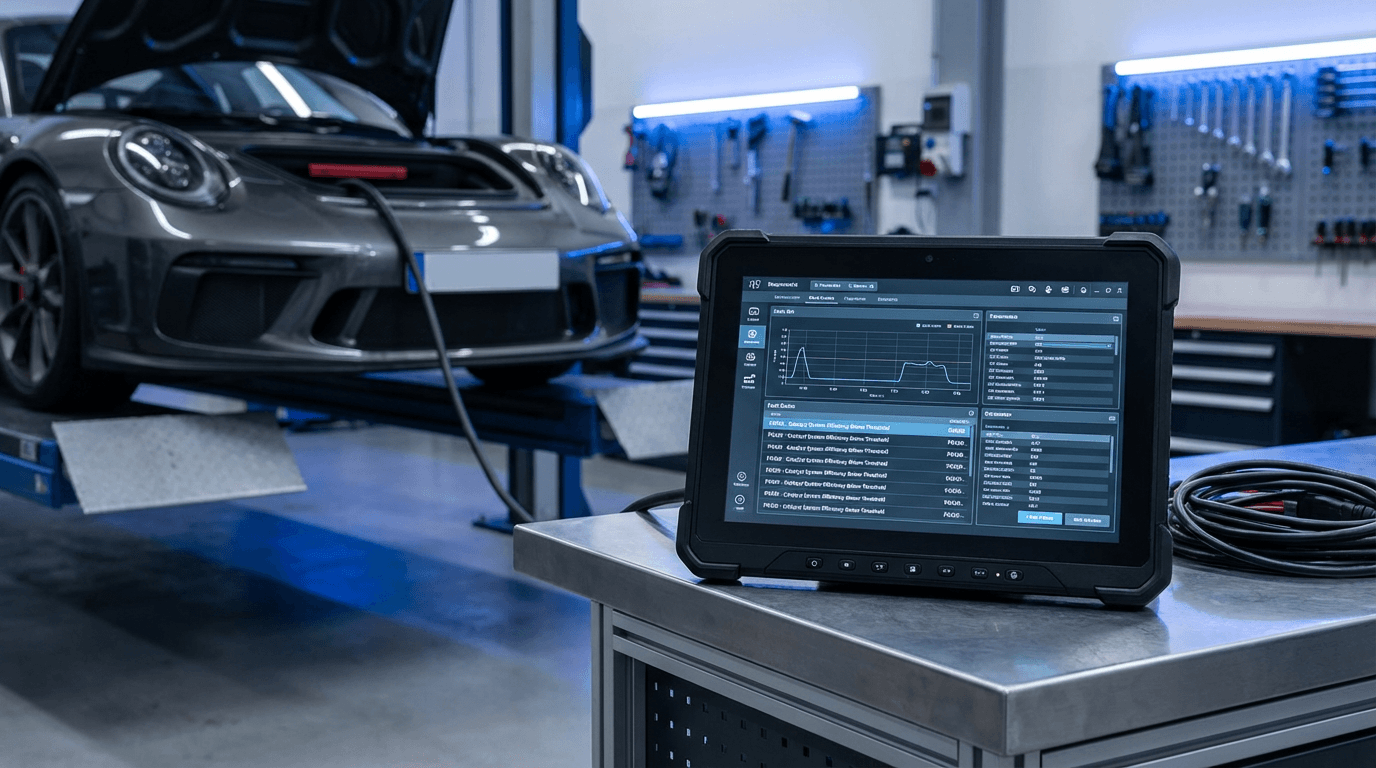
PIWIS (Porsche Integrated Workshop Information System) is the factory diagnostic and programming platform developed by Porsche for its authorized service network. It consists of:
- Dedicated diagnostic hardware — a ruggedized laptop with Porsche-specific interface modules
- Vehicle interface cables — model-specific connections (OBD-II plus supplementary connectors on some models)
- Software subscription — Porsche maintains the software with regular updates for new models, technical bulletins, and firmware revisions
- Online connection — links to Porsche's central diagnostic database for real-time access to technical information
The current version is PIWIS 4, which supports all Porsche models from approximately 2005 to present. Older models (up to early 2000s) require PIWIS 2 or the earlier PST2 (Porsche System Tester).
What PIWIS Can Do That Generic Scanners Can't
1. Complete System Access
A generic OBD-II scanner accesses emissions-related systems (engine, transmission) and basic chassis codes. That's what the OBD-II standard requires.
A modern Porsche has 40-80+ individual control modules. PIWIS accesses all of them:
- Engine management (DME)
- Transmission control (PDK/Tiptronic)
- PASM (Porsche Active Suspension Management)
- PDCC (Porsche Dynamic Chassis Control)
- PSM (Porsche Stability Management)
- PCM (Porsche Communication Management / infotainment)
- Sport Chrono / Sport Response
- Rear-axle steering
- PCCB brake management
- Active aerodynamics (rear spoiler, front diffuser)
- Front lift system
- LED matrix headlights
- Climate control
- Seat memory and adjustment modules
- Hybrid system management (918, Cayenne/Panamera E-Hybrid, Taycan)
- Battery management
- Charging system control
Why it matters: An intermittent fault in the rear-axle steering system won't set an OBD-II code. A generic scanner will show nothing wrong. PIWIS will show the specific fault, when it occurred, what conditions triggered it, and the diagnostic procedure to resolve it.
2. Porsche-Specific Fault Codes
Generic scanners read "P-codes" (standardized powertrain codes like P0300 = Random Misfire). But Porsche uses thousands of manufacturer-specific codes that generic scanners either can't read or can't interpret correctly.
Example: A generic scanner might show P0171 (System Too Lean). PIWIS provides the Porsche-specific code along with freeze-frame data showing exactly which operating condition triggered the fault, which bank is affected, fuel trim values at the time of the fault, and the specific diagnostic procedure.
3. Programming and Coding
Many maintenance and repair procedures require software interaction:
- Service reset: Clearing the service interval indicator after an oil change
- Key programming: Adding or replacing key fobs
- Module coding: Configuring replacement control modules with vehicle-specific parameters
- Firmware updates: Applying Porsche software updates to individual systems
- Calibration: Re-calibrating sensors after component replacement (steering angle, PASM, etc.)
- Feature activation: Some features require software coding to enable
A generic scanner cannot perform any of these operations. This means that even for a routine oil service, PIWIS access is necessary to properly reset the service indicator on many Porsche models.
4. Guided Fault-Finding
PIWIS includes Porsche's technical diagnostic procedures — step-by-step guided workflows for diagnosing specific symptoms. These procedures are developed by Porsche engineers and draw on data from the global service network.
For a technician diagnosing an intermittent electrical issue, this guided approach can save hours of diagnostic time (and hundreds of dollars for the customer) compared to manual troubleshooting with a generic scanner.
Real-World Diagnostic Examples
Example 1: PASM Fault — "Check Chassis" Warning
What the customer experienced: Intermittent "Check Chassis" warning on the dash of a 991.2 GT3, accompanied by the suspension defaulting to a stiff setting.
What a generic scanner showed: No relevant fault codes. The OBD-II system doesn't monitor PASM.
What PIWIS revealed: A specific fault code in the PASM control module pointing to an intermittent signal from the rear-left ride height sensor. Freeze-frame data showed the fault occurred only at highway speeds over bumps — a specific wiring connector was making intermittent contact due to vibration.
Resolution: Repaired the connector — a $200 fix that would have been nearly impossible to diagnose without PIWIS.
Example 2: PDK Performance Issues
What the customer experienced: Hesitant shifts and occasional harsh engagement in a 991 GT3.
What a generic scanner showed: No fault codes.
What PIWIS revealed: PDK adaptation values had drifted significantly from nominal. The clutch wear parameters were within specification, but the shifting logic had adapted to compensate for aging fluid. A PDK fluid service and adaptation reset resolved the issue completely.
Without PIWIS: The shop would have been guessing — potentially recommending unnecessary clutch replacement ($15,000+) when a $1,500 fluid service and software reset was the actual solution.
Example 3: Hybrid System Warning (918 Spyder)
What the customer experienced: Reduced electric range and a yellow hybrid system warning.
What a generic scanner showed: Generic hybrid fault code with no useful detail.
What PIWIS revealed: Individual cell voltage data showing one cell group slightly below threshold. The battery management system had limited output as a protective measure. The cooling system flow rate to that cell group was reduced due to a partially restricted coolant line.
Resolution: Coolant line service restored full battery performance — avoiding premature battery replacement.
The Cost of PIWIS
PIWIS hardware and software represent a significant investment for any shop:
- Hardware: $5,000-$10,000 for the dedicated laptop and interface modules
- Software subscription: $3,000-$5,000 annually for current software and updates
- Training: Porsche diagnostic training for technicians (ongoing)
- Multiple versions: Older cars may require PIWIS 2 or PST2 in addition to PIWIS 4
This investment is why PIWIS access is a meaningful indicator of a shop's commitment to Porsche service. A shop that maintains current PIWIS licensing is signaling that they're serious about doing the job correctly.
What to Ask Your Shop About Diagnostics
- "Do you have current PIWIS access?" — "Current" matters. Outdated software can't diagnose newer models or read updated fault codes.
- "Which PIWIS version?" — PIWIS 4 for modern cars, PIWIS 2 for older models. Ideally both.
- "Is your PIWIS subscription current?" — The software requires annual renewal. Some shops let subscriptions lapse.
- "Can you perform software updates and coding?" — This requires online PIWIS connection, not just offline diagnostic capability.
Beyond PIWIS: Complementary Diagnostic Tools
Quality Porsche specialists supplement PIWIS with additional diagnostic equipment:
- Oscilloscopes — for waveform analysis of sensor signals and ignition systems
- Smoke machines — for finding vacuum and boost leaks
- Bore scopes — for internal engine inspection without disassembly
- Pressure transducers — for fuel system and compression testing
- Thermal imaging — for identifying cooling system issues and electrical hot spots
- Battery analyzers — for 12V and hybrid battery health assessment
Related Resources
- How to Choose a Porsche Specialist
- Independent vs Dealership Service
- Gold Meister Certification Explained
- Porsche Service Costs: What to Expect
Diagnostic Service at Repasi Motorwerks
Our facility maintains current PIWIS 4 and PIWIS 2 licensing for comprehensive diagnostic coverage across all Porsche models. Whether you're troubleshooting an intermittent fault, preparing for a pre-purchase inspection, or simply want a thorough health check, we have the equipment and expertise to provide clear answers.