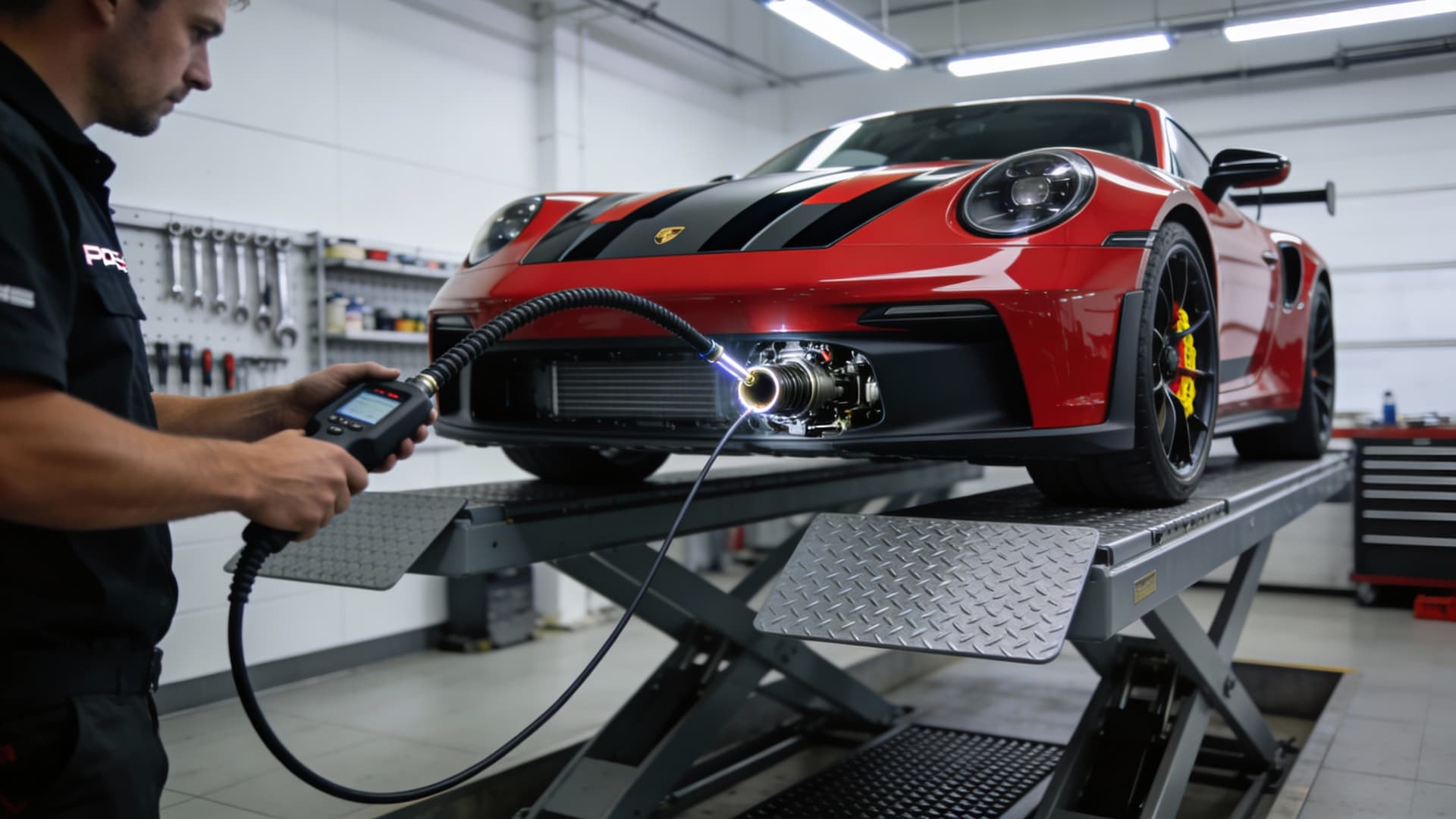
The 997 GT3 looked perfect. Silver paint gleaming under showroom lights, orange Alcantara interior without a mark, service records from a respected dealer. The seller's asking price sat right at market—fair for what appeared to be an exceptional example. Our client was ready to wire the money that afternoon.
Then we measured the paint. For help choosing who to trust with your PPI, see our guide to choosing a Porsche specialist.
The front bumper read 6.2 mils. The hood read 6.8 mils. The driver's fender read 4.1 mils. In an undamaged car, all panels should read nearly identical—Porsche's factory paint typically measures around 4.0 to 5.0 mils. When we see significant variation, particularly with higher readings, it means those panels have been repainted. When the entire front end reads high while the rest of the car reads normal, someone hit something and didn't want to talk about it.
We pulled back the front wheel well liners and found what the pretty paint was hiding: rippled metalwork, obvious filler, and fasteners that didn't match the factory originals. This car had sustained significant front-end damage and been cosmetically repaired. No accident on the Carfax. No disclosure from the seller. And about $30,000 in hidden value loss.
Our client walked away. Without that pre-purchase inspection, he'd have learned about the damage when he tried to sell the car—and discovered his six-figure purchase was worth $30,000 less than he paid.
This is why pre-purchase inspections matter.
What We're Really Looking For
A pre-purchase inspection isn't just a checklist—it's detective work. Every Porsche tells a story through its wear patterns, repair evidence, and maintenance history. Our job is reading that story and translating it for buyers before money changes hands.
We examine over 200 individual points during a comprehensive PPI, but the goal isn't just checking boxes. We're looking for the relationship between what we find and what the seller claims. Odometer reads 28,000 miles but the pedal rubber is worn to bare metal? Something doesn't add up. Service records show oil changes every 10,000 miles at the dealer but we find aftermarket filters? Someone's not telling the whole story.
The physical inspection starts with the engine because that's typically the most expensive thing to repair. We check compression and leak-down on every cylinder, comparing results to factory specifications and looking for variations between cylinders that might indicate developing problems. A cylinder reading significantly different from its neighbors warrants investigation even if all readings fall within published tolerances.
Oil tells its own story. We check condition and level, look for evidence of coolant mixing that would indicate gasket problems, and examine for metal contamination that suggests internal wear. The underside of the oil cap, the dipstick, and the inside of the valve cover (when accessible) reveal how this engine has been living.
Cooling system inspection goes beyond just checking the reservoir level. We trace hoses looking for soft spots or cracks, examine the water pump weep hole for evidence of bearing wear, and check radiator and intercooler cores for damage from road debris. Overheating kills Porsche engines; proper cooling system health is non-negotiable.
The Transmission Tells Everything
Transmission problems can rival engine costs, and they announce themselves to those who know how to listen. In manual cars, we evaluate clutch engagement point, pedal feel, and whether every gear engages smoothly without resistance or grinding. Synchros that balk going into second or third reveal worn synchronizer rings—problems that only get worse.
PDK transmissions require different evaluation. We feel for shift quality through all gears, listen for unusual noises, and check stored fault codes that might reveal adaptation issues or clutch wear. The mechatronic unit is sophisticated and expensive; problems there can run $15,000 or more to address properly.
We drive through every gear, accelerate and decelerate through the rev range, and pay attention to anything that feels hesitant or rough. The road test reveals what static inspection cannot—how all these systems perform under actual load.
Reading the Chassis Story
Suspension components wear with miles and aggressive driving, but they also reveal usage patterns. A car supposedly never tracked that shows heavily worn ball joints and bushings has been driven harder than claimed. Springs that have settled or shock absorbers that leak suggest either high mileage or deferred maintenance.
Steering feel provides immediate feedback about component health. Excessive play, wandering at speed, or vibration through the wheel all indicate problems ranging from simple alignment issues to worn rack components or wheel bearing failure. We evaluate the complete steering system from wheel to rack, looking for loose tie rods, worn bushings, and power steering system condition.
Wheel bearings receive specific attention. Play in bearings means replacement is needed; noise from bearings means replacement is overdue. We check for both, spinning wheels while listening for roughness and checking for movement that shouldn't exist.
Brakes Deserve Obsessive Attention
Safety-critical systems get safety-critical inspection. We measure pad thickness and check for even wear patterns—uneven wear indicates caliper problems or alignment issues. Rotor thickness goes on record, along with surface condition and any evidence of heat damage.
Ceramic composite brakes deserve particular scrutiny. PCCB rotors can develop surface cracking that's cosmetic or structural, and distinguishing between the two requires experience with these systems. Glazed rotors affect stopping performance; cracked rotors may need replacement at $8,000 to $12,000 per axle.
We test every caliper for proper function, checking piston operation and seal condition. Brake fluid gets evaluated for moisture content and contamination. The ABS system gets road-tested for proper function. Brakes are not an area where we take anything for granted.
The Body Never Lies
Paint depth gauges reveal what sellers prefer to hide. Factory paint measures consistently across all panels; repainted panels read higher. Significant variations tell us exactly which parts of the car have been refinished, and refinished panels raise obvious questions about why.
Panel gaps reveal structural history. Factory Porsches fit together with remarkable precision; gaps that are uneven or panels that don't quite align properly suggest either accident damage or poor repair work. We check door fit, trunk alignment, and hood gaps, looking for the consistency that indicates an undamaged car.
Underneath tells an even more honest story. Floor pans show accident damage that cosmetic repairs can hide. Frame rails reveal straightening work or replacement. Seam sealer that's been disturbed indicates panels were removed for repair. We get under every car on a lift, examining structure that most buyers never see.
The Electrical Deep Dive
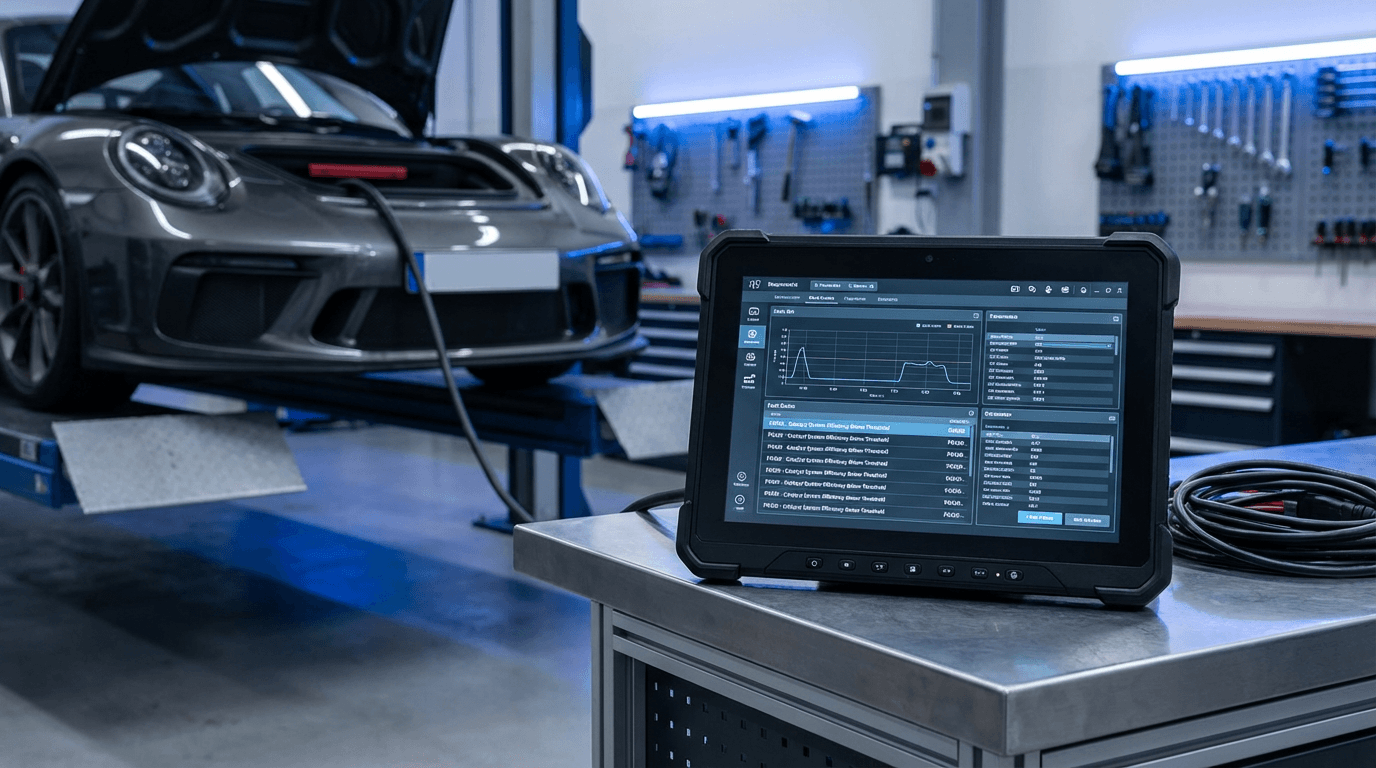
Modern Porsches are rolling computers, and those computers keep records. Our PIWIS diagnostic scan pulls every stored fault code—current problems and historical ones. Some codes clear when issues are corrected; others remain in memory. Finding a car full of cleared codes but no documentation of repairs raises questions about what was happening and whether it was properly addressed.
We test every electrical function: windows, locks, lights, HVAC, audio, navigation, instrument cluster, and all the warning systems. Intermittent electrical problems are maddening to diagnose and expensive to repair; finding them before purchase is infinitely preferable to chasing them after.
Battery health receives specific evaluation because Porsches are hard on batteries. Sitting unused drains them; repeated short trips prevent full charging. A weak battery can mask charging system problems until both fail simultaneously. We load test batteries and verify charging system function.
Documentation Completes the Picture
Service records reveal ownership character. Regular maintenance at qualified shops suggests conscientious care. Sporadic records or work done at general mechanics raises questions about what else might have been deferred or done incorrectly. We review every record available, building a timeline of how this specific car has been maintained.
We verify title status and ownership history. Branded titles, liens, and excessive ownership changes all affect value and warrant investigation. Carfax and AutoCheck reports provide useful starting points, though they're not complete—our 997 GT3 story above demonstrates how accidents can go unreported.
Model-Specific Concerns Get Model-Specific Attention
Different Porsches have different vulnerabilities, and we adjust our focus accordingly. The 996 and 997 generation cars warrant specific attention to IMS bearing condition and bore scoring risk. When indicators suggest problems, we recommend bore scope inspection before purchase—a camera inspection that can reveal cylinder wall damage before it causes catastrophic failure.
Carrera GT inspections center on the clutch because that's the component most likely to generate five-figure repair bills. We measure clutch wear, evaluate engagement character, and assess whether remaining clutch life justifies the asking price. A car priced at market with a clutch that needs replacement soon is actually overpriced by the cost of that repair.
The 918 Spyder brings hybrid complexity. Battery health, electric motor function, high-voltage system integrity, and charging capability all require specialized evaluation beyond what conventional Porsche inspection covers. These systems are expensive to repair and essential to the car's function.
Air-cooled 911s demand different focus: chain tensioner condition, case integrity, thermal reactor function on early cars, and the various issues specific to each year and variant. The knowledge required is different from water-cooled cars, and inspection must reflect that.
GT3 and GT3 RS models receive scrutiny for track use evidence. These cars were built to be driven hard, and many have been. That's not necessarily bad, but buyers should know what they're getting. Brake wear patterns, suspension condition, and engine wear all reveal usage intensity.
What Our Reports Include
Every PPI produces comprehensive documentation. The written report runs twenty pages or more, covering each system with specific findings, condition ratings, and recommended actions. We don't just list what we checked—we explain what we found and what it means.
Photographic documentation captures everything. Over 100 images accompany most reports, showing condition details, measurements, and anything noteworthy we discovered. These photos become permanent records of the car's condition at the time of purchase.
The PIWIS diagnostic printout provides complete system status—every module, every code, every parameter we can access. For cars with stored fault history, we interpret what those codes mean and whether they indicate ongoing concerns.
When we find issues, we estimate repair costs. This information supports negotiation or helps buyers understand what they're taking on. Sometimes our findings justify the seller's price; sometimes they reveal the car is worth less than asking. Either way, buyers make decisions with complete information.
Examples That Saved Buyers
The 997 GT3 story that opened this article saved our client from a $30,000 mistake. But that's not unusual. PPIs regularly reveal problems that would have become expensive surprises.
A well-presented 997.1 Carrera S showed no obvious issues until we sent oil for analysis and listened carefully at idle. Early bore scoring symptoms emerged—this engine was heading toward failure that would have cost $15,000 to $25,000 to address. The buyer renegotiated accordingly.
A "low-mileage" Carrera GT showed clutch wear inconsistent with its claimed odometer reading. Combined with other evidence suggesting the mileage might not be accurate, our client decided the risk wasn't worth taking regardless of how good the car looked otherwise.
A 996 that had passed a basic check elsewhere showed IMS bearing wear that would have caused catastrophic failure soon. The $8,000 cost for preventive repair was negotiated off the purchase price, and the work was done properly before the bearing destroyed the engine.
A Cayenne with a "clean" title revealed flood evidence during our inspection—corrosion patterns, water line evidence in hidden areas, electrical anomalies suggesting moisture damage. Total loss avoided.
Making the Investment
PPI pricing ranges from around $500 for standard models to $1,500 for complex cars like the Carrera GT or 918 Spyder. Travel fees apply when we go to the car rather than the car coming to us. The investment is minimal compared to what proper inspection protects against.
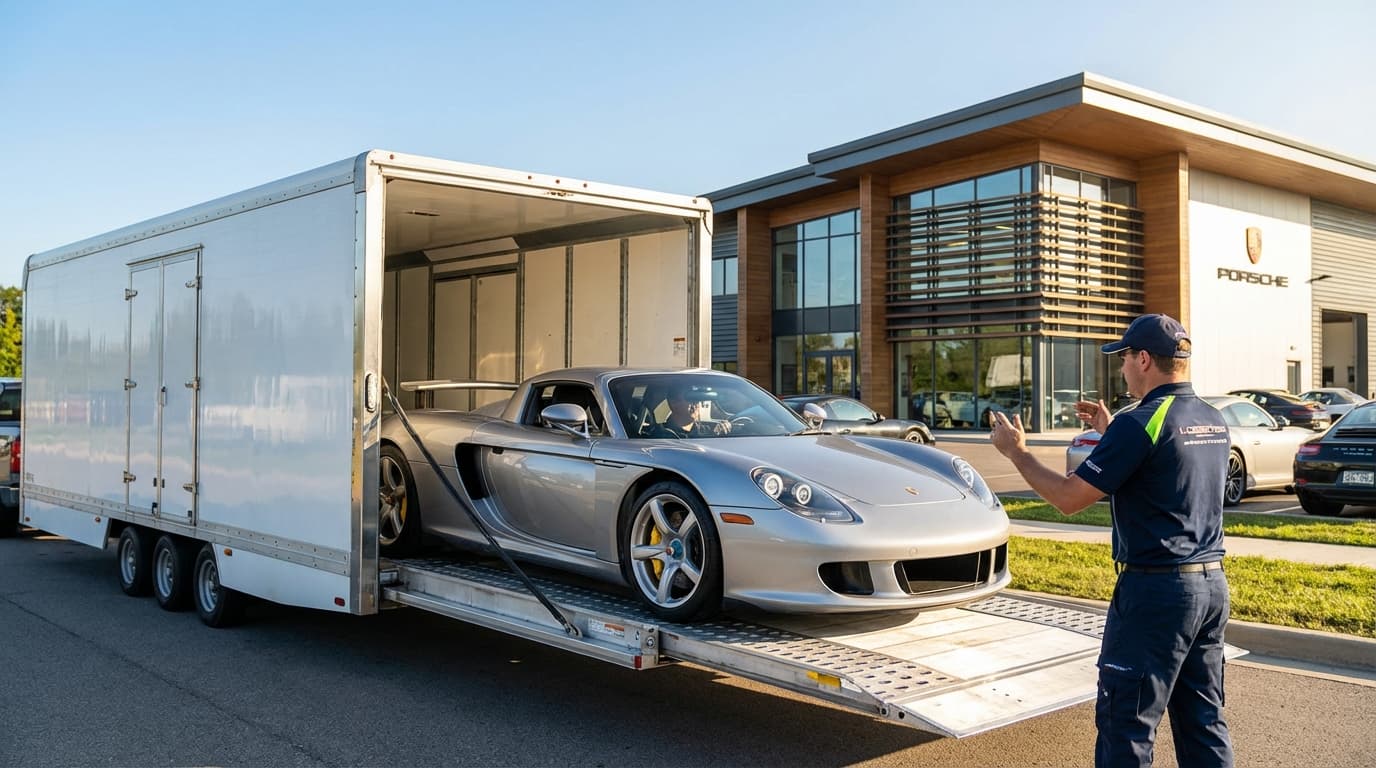
We accommodate various scenarios. Local vehicles come to our shop or we meet at the seller's location. Dealer purchases happen at dealerships—most accommodate serious buyers who want independent inspection. Out-of-state purchases sometimes justify our travel; the cost of our flight and time pales against the risk of buying a problematic car sight-unseen. Auction vehicles can be inspected during preview periods when access is available.
The math is simple. A $1,000 inspection that reveals nothing wrong provides peace of mind and confirms you're paying fairly for what you're buying. A $1,000 inspection that reveals $20,000 in problems saves you $19,000—or saves you from a fundamentally bad purchase. Either outcome justifies the investment.
Every Porsche purchase is significant. Making that purchase with complete information about what you're buying is the least you owe yourself. We're here to provide that information.