Oil consumption on the Porsche 993 is one of the most frequently misunderstood topics in the air-cooled Porsche world. I hear some variation of the same question at least once a week: my 993 is using oil — is something wrong?
The answer is almost always more nuanced than a simple yes or no. The 993 engine consumes oil by design, and understanding what is normal versus what indicates a problem saves owners from both unnecessary worry and delayed action on real issues.
What Is Normal Oil Consumption on a 993?
The Porsche 993 flat-six engine uses oil as part of its normal operation. Oil lubricates the cylinder walls, and a small amount passes the piston rings and is burned during combustion. This is by design — the rings are not meant to seal perfectly, because some oil on the cylinder walls is necessary to prevent scuffing.
Normal range: 1 quart per 1,500 to 3,000 miles is considered acceptable for a healthy 993 engine. Porsche's factory specification allows up to 1 quart per 1,000 miles, though I consider that the upper limit of acceptable for a well-maintained engine.
Factors that affect consumption:
- Driving style: Hard driving increases consumption. Track use can double or triple the rate.
- Ambient temperature: Hot weather increases consumption slightly.
- Oil viscosity: Thinner oils consume faster than heavier oils.
- Engine temperature: The air-cooled 993 runs hotter than water-cooled engines, which increases the rate at which oil passes the rings.
If your 993 uses a quart every 2,000 miles during normal street driving, that is within the expected range. Check it regularly, top it off, and do not lose sleep over it.
When Oil Consumption Indicates a Problem
The warning signs are not just about quantity — they are about pattern and symptoms.
Blue Smoke on Cold Start
If you see a puff of blue-gray smoke from the exhaust when you first start the engine (especially after it has sat overnight or for several hours), this almost always points to worn valve guide seals.
Here is what happens: oil seeps past the hardened valve guide seals while the engine is off, pooling on top of the valves. When you start the engine, that pooled oil burns off in the first few seconds, producing the characteristic blue puff. Once the engine is running, the oil stops accumulating on the valves and the smoke disappears.
Severity: Moderate. Valve guide seals do not typically worsen quickly, and the actual oil loss from this condition is usually small — perhaps an extra half-quart per 1,000 miles. But it does get worse over time and eventually leads to enough consumption to warrant repair.
Blue Smoke Under Load or Acceleration
Blue smoke that appears when you accelerate hard, climb a hill, or put the engine under sustained load points to worn piston rings. Under load, cylinder pressures increase and push more oil past worn or stuck rings. Unlike the cold-start puff from valve guides, ring-related smoke tends to be present whenever the engine is working hard.
Severity: More serious than valve guide seals. Ring wear indicates the cylinders and rings are approaching the end of their service life. Left unaddressed, this progresses to increasing consumption and eventually to cylinder wall damage.
Constant Blue Smoke
If the exhaust has a persistent blue tint at all operating conditions, the engine has significant internal wear — likely a combination of valve guide, ring, and possibly cylinder wall issues. At this point, consumption is typically well above 1 quart per 1,000 miles, and the engine is on borrowed time.
Oil in the Intake System
On the 993 VarioRam engine, worn crankcase breather components can push oil into the intake manifold. This is not true engine consumption (the oil is being recirculated, not burned) but it creates smoke, fouls spark plugs, and indicates a pressure issue in the crankcase that should be investigated.
Diagnostic Testing
When a 993 owner comes to me concerned about oil consumption, here is the diagnostic process I follow:
Compression Testing
A compression test measures the pressure each cylinder can build during the compression stroke. On a healthy 993, you should see 170-190 PSI across all six cylinders with no more than 10-15 PSI variation between the highest and lowest.
Low compression in one or more cylinders tells you the rings or valves are not sealing properly, but it does not tell you which one. That is where the leak-down test comes in.
Leak-Down Testing
This is the more informative test. We pressurize each cylinder to a set pressure (typically 100 PSI) and measure how much air leaks out. On a healthy 993:
- Less than 5% leakage: Excellent condition
- 5-10% leakage: Normal wear, monitor
- 10-15% leakage: Wear is present, plan for service
- Over 15% leakage: Needs attention
More importantly, the leak-down test tells us where the air is leaking:
- Air heard at the oil filler cap: Rings are leaking (air passing into the crankcase)
- Air heard at the exhaust: Exhaust valve not sealing
- Air heard at the intake: Intake valve not sealing
This distinction is critical for determining whether you need a top-end rebuild (valve work only) or a more comprehensive repair that includes cylinders and rings.
Oil Analysis
Sending a used oil sample to a lab like Blackstone Laboratories provides data on metal wear particles, combustion byproducts, and oil condition. Over multiple samples, oil analysis can track the progression of internal wear and help predict when an engine will need attention.
I recommend oil analysis at every oil change for 993 owners who are monitoring consumption.
Borescope Inspection
A borescope camera inserted through the spark plug holes lets us directly inspect the cylinder walls, piston tops, and valve heads without disassembling anything. We can see scoring, carbon buildup, and physical damage that confirms or rules out specific wear patterns.
Repair Options
Valve Guide Seal Replacement (Top-End Refresh)
If the leak-down test shows air leaking past the valves and the rings test healthy, a valve guide seal replacement can address the consumption without a full rebuild.
This involves removing the cylinder heads, replacing the valve guide seals (and often the guides themselves if they are worn), cutting the valve seats, and reassembling. This is often combined with new valve cover gaskets and other external seals.
Cost: $5,000-9,000 depending on the condition of the heads and whether additional valve work is needed.
Expected outcome: Eliminates cold-start smoke and reduces consumption to within the normal range.
Cylinder and Ring Replacement
If the rings are worn and the cylinders are scored, new cylinders and pistons are needed. This is a more involved job that may or may not require splitting the case halves, depending on the extent of wear.
Cost: $10,000-18,000 depending on whether the case needs to come apart.
Full Engine Rebuild
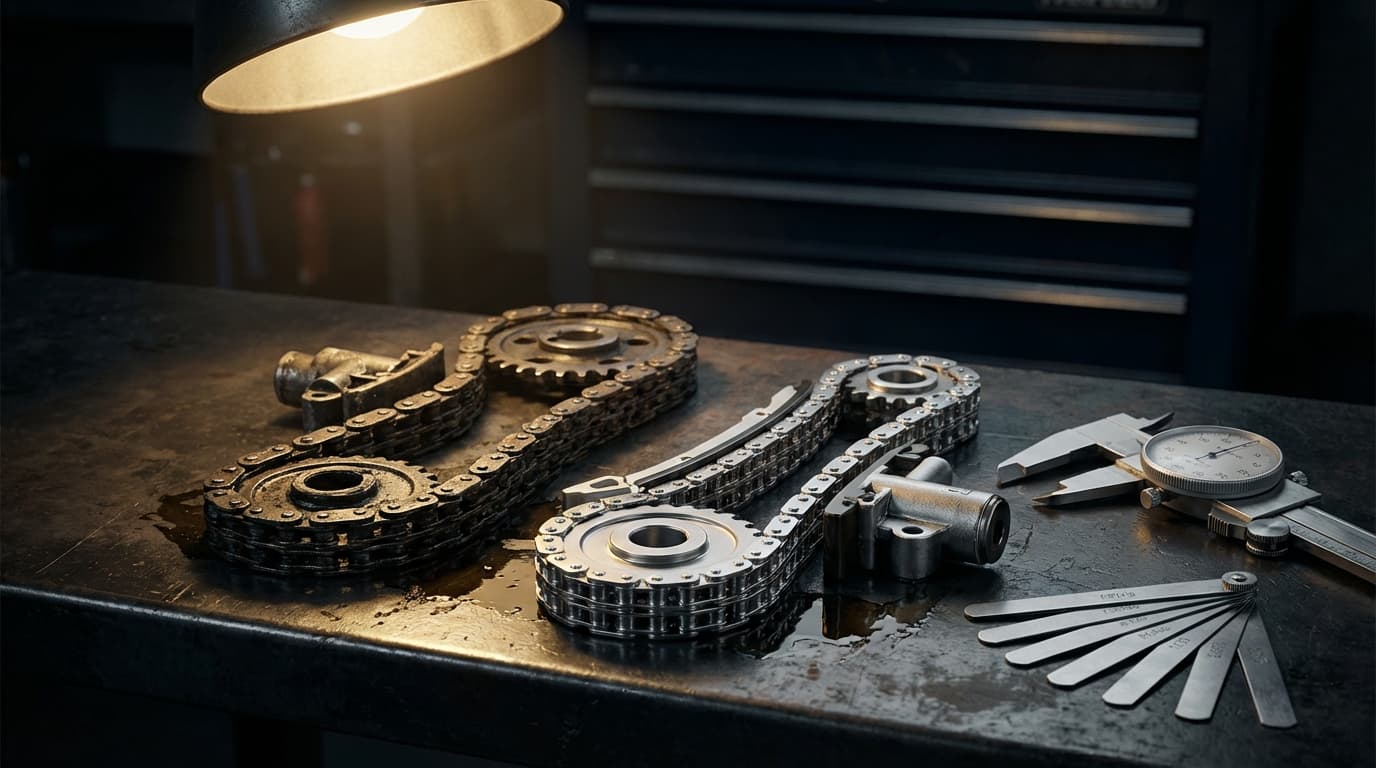
If testing reveals wear in multiple areas — rings, valve guides, bearings, chain system — a full engine rebuild is the most cost-effective path forward. Rather than addressing each issue piecemeal, a complete rebuild resets the entire engine to like-new condition.
Cost: $15,000-28,000+ depending on scope.
When to Just Monitor vs When to Act
This is the most important practical question, and here is my framework:
Monitor If:
- Consumption is under 1 quart per 1,500 miles
- No visible smoke at any operating condition
- Compression and leak-down numbers are within acceptable range
- Oil analysis shows stable wear metal levels
- The car is driven regularly (sitting is worse for seals than driving)
Plan for Service If:
- Consumption is increasing over time
- Cold-start smoke is present and worsening
- Leak-down shows 10-15% across multiple cylinders
- Oil analysis shows increasing wear metals
Act Now If:
- Consumption exceeds 1 quart per 1,000 miles
- Smoke is visible under load
- Leak-down exceeds 15% on any cylinder
- Compression variation between cylinders exceeds 15-20 PSI
- You are finding oil in the intake system
Monitoring Best Practices
For 993 owners who are tracking consumption:
- Check oil at the same conditions every time: Engine warm, on level ground, five minutes after shutdown.
- Log your readings: Date, mileage, and oil level. This data is valuable for trending.
- Use the same oil: Switching brands or viscosities makes comparison difficult. Stick with a quality oil and keep it consistent. See our oil selection guide for recommendations.
- Change oil on schedule: Degraded oil accelerates wear. Do not stretch intervals.
- Get annual oil analysis: Even if you are not concerned about consumption, this data builds a baseline.
The 993 is a magnificent engine — the final evolution of the air-cooled flat-six. With proper monitoring and timely maintenance, these engines can provide hundreds of thousands of miles of service. The key is knowing what is normal, recognizing when things change, and acting at the right time.
If you are concerned about oil consumption on your 993, contact us to schedule a diagnostic evaluation. We will test your engine, give you the numbers, and help you make an informed decision about next steps.