The Porsche 930 Turbo earned the nickname "Widowmaker" not because it was unreliable, but because its power delivery caught unprepared drivers off guard. That turbo lag followed by a sudden rush of boost, combined with the 911's rear-engine weight bias, made the 930 one of the most exciting — and demanding — sports cars of its era.
Today, the 930 is a celebrated classic, valued as much for its driving intensity as for its place in Porsche history. But maintaining a 930 properly requires understanding both the standard air-cooled flat-six maintenance and the additional complexity that turbocharging introduces.
At Repasi Motorwerks, we've maintained 930 Turbos for collectors, drivers, and concours enthusiasts. This guide covers the turbo-specific maintenance concerns that set the 930 apart from naturally aspirated air-cooled 911s. For general air-cooled maintenance, see our comprehensive Air-Cooled Porsche Service Guide.
930 Turbo: Quick Overview
Production years: 1975-1989 Engine: 3.0-liter (1975-1977), 3.3-liter (1978-1989) air-cooled turbo flat-six Power: 260 hp (3.0L) / 300 hp (3.3L) / 330 hp (late models with revised fuel management) Turbocharger: Single KKK (Kühnle, Kopp & Kausch) turbo Boost pressure: Approximately 0.8-0.85 bar Intercooler: Tea-tray style top-mounted (3.3L models) Transmission: 4-speed manual (930) — 5-speed was introduced in 1989 only
Turbo-Specific Maintenance
Turbocharger System
The KKK turbocharger is the heart of what makes the 930 special. Proper maintenance ensures it continues to deliver that legendary boost.
Oil feed and drain lines:
- The turbo is lubricated by engine oil through dedicated feed and drain lines
- These lines are exposed to extreme heat cycling and can develop leaks or restrictions with age
- Inspect at every service — a restricted oil feed starves the turbo bearings
- A clogged drain line causes oil to pool in the turbo, potentially contaminating the intake tract
- Replace lines proactively during major services rather than waiting for failure
Turbo bearing condition:
- Listen for whining or grinding sounds from the turbo at operating temperature
- Check for shaft play — lateral and axial — by removing the intake pipe and gently checking movement
- Excessive play indicates bearing wear and impending failure
- Turbo rebuild or replacement: $2,500-$5,000 depending on the unit
Cool-down procedure:
- After spirited driving, always idle the engine for 2-3 minutes before shutting off
- This allows oil to continue flowing through the turbo bearings as they cool
- Shutting off immediately after boost traps hot oil in the turbo, accelerating bearing wear
- Many owners install turbo timers, but simply being mindful of idle time works equally well
Wastegate and Boost Control
The wastegate regulates maximum boost pressure by diverting exhaust gases around the turbine wheel. Proper wastegate function is critical for both performance and engine safety.
Wastegate diaphragm:
- The spring-loaded diaphragm inside the wastegate actuator degrades with heat and age
- A leaking diaphragm can cause either overboosting (dangerous) or underboosting (performance loss)
- Test wastegate function with a hand-operated pressure tester
- Rebuild kits are available and should be installed every 5-7 years or if any irregularity is detected
- Cost: $300-$500 for a wastegate rebuild
Boost pressure verification:
- Install a quality boost gauge if one isn't already present (many owners have added them)
- Maximum boost should match specification — overboosting risks engine damage
- Underboosting indicates either a wastegate issue or a boost leak in the intake tract
- Check all boost plumbing for leaks, cracks, and loose clamps
Intercooler (3.3L Models)
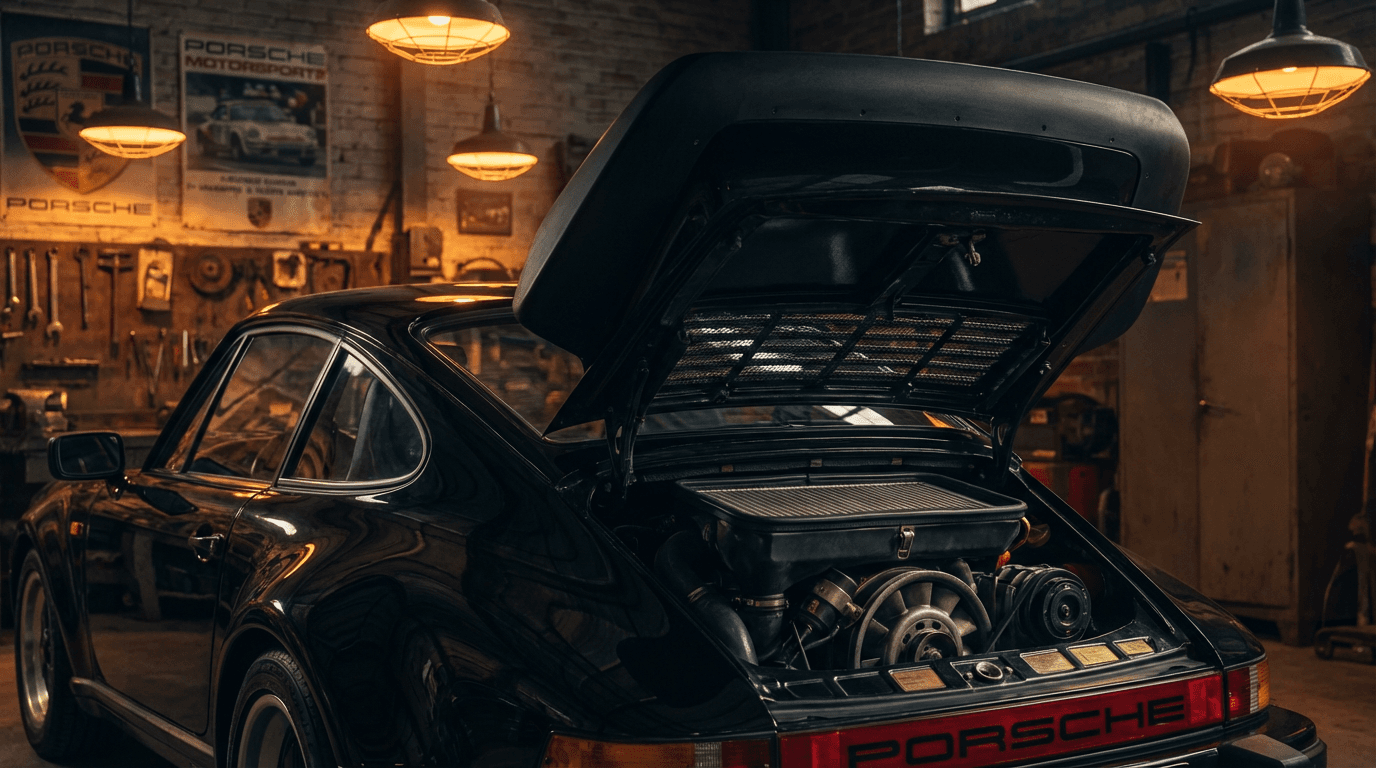
The distinctive "tea-tray" intercooler mounted in the whale tail spoiler is one of the 930's most recognizable features. It cools compressed intake air before it enters the engine.
Inspection:
- Check for physical damage — road debris, mounting damage, or corrosion
- Inspect inlet and outlet connections for leaks (boost leaks reduce performance)
- Clean the intercooler core periodically — bugs and debris reduce cooling efficiency
- Internal cleaning (with appropriate solvents) removes oil residue that accumulates from turbo seal seepage
Upgrade consideration: Aftermarket intercoolers with improved core designs can reduce intake temperatures by an additional 10-20°F. This is a worthwhile upgrade for cars that are driven hard, but originality-focused owners may prefer to maintain the factory unit.
CIS Fuel Injection and Boost
The 930 uses Bosch CIS (Continuous Injection System) fuel injection, which must be calibrated to work correctly with the turbo system. Unlike modern electronic fuel injection, CIS is a mechanical system that relies on fuel pressure and airflow to determine fueling.
CIS under boost:
- A frequency valve modifies fuel enrichment under boost conditions
- This valve is critical — too lean under boost causes detonation and engine damage
- Proper CO mixture adjustment is essential and should only be done with proper equipment
- The warm-up regulator must function correctly to prevent lean conditions during cold start
Fuel system maintenance:
- Fuel filter replacement every 15,000 miles (these cars are hard on fuel filters)
- Fuel accumulator function check — maintains system pressure and prevents hot-start issues
- Fuel injector spray pattern test — uneven spray causes mixture imbalance
- System pressure test with proper CIS gauge set at every major service
Important: CIS tuning on a turbocharged car is significantly more complex than on a naturally aspirated 911. This is specialist work that requires both experience and proper equipment.
Cooling System — Amplified Demands
The 930's turbo generates significantly more heat than a naturally aspirated flat-six. Every component of the cooling system must be in perfect condition.
Engine cooling (air):
- All standard air-cooled cooling concerns apply, but with less margin for error
- Fan belt failure, missing tin work, or stuck thermostat flaps are more dangerous on a turbo car
- Oil temperature gauge is mandatory — monitor it constantly during spirited driving
- Target oil temperature: below 250°F; sustained operation above 270°F risks bearing damage
Oil cooler:
- The factory oil cooler works adequately for street use but can be marginal during aggressive driving
- Inspect oil cooler lines and fittings for leaks — the turbo-induced heat cycling stresses these connections
- Aftermarket auxiliary oil coolers are available and recommended for tracked cars
Brake Upgrades: Stopping the Power
The 930 came with larger brakes than standard 911s, but by modern standards they're still modest for the car's power output, especially considering the turbo's weight penalty.
Factory brakes:
- Ventilated discs front and rear (4-piston calipers, depending on year)
- Adequate for normal street use
- Marginal for spirited driving, particularly in hilly terrain or repeated hard stops
Recommended upgrades:
- Braided stainless steel brake lines (improved pedal feel and heat resistance)
- Performance brake pads (avoid cheap pads that fade under heat)
- Brake fluid upgrade to DOT 4 racing specification
- For serious use: Big brake kit conversions are available from several suppliers
Critical note: The 930's weight bias means the rear brakes work harder than on a mid-engine or front-engine car. Rear brake pad wear should be monitored closely, and pad condition affects handling balance under braking.
Turbo Lag Management: The Driving Technique
Understanding turbo lag isn't just about driving — it informs maintenance priorities.
How the 930's lag works:
- At low RPM, the turbo is spinning slowly — minimal boost
- As RPM rises, the turbo spools up — boost arrives suddenly at approximately 3,500-4,000 RPM
- The transition from no boost to full boost is abrupt compared to modern turbo cars
- This characteristic is what earned the "Widowmaker" reputation
Why this matters for maintenance:
- The abrupt power delivery stresses drivetrain components — clutch, transmission, axles
- Smooth driving extends component life significantly
- Clutch condition monitoring is important — the 4-speed transmission handles torque differently than modern 5/6-speed units
- Wheel bearings on the rear axle work harder due to the weight and power combination
Annual Maintenance Budget
| Item | Annual Cost |
|---|---|
| Basic annual service (oil, filters, valve adjustment) | $2,000-$3,000 |
| Turbo system inspection and maintenance | $500-$1,000 |
| Fuel system service | $500-$1,000 |
| Brake inspection and maintenance | $500-$1,500 |
| Unexpected repairs (budget 10-15% of car value annually) | Varies |
| Total routine budget | $3,500-$6,500 |
Note: This budget assumes the car is in sound mechanical condition. Deferred maintenance or neglected turbo systems can result in significantly higher costs to bring the car back to proper condition.
Related Resources
- Air-Cooled Porsche Service Guide
- 964 vs 993 Buyer's Guide
- Chain Tensioner Failure: Prevention & Repair
- How to Choose a Porsche Specialist
930 Turbo Service at Repasi Motorwerks
The 930 Turbo demands a specialist who understands both air-cooled fundamentals and turbo-specific systems. Our team has the experience and tooling to maintain these iconic cars properly — from routine services to complete turbo system overhauls.