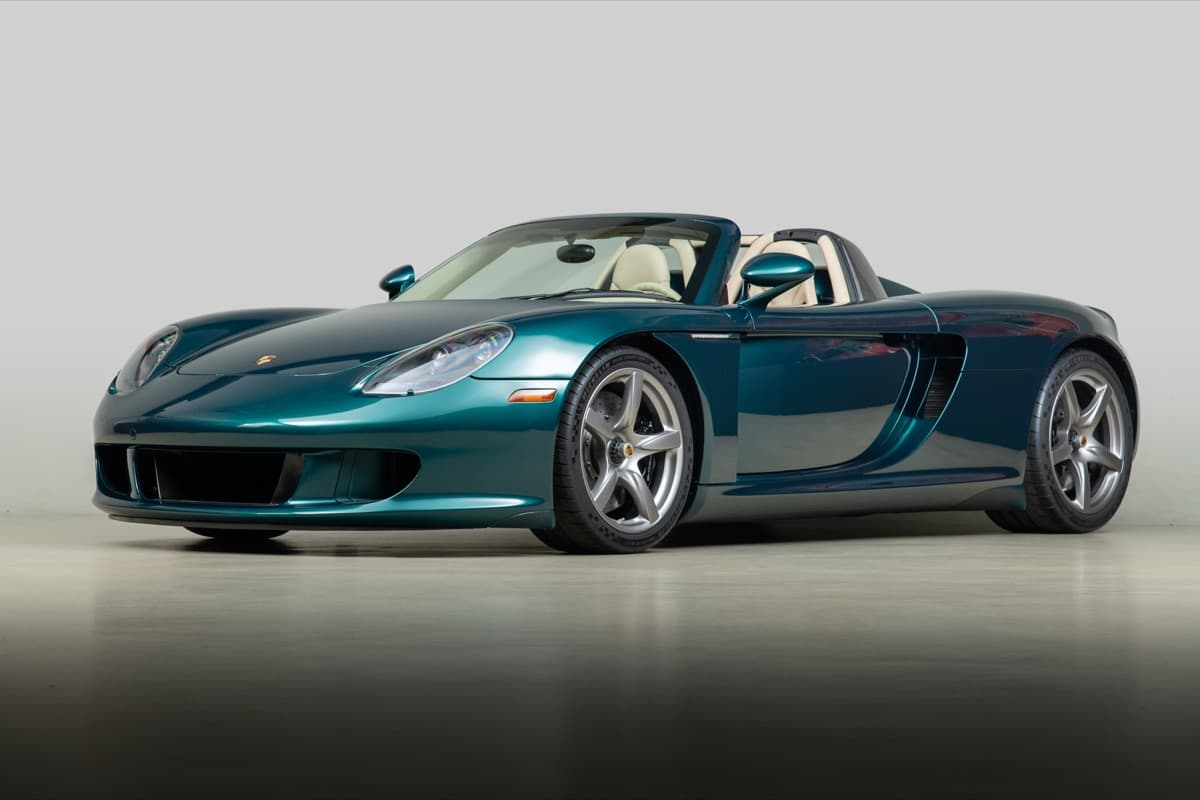
The Porsche Carrera GT remains one of the most celebrated supercars ever produced, and its specifications explain why. Every number tells part of a story about engineering ambition that prioritized driving purity over convenience, raw capability over electronic mediation. Twenty years after production ended, these specifications still impress—and the experience they create still cannot be replicated by anything on the road today.
The Engine: Formula One Lineage
The heart of the Carrera GT is a 5.7-liter V10 derived from Porsche's cancelled Formula One program. When the F1 project ended, the engineering team recognized they had created something too special to abandon. The engine found its way into what would become the Carrera GT, adapted for road use but retaining its racing DNA. For the complete picture of CGT ownership, see our Carrera GT resource center.
The numbers are extraordinary for a naturally aspirated engine. Six hundred five horsepower arrives at eight thousand RPM, with peak torque of 435 pound-feet at 5,750 RPM. The specific output—over 105 horsepower per liter without forced induction—matched turbocharged engines of the era. The redline sits at 8,400 RPM, allowing the V10 to sing in a register that turbocharged or hybrid successors cannot approach.
The configuration is a sixty-eight degree V10 with 98mm bore and 76mm stroke, built around dry sump lubrication that keeps the engine running under the extreme lateral and longitudinal forces the chassis can generate. Each cylinder operates four valves through dual overhead camshafts, with sequential multi-point injection delivering fuel precisely where and when it's needed.
Transmission: The Infamous Clutch
A six-speed manual transmission connects the engine to the rear wheels through Porsche's limited-slip differential with a 3.44:1 final drive ratio. There is no alternative. No automated option. No paddles. Just three pedals and a shift lever, exactly as Porsche's engineers intended.
The ceramic clutch is legendary for its challenging engagement characteristics. The material doesn't provide the progressive friction that conventional clutches deliver. The transition from disengaged to engaged happens more suddenly, demanding precise throttle modulation and practiced timing from the driver. New owners often struggle. Experienced ones develop a technique that works. Nobody claims it's easy—but nobody who has mastered it would trade the directness for automation.
Chassis: Racing Technology for the Road
The monocoque is carbon fiber reinforced plastic—genuine racing construction adapted for road use. Body panels are carbon fiber. Subframes are aluminum. Crash structures combine carbon fiber and aluminum to meet safety requirements while minimizing weight. The resulting structure provides exceptional rigidity with dry weight of just 2,755 pounds. With fluids and nominal fuel, curb weight reaches 3,043 pounds.
Dimensions reflect supercar proportions: 182 inches long, 75.6 inches wide, and just 45.9 inches tall. The wheelbase of 107.5 inches provides stability without sacrificing agility. Weight distribution sits at 44/56 front to rear—biased toward the driven rear wheels where the engine lives.
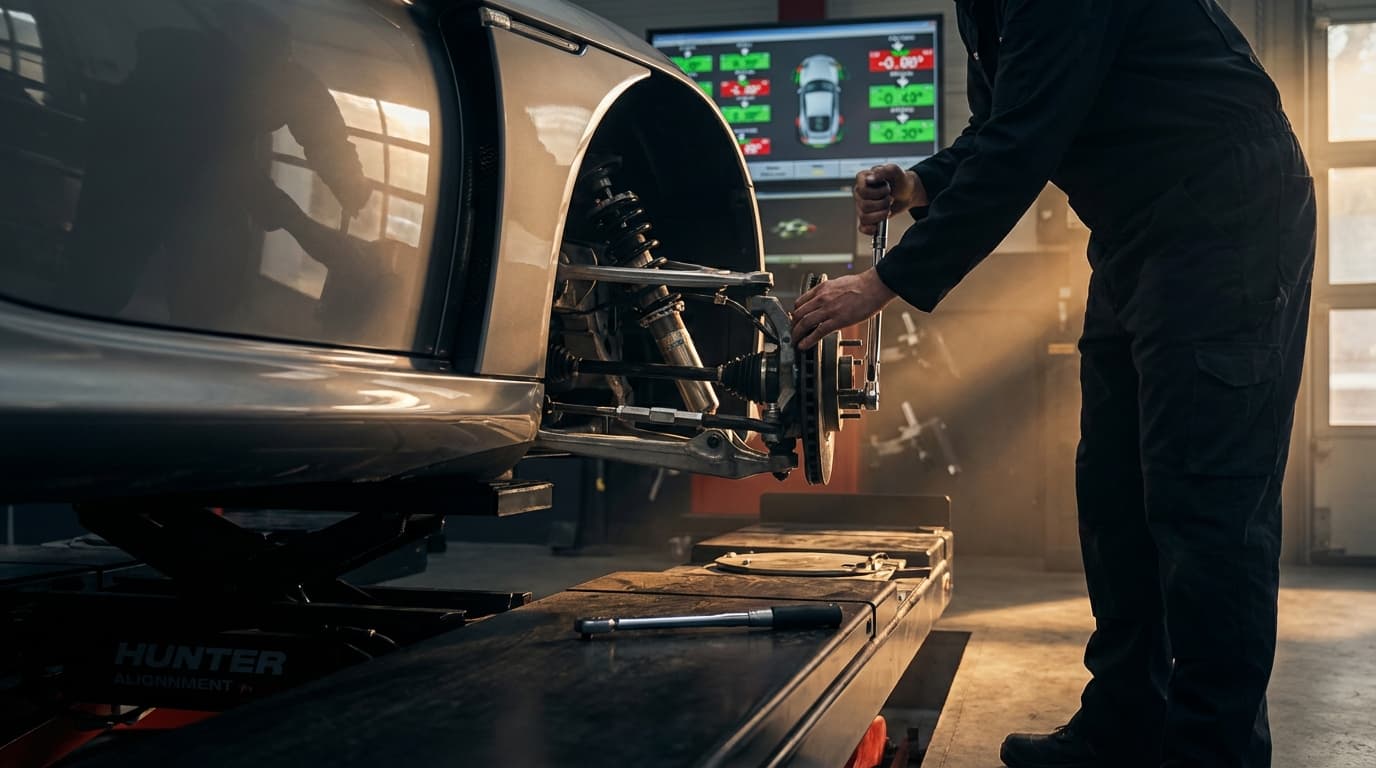
The suspension is directly derived from racing practice. Double wishbones at all four corners with pushrod actuation allow precise control of wheel motion through inboard-mounted springs and dampers. Adjustable coilover springs and anti-roll bars front and rear allow setup changes for different conditions. This is not simplified race suspension; it's actual race technology made road-legal.
Brakes and Wheels
Porsche Ceramic Composite Brakes were still relatively new when the Carrera GT debuted, and the car showcased the technology's capabilities. Carbon ceramic rotors measuring 380mm at the front and 350mm at the rear provide fade-resistant stopping power through six-piston front and four-piston rear calipers. These brakes can bring the car from 60 mph to a stop in 98 feet, from 100 mph in 278 feet, and from 130 mph in 472 feet.
Wheels are staggered significantly to accommodate the rear-weight bias and maximize traction from the driven wheels. Fronts measure 19 inches by 9.5 inches, wearing 265/35 ZR19 tires. Rears grow to 20 inches by 12 inches, mounting 335/30 ZR20 rubber. This massive rear contact patch puts the V10's power to the ground.
Performance: The Numbers
Third-party testing has verified the Carrera GT's capabilities thoroughly. Zero to sixty mph takes 3.5 seconds. The quarter mile completes in 11.2 seconds at 131 mph. Zero to 100 mph requires 6.8 seconds. Zero to 150 mph takes 14.5 seconds.
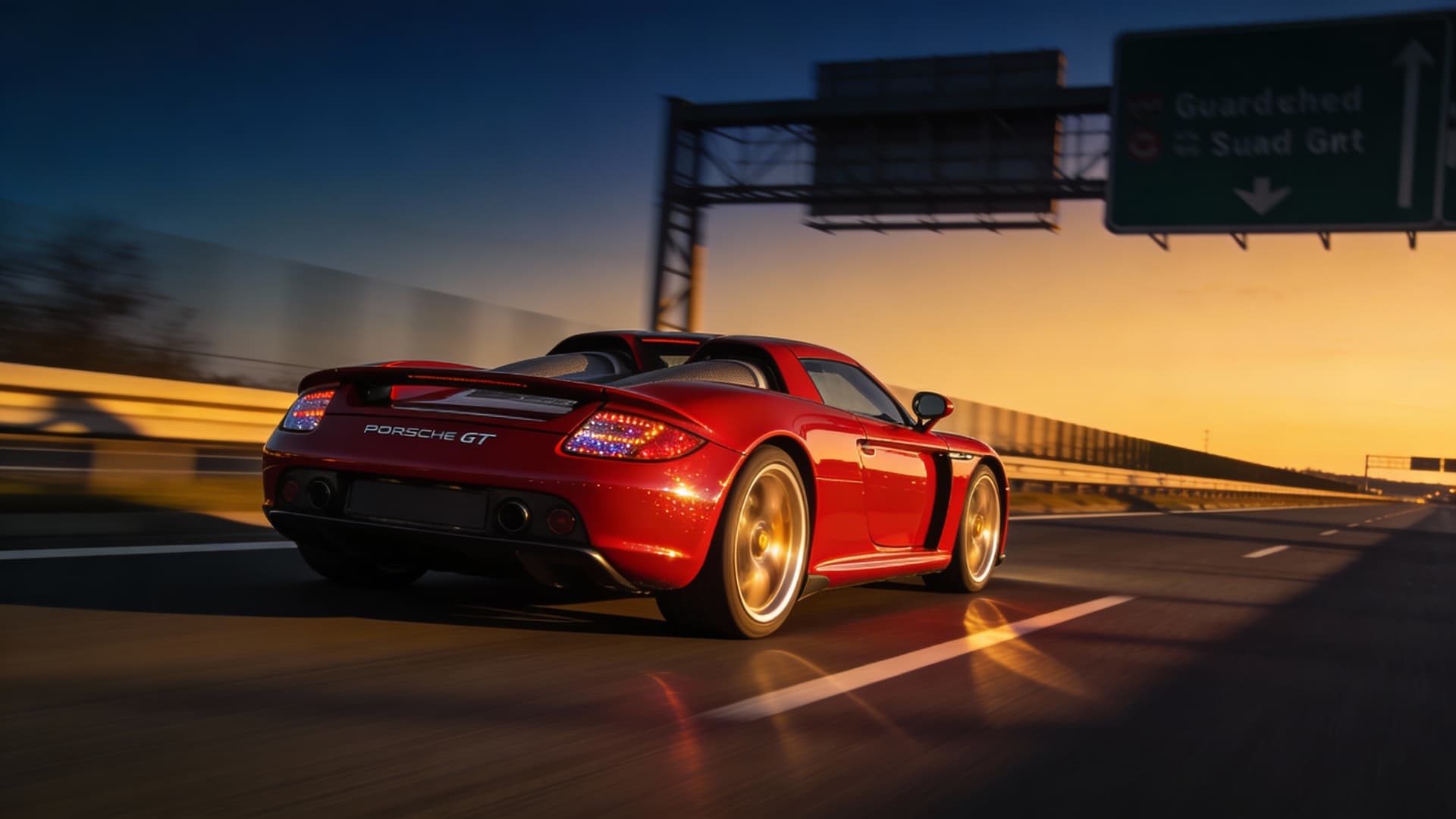
Top speed reaches 205 mph—not an electronically governed limit but the car's actual aerodynamic and power-limited maximum. The car will run until physics say stop.
Lateral acceleration on the skidpad reaches 1.05g, reflecting the combination of wide tires, low center of gravity, and race-derived suspension. In corners, the Carrera GT generates the grip that its brakes and acceleration suggest it should.
Context Among Contemporaries
The Carrera GT emerged alongside other hypercar legends, and the comparisons remain instructive.
The Ferrari Enzo, built from 2002 to 2004, used a 6.0-liter V12 producing 651 horsepower. It was slightly quicker to sixty mph at 3.3 seconds and slightly faster at 217 mph top speed. It also cost substantially more at ,000 versus the Carrera GT's ,400. The Enzo used an automated manual transmission; the Carrera GT remained stubbornly, gloriously manual.
The Mercedes-McLaren SLR, built from 2003 to 2009, offered a supercharged 5.4-liter V8 making 617 horsepower. It was heavier at 3,880 pounds and oriented more toward grand touring than the Carrera GT's uncompromising driver focus. Performance was comparable, but character differed dramatically.
Modern comparison reveals how performance has evolved. The 991.2 GT2 RS produces 700 horsepower from its twin-turbocharged flat-six and reaches sixty mph in 2.7 seconds—nearly a full second quicker than the Carrera GT. It tops 211 mph. On paper, it's faster in nearly every measurable dimension. Yet the Carrera GT's character—its V10 howl, its manual transmission, its analog nature—cannot be replicated by any amount of turbocharging or electronic assistance.
Production and Value
Porsche built 1,270 Carrera GTs between 2004 and 2007, with roughly 650 allocated to the United States. Original pricing ranged from ,400 to ,500 depending on options and market conditions.
Current values reflect the car's significance and the passage of time. Museum-quality examples with under one thousand miles command .8 million to .5 million or more. Excellent examples in the one-to-five-thousand mile range typically trade between .0 and .8 million. Very good examples with five to ten thousand miles fall in the .7 to .0 million range. Good examples with moderate mileage up to fifteen thousand command .4 to .7 million. Even high-mileage drivers rarely trade below .2 million.
The appreciation trajectory suggests these values may continue climbing. Only 1,270 were built. Many are stored rather than driven. The pool of available examples shrinks over time through accidents, fire, and permanent museum placement.
Why the Numbers Matter
Specifications alone don't capture what makes the Carrera GT special. Numbers cannot convey the sound of the V10 approaching redline, the feedback through the pushrod suspension, the directness of the manual transmission. But the numbers provide context for understanding the engineering achievement these cars represent.
The Carrera GT was built to be the ultimate expression of analog supercar capability. Its specifications—every dimension, every component, every performance figure—reflect that singular purpose. Twenty years later, nothing has replaced it.
Considering a Carrera GT, or need service for one you own? Contact Repasi Motorwerks in Stratford, Connecticut. We've built our expertise around these cars and would welcome the opportunity to help.