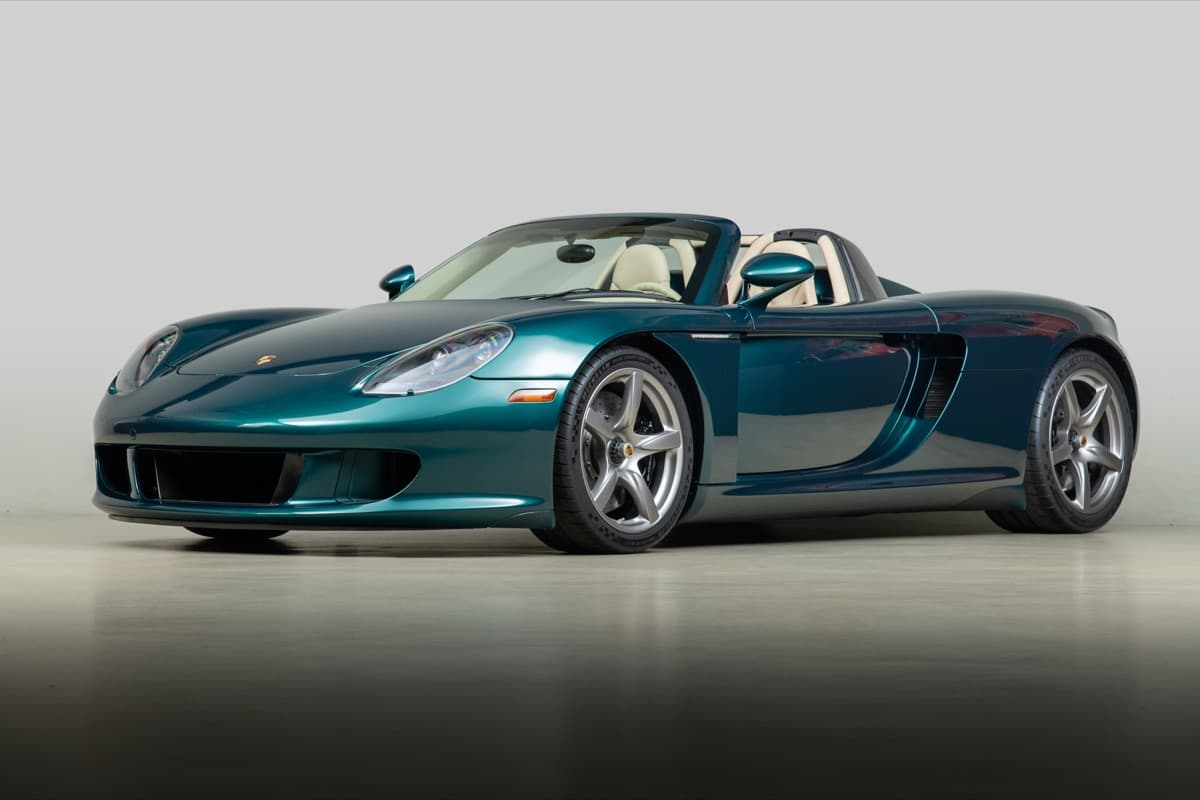
There's a moment, right around seven thousand RPM, when the Carrera GT's V10 stops sounding like a car and starts sounding like something that should be circling a racetrack at Le Mans. That's because, in a sense, it should be. The engine under that rear clamshell began its life as a Formula 1 project, and even in road-going form, it retains more of its racing DNA than perhaps any production car engine ever built.
Understanding the V10's origins helps explain why owners speak about it with something approaching reverence. This isn't marketing mythology—it's engineering fact, and the facts tell a story worth knowing. Visit our Carrera GT resource center for more on the engineering behind this legendary machine.
From Formula 1 to Production Car
In the late 1990s, Porsche developed a V10 engine for the Footwork F1 team. The project aimed to demonstrate Porsche's capability in Formula 1's engine arena, competing against established powerhouses like Ferrari, Mercedes, and Honda. When the F1 program was cancelled before reaching the grid, Porsche found itself with a remarkably sophisticated engine and no car to put it in.
Most companies would have shelved the technology or adapted it into something thoroughly detuned for production use. Porsche chose a different path. They increased displacement to 5.7 liters, added the necessary equipment for emissions compliance, and retained as much of the racing character as possible.
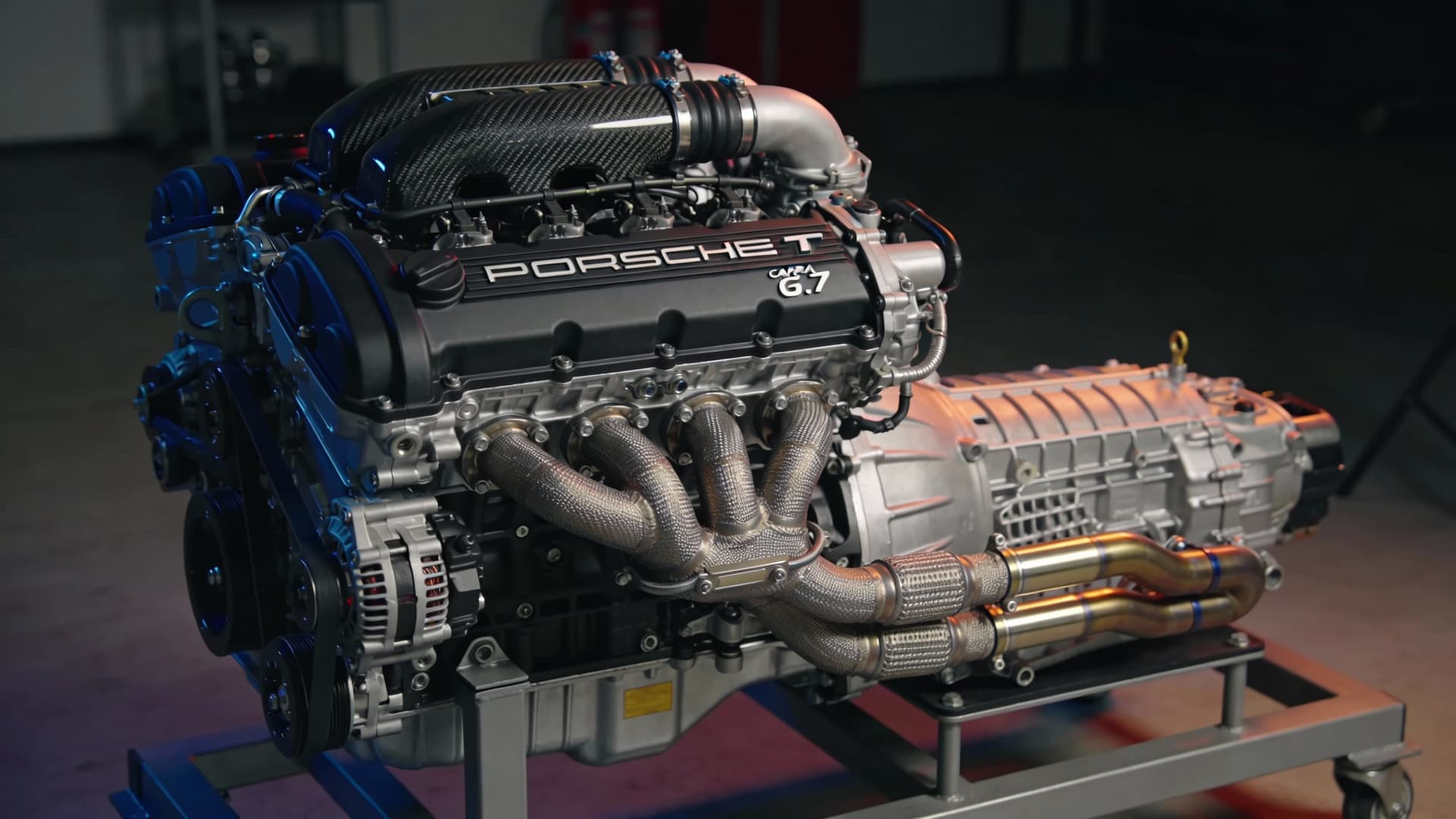
The result keeps elements that racing engines usually sacrifice for production: the 68-degree V-angle optimized for F1 packaging rather than production car convention, dry sump lubrication rather than a simpler wet sump, a carbon fiber intake manifold that saves weight at the cost of production complexity, titanium connecting rods that reduce reciprocating mass, and the ability to rev to 8,400 RPM in an era when most road car engines hit fuel cutoff by 7,000.
What Porsche added for road use—catalytic converters, increased durability margins, noise compliance measures—was the minimum necessary. The engine that emerged was as close to a pure racing engine as any production car has ever offered.
What the Specifications Actually Mean
The numbers alone are impressive: 5,733 cc of displacement, 605 horsepower at 8,000 RPM, 435 lb-ft of torque at 5,750 RPM. But statistics don't capture what makes this engine special. The character does.
Natural aspiration matters here in ways that modern turbocharged engines can't replicate. There is no delay between throttle input and power delivery. Press the accelerator, and the engine responds. Not a fraction of a second later—instantly. This direct connection creates predictability that turbos sacrifice for their power advantages. You know exactly what the engine will deliver at any point in the rev range, modulating power as precisely as you can move your right foot.
The power builds linearly, proportionally, predictably. At three thousand RPM, you have access to a certain amount of power. At six thousand, more. At eight thousand, everything the engine can give. There are no surges, no sudden transitions, no moments where the power delivery changes character. It simply builds, and builds, and builds, until you're approaching the redline and the sound alone tells you it's time to shift.
About that sound: technical explanations help understand why the V10 sounds as it does, but they can't capture the experience. The 68-degree V-angle and specific firing order create a harmonic signature that neither V8 nor V12 can produce. Without turbochargers absorbing exhaust pulses, every combustion event is audible. The titanium exhaust resonates differently than steel. The carbon fiber intake manifold creates its own howl at high RPM, complementing the exhaust with a racing-derived intake roar.
Together, these elements produce what many consider the greatest exhaust note ever fitted to a road car. That claim gets made frequently about various vehicles. In the Carrera GT's case, it's defensible.
Racing Construction for Road Use
Open the engine bay—not that this is simple on a Carrera GT—and you're looking at construction that would be at home on a race car. The aluminum block is precision machined to tolerances that production cars rarely require. Aluminum cylinder heads feature large valves and efficient port design for high-flow capability. The crankshaft is forged steel, fully counterweighted for smooth operation at the engine's extreme operating speeds.
The connecting rods deserve special attention. Titanium rod construction reduces reciprocating mass dramatically, enabling the high-RPM capability that defines the engine's character. It also means that if connecting rods ever need replacement, the cost is breathtaking. Fortunately, with proper maintenance, this is a theoretical concern rather than a practical one.
The carbon fiber intake manifold saves weight where it matters—high on the engine, reducing the car's center of gravity—while providing thermal insulation that helps intake charge density. It's also visible through the glass engine cover, a constant reminder of the engineering beneath.
The dry sump lubrication system maintains oil pressure during the kind of lateral loading that conventional wet sump systems struggle with. On track, through sustained high-g cornering, the engine never starves for oil. This system also lowers the engine in the chassis, improving the car's center of gravity beyond what a wet sump configuration would allow.
What Maintenance the V10 Requires
The Carrera GT's V10 rewards proper care with remarkable reliability. The technology is sophisticated, but the maintenance requirements are straightforward for those who understand them.
Oil changes should happen every five thousand miles or annually, whichever comes first. The engine holds approximately ten quarts and should receive only Porsche-approved 0W-40 specification oil. Premium filtration matters—this engine was designed for racing-quality consumables.
Spark plug replacement at fifteen thousand miles keeps all ten cylinders firing optimally. Proper gap and installation matter more here than in less demanding engines. Air filter replacement at the same interval ensures the high-flow intake receives clean air. Restricted airflow affects performance and can damage mass airflow sensors.
Every four years or fifteen thousand miles, the engine requires major service including valve adjustment. Unlike many modern engines with hydraulic lifters, the V10 uses solid tappets that require periodic clearance adjustment. This is critical for optimal performance and preventing valve damage. The procedure involves removing intake manifold components, measuring current clearances at each of the forty valves, adjusting to specification, and reassembling. Labor runs six to ten hours, with total cost typically between twenty-five hundred and four thousand dollars.
Major service also includes complete fluid changes—engine oil, transmission fluid, brake fluid, power steering fluid, and coolant if due—plus thorough inspection of cooling system components, drive belts, exhaust system, fuel system, and all seals and gaskets.
What Can Go Wrong
The V10 is fundamentally reliable, but certain issues occur with age and use.
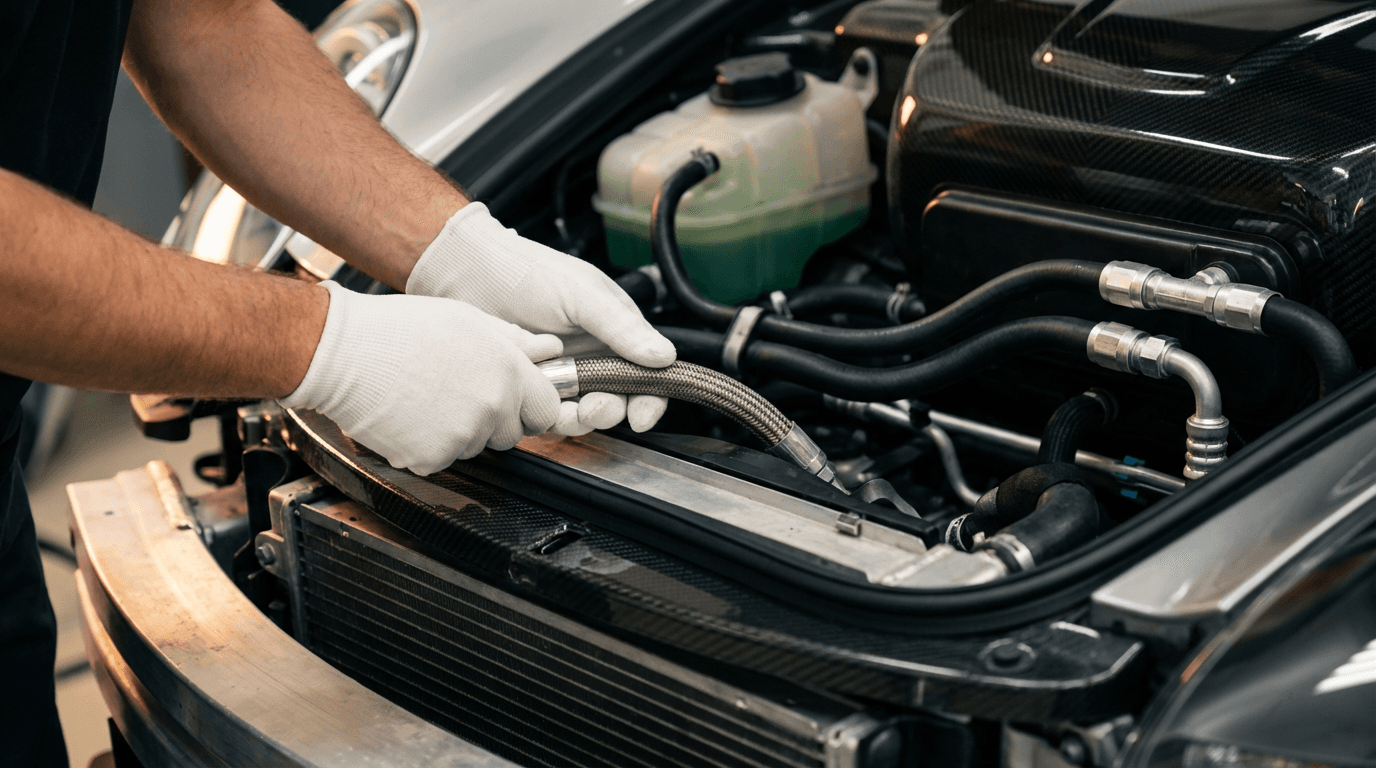
Valve cover gaskets and various seals can weep with age. Oil leaks should be addressed promptly to prevent escalation—what starts as a minor seep can become significant if ignored. Coolant system components age over time; hoses become brittle, thermostats lose accuracy, water pump components wear. Proactive replacement prevents roadside failures.
Vacuum hoses throughout the engine become brittle with heat cycling, causing idle quality issues and potential check engine lights. These are typically straightforward repairs once diagnosed. Exhaust manifold studs can loosen or manifolds can crack on high-mileage examples that have seen extensive heat cycling.
None of these issues are catastrophic. They're the normal aging process of a twenty-year-old high-performance engine. Address them systematically and the V10 continues performing as intended.
Why Nothing Modern Compares
Modern engines produce more power more efficiently. A current turbo V8 makes more horsepower per liter, uses less fuel, and meets emissions standards that the Carrera GT's V10 would struggle to approach. By objective measures, modern engines are better.
But they cannot replicate the V10's character. The instant throttle response. The linear power delivery. The sound that builds from a mechanical rumble to a racing scream. The connection between right foot and crankshaft that makes the driver feel integrated into the machine.
This engine represents an approach to performance that no longer exists in new production. Turbocharging and hybridization and emissions requirements have pushed automotive engineering toward efficiency and peak power. The Carrera GT's V10 pursued a different goal: creating an engine that felt like racing technology translated for the road.
It succeeded. And because that goal no longer drives engine development, the V10's character has become irreplaceable.
What We Do for Carrera GT Engines
At Repasi Motorwerks, we've performed every type of service on Carrera GT V10 engines. Routine oil and filter services. Complete valve adjustments. Cooling system overhauls. Exhaust system repairs. Full engine restorations. Our experience spans dozens of these cars, providing perspective that most shops simply cannot offer.
Whether you're maintaining a regularly-driven example or preserving a low-mileage collector car, we provide the expertise the V10 deserves. These engines were built to last—and with proper care, they do.
Questions about your Carrera GT's V10? Contact Repasi Motorwerks in Stratford, Connecticut. We understand what these engines need to continue performing as Porsche intended—and we provide the service to make that happen.
Schedule Your Carrera GT Service