An oil change might seem like the simplest service any car requires. Remove old oil, replace filter, add new oil. Anyone with a drain pan and a wrench can do it, right?
Not on a Carrera GT. See our Carrera GT resource center for complete maintenance guidance.
The V10's dry sump system, racing-derived tolerances, and specific lubricant requirements transform this basic service into something that demands genuine expertise. At Repasi Motorwerks, we've performed countless Carrera GT oil services, and I can tell you that the difference between proper service and amateur work shows up in how these engines age.
Let me walk you through what oil service on a Carrera GT actually involves—and why cutting corners here costs far more than you save.
What the V10 Demands From Its Oil
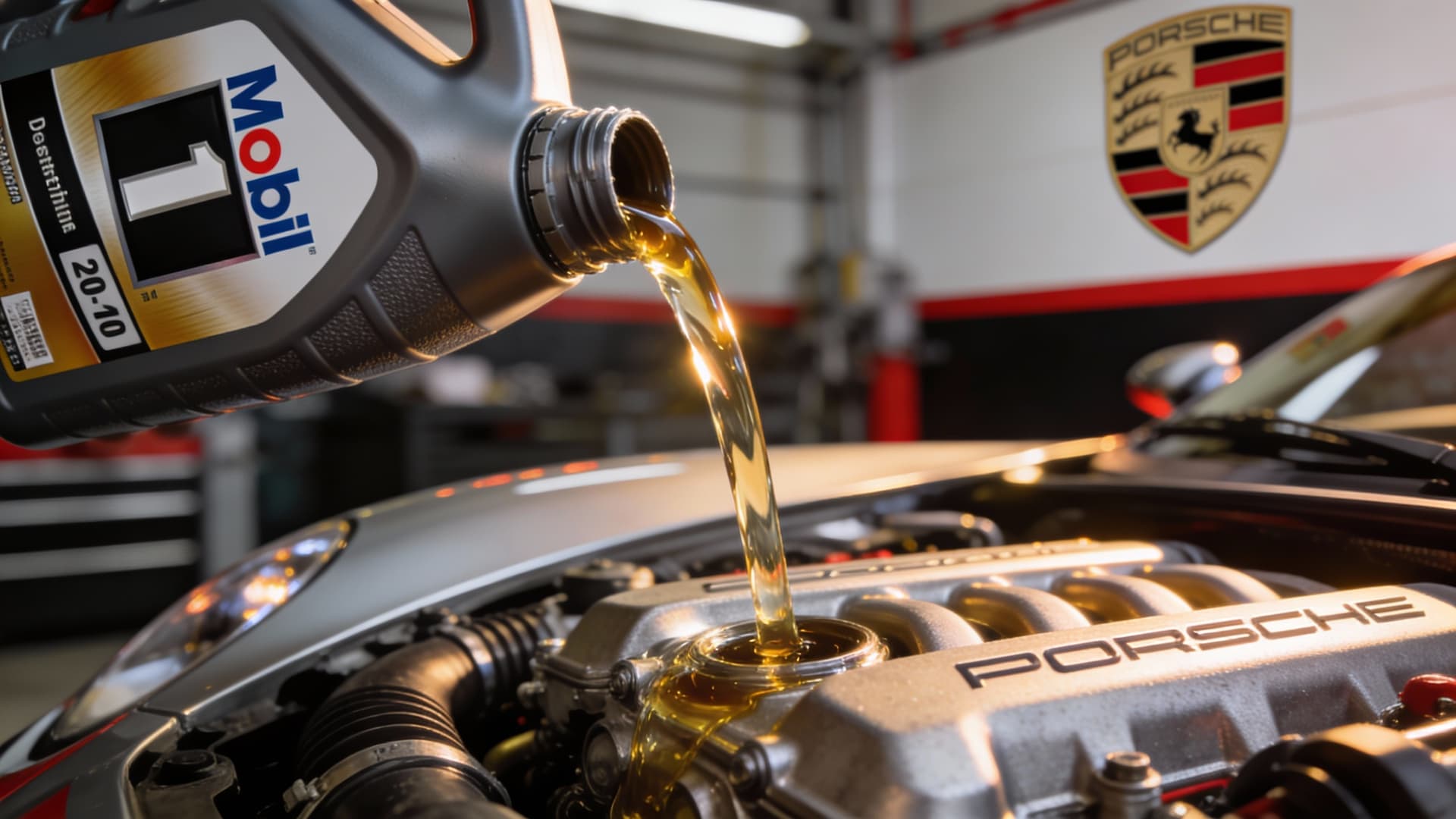
The Carrera GT requires Mobil 1 0W-40 or equivalent meeting Porsche A40 specifications. This isn't arbitrary brand loyalty—it's recognition that the V10 operates under conditions that most road car engines never experience.
The engine revs to 8,400 RPM and produces over 600 horsepower from 5.7 liters of displacement. Operating temperatures and pressures exceed what typical engines generate. The dry sump system circulates oil differently than conventional wet sump configurations. All of these factors mean the oil faces stresses that lesser lubricants cannot handle.
Wrong oil choices have consequences. At high RPM, inadequate oil fails to protect critical surfaces. Under sustained heat, improper formulations break down prematurely. During cold starts, wrong viscosity means momentary oil starvation. And because the V10 uses hydraulic components that depend on proper oil pressure and viscosity, wrong oil affects more than just engine wear—it affects how the entire engine operates.
The A40 specification exists because Porsche engineers understood what these engines require. Using anything less is gambling with an engine that costs six figures to rebuild.
The Dry Sump Difference
Most car owners never think about oil capacity because most cars hold four to six quarts. The Carrera GT holds approximately thirteen quarts—around 13.7 to be precise—split between the engine itself, the external oil tank, and the filter.
This substantial capacity exists because dry sump systems separate oil storage from the engine. A dedicated tank holds the bulk of the oil, with scavenge pumps continuously pulling oil from the engine's crankcase and returning it to the tank. The pressure pump then feeds oil from the tank back to the engine's lubrication points.
The advantages for performance are significant. The engine sits lower because there's no oil pan reservoir beneath the crankshaft. Oil pickup is reliable during hard cornering when conventional systems might starve. And the larger total capacity means the oil can better absorb and dissipate heat.
For service, though, this means considerably more oil to drain, more oil to purchase, and specific procedures to ensure the system is properly filled. The cost of materials alone runs a hundred fifty to a hundred eighty dollars just for the oil, before you add the filter and other consumables.
How Often the V10 Needs Fresh Oil
Porsche's factory recommendation calls for oil service every twelve thousand miles or twelve months, whichever comes first. That recommendation works for cars driven gently in ideal conditions.
Real-world Carrera GT use often demands shorter intervals. For street driving with occasional spirited runs, I recommend ten thousand miles or annually. For owners who regularly push their cars—canyon roads, track days, enthusiastic driving—seven thousand five hundred miles or annually makes more sense. For cars seeing regular track use, five thousand miles or after each track event protects the engine from the accelerated stress that racing conditions create.
Storage complicates the calculation. Oil sitting in an engine for months absorbs moisture and contaminants from condensation. Before putting a Carrera GT into storage, fresh oil provides clean lubricant that won't degrade while the car sits. After extended storage, another change removes any contamination that accumulated during dormancy.
Track use deserves special attention. A single track day subjects the engine to more stress than thousands of miles of street driving. Heat cycles, sustained high RPM operation, and continuous hard use break down oil chemistry faster than calendar time or street mileage would suggest. Owners who track their Carrera GTs should budget for frequent oil changes regardless of their street mileage.
What Proper Service Actually Involves
A correct Carrera GT oil service begins with warming the engine to operating temperature. Hot oil drains more completely and carries more suspended contaminants out with it. This isn't a step to skip—incomplete draining leaves old, degraded oil mixed with the fresh supply.
Draining the dry sump system requires attention to both the tank and the engine itself. The oil filter comes out and is replaced with OEM or equivalent specification parts. Drain plug seals—often overlooked—should be replaced to ensure proper sealing. The system is then refilled with measured quantities of fresh oil.
After refilling, the engine runs until oil circulates throughout the system. The level is then checked and adjusted. Visual inspection confirms no leaks at drain plugs, filter, or elsewhere. A basic diagnostic scan verifies no oil-related fault codes.
The entire process takes an hour and a half to two hours when done correctly. Rushing it risks incomplete draining, improper filling, or missed problems.
What Oil Service Costs
Parts for Carrera GT oil service run two hundred to two hundred sixty dollars: fourteen quarts of proper oil, an OEM filter, and drain plug seals. Labor at specialist rates—typically a hundred seventy-five to two hundred twenty-five dollars per hour—adds two hundred sixty to four hundred fifty dollars.
A basic oil service therefore runs five hundred to seven hundred dollars. Adding a comprehensive inspection pushes the cost to six to nine hundred. Annual service that includes more extensive checks and documentation typically runs eight hundred to twelve hundred.
These numbers surprise some owners accustomed to fifty-dollar oil changes on normal cars. The reality is that Carrera GT ownership costs what it costs. The oil alone costs more than a complete service on a Camry. Fighting this reality doesn't change it—it just creates deferred maintenance problems.
Understanding Oil Consumption
The Carrera GT's V10 consumes oil under normal operation. This is by design, not a defect.
With typical street driving, expect about a quart every three to four thousand miles. Spirited driving increases consumption to a quart every two to three thousand miles. Track use can consume a quart in a single day of running.
These numbers are normal. What's not normal is consumption exceeding a quart per fifteen hundred miles during typical use. That level suggests valve seal wear, piston ring issues, or external leaks that warrant investigation. But the engine's design accepts some oil consumption as the price of high-revving performance.
Monitor your oil level between services. Top off as needed with the same specification oil. And track your consumption to catch any sudden increases that might indicate developing problems.
The Value of Oil Analysis
For owners who want maximum insight into their engine's health, oil analysis provides valuable data. A sample of used oil, sent to a laboratory before being discarded, reveals what's happening inside the engine.
Metal content shows bearing wear, cylinder wall wear, and valve train condition. Contamination reveals whether coolant is leaking into oil passages or fuel is washing cylinder walls. Oil condition measurements show viscosity breakdown and oxidation levels. Additive depletion indicates whether the oil was changed soon enough.
For tracked cars, I recommend analysis at every oil change. For street-driven cars, every other change provides good trending data without excessive cost. Before and after storage, analysis confirms the oil handled the dormant period without excessive degradation.
The cost—thirty to fifty dollars per sample—is trivial compared to the insight provided. Catching a developing problem through oil analysis costs far less than waiting for the problem to become obvious through symptoms or failure.
Questions Owners Ask
Can you use synthetic blend oil instead of full synthetic? No. The Carrera GT requires full synthetic meeting A40 specifications. Blends don't provide adequate protection for this engine's operating conditions.
Should you change oil before or after storage? Both, ideally. Before storage, fresh oil removes contaminants that would sit and attack surfaces during dormancy. After storage exceeding six months, another change removes any condensation or degradation products that accumulated.
Is dealer service required? Absolutely not. Any qualified specialist with proper fluids and correct procedures can service the oil system. Many dealers actually lack Carrera GT-specific experience—they see too few of these cars to develop genuine expertise.
What about oil additives? We don't recommend aftermarket additives. Properly specified Mobil 1 0W-40 contains appropriate additive packages balanced by engineers who understand the chemistry. Additional additives can interfere with that balance, creating problems rather than solving them.
What We Do for Carrera GT Oil Service
At Repasi Motorwerks, our Carrera GT oil service includes complete drain and refill using proper specification oil, OEM filter replacement, drain plug seal replacement, level verification after running, leak inspection, and documentation for your records.
For annual service, we add comprehensive fluid checks across all systems, a basic diagnostic scan, multi-point inspection, and optional oil sample collection for laboratory analysis.
The oil coursing through that V10 is quite literally its lifeblood. Treat it accordingly.
Ready to schedule Carrera GT oil service? Contact Repasi Motorwerks in Stratford, Connecticut. We provide the careful, documented service your V10 deserves.
Schedule Carrera GT Oil Service