
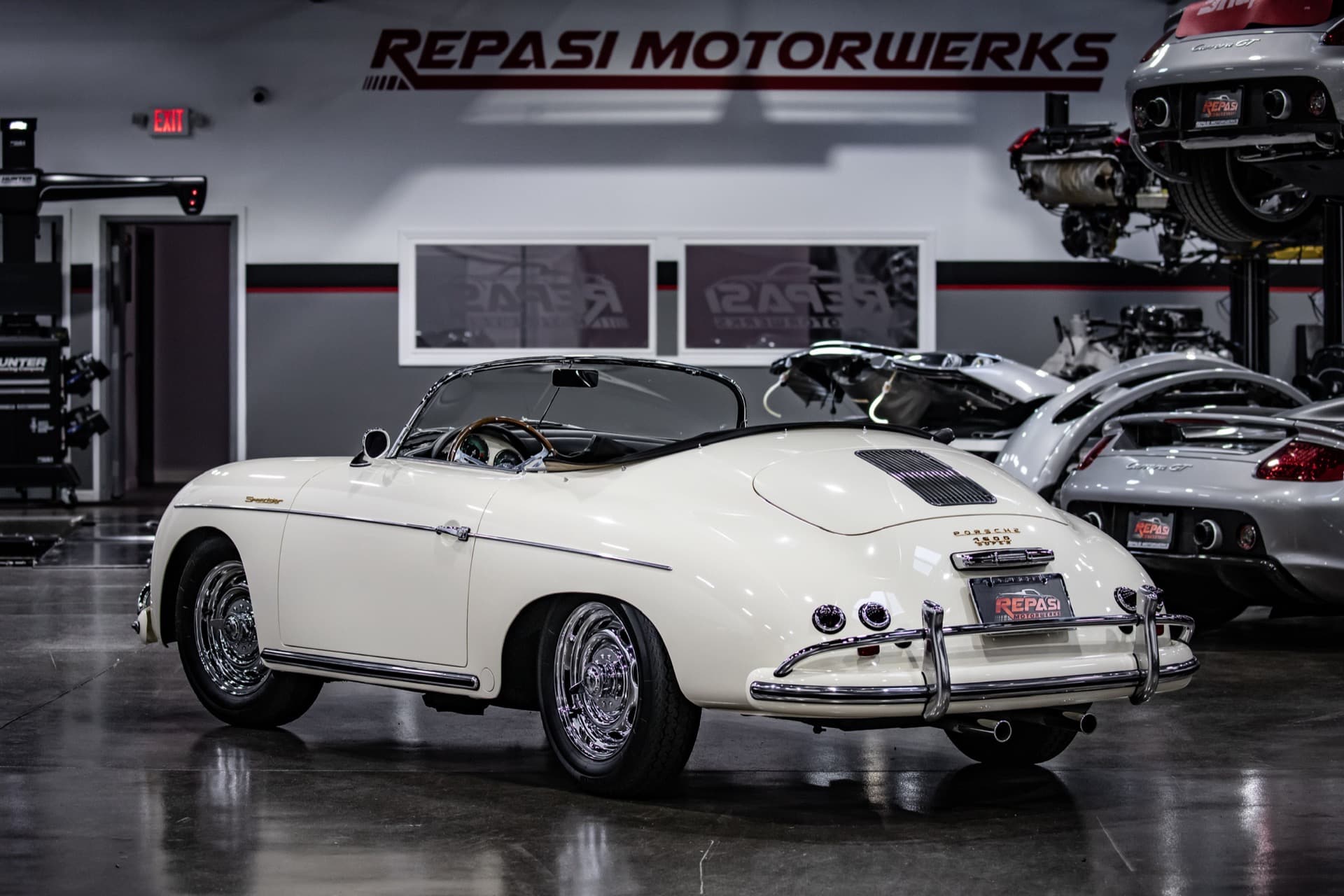
930 Turbo
Porsche 930 Turbo Service & Maintenance
The 930 Turbo was the car that changed everything—the widowmaker that defined supercar performance in the 1970s and 80s. These legendary machines demand respect and expertise. Our technicians understand both the legend and the reality of maintaining these air-cooled turbocharged icons.
Gold Meister Certified · PIWIS Factory Diagnostics · Stratford, CT
Our 930 Turbo Expertise
- All 930 Turbo years (1975-1989)
- 3.0L and 3.3L turbo engine expertise
- K-Jetronic fuel injection service
- Boost and wastegate calibration
- Whale tail and flat nose variants
930 Turbo Services We Provide
Turbo System Service
Turbocharger inspection, wastegate adjustment, and boost pressure verification. Oil feed line service.
Oil Service
Turbo-appropriate oil with proper viscosity for air-cooled operation. Turbo cool-down procedures.
K-Jetronic Service
CIS fuel injection diagnosis and adjustment. Warm-up regulator and fuel distributor service.
Cooling Service
Intercooler inspection and service. Oil cooler maintenance and thermostat operation.
Brake Service
Cross-drilled rotor service. Caliper rebuild and performance pad installation.
930 Turbo Major Services
In-depth service procedures for the most critical 930 Turbo maintenance and repair work.
Turbocharger Rebuild
Specialized
KKK K26 Turbocharger
The 930 Turbo uses a single KKK (Kühnle, Kopp & Kausch) K26 turbocharger feeding the 3.0L or 3.3L flat-six through a wastegate-controlled boost system. Stock boost pressure is approximately 0.8 bar (11.6 psi). The turbo bearings are oil-fed from the engine's lubrication system, and because the 930 is air-cooled, there is no water cooling for the turbo housing — making proper cool-down procedures absolutely critical. Shutting down a hot 930 Turbo without allowing the turbo to cool causes oil coking in the bearing housing, which is the primary cause of turbo failure.
- KKK K26 turbocharger with approximately 0.8 bar (11.6 psi) stock boost pressure
- Oil-cooled bearings only — no water cooling jacket like modern turbos
- Cool-down procedure critical: idle for 2-3 minutes after hard driving before shutdown to prevent oil coking
- Turbo timer installation recommended for owners who may forget the cool-down procedure
Rebuild Process
Turbo rebuild involves removing the K26 unit, disassembling the center cartridge, inspecting shaft and bearings for wear, and reassembling with new bearings, seals, and thrust components. The compressor and turbine wheels are inspected for blade damage and shaft play is measured. The wastegate actuator is tested and recalibrated to ensure proper boost cutoff. We work with turbo rebuild specialists who maintain OEM specifications for the K26.
- Center cartridge disassembly: shaft, bearings, thrust collar, and seals all inspected and replaced
- Compressor and turbine wheel inspection: blade erosion, tip contact, and balance verified
- Wastegate actuator: diaphragm and spring tested — recalibrated to factory boost specification
- Oil feed and return lines replaced during turbo service — restricted lines are the primary turbo failure enabler
Engine Rebuild & Boost System
Engine-Out
3.0L vs 3.3L Turbo Engines
The 930 Turbo was produced with two engine displacements: the 3.0L (1975-1977) producing approximately 260 hp, and the 3.3L (1978-1989) producing approximately 300 hp with the addition of an air-to-air intercooler. The 3.3L engine uses larger cylinders and pistons with lower compression ratio to accommodate boost. Both engines use Nikasil-coated cylinders, forged pistons, and heavy-duty connecting rods designed for forced induction. Rebuild involves the same fundamental air-cooled procedure with turbo-specific considerations: lower compression ratio pistons, boost-rated head gaskets, and attention to the oil feed system for the turbocharger.
- 3.0L (1975-1977): no intercooler, higher compression, approximately 260 hp — the original 930 configuration
- 3.3L (1978-1989): intercooled, lower compression, approximately 300 hp with improved mid-range torque
- Forged pistons and heavy-duty connecting rods designed for forced-induction duty in both variants
- Nikasil cylinder coatings inspected: cylinder bore measurement and crosshatch pattern assessment
K-Jetronic CIS Overhaul
Specialized
CIS on the 930 Turbo
The 930 Turbo uses the Bosch K-Jetronic Continuous Injection System (CIS) with boost-enrichment modifications specific to the turbocharged application. The CIS system must deliver more fuel under boost conditions, which is managed by a frequency valve and warm-up regulator calibrated for the turbo engine. System pressure specification is approximately 5.0-5.4 bar, with control pressure varying based on engine temperature. Diagnosing CIS issues on a turbo car requires understanding both the base CIS operation and the boost enrichment modifications.
- Fuel distributor: the heart of the CIS system — controls fuel quantity to each injector based on airflow
- Warm-up regulator: controls mixture enrichment during cold start — specific calibration for turbo application
- Frequency valve (turbo-specific): provides additional fuel enrichment under boost — critical for safe WOT operation
- System pressure tested with CIS gauge set: line pressure, control pressure, and residual pressure all measured
Cooling & Intercooler Service
System
Air-Cooled Turbo Thermal Management
The 930 Turbo relies entirely on air and oil cooling — there is no liquid engine cooling system. The engine oil carries a significant portion of the heat load, making oil cooler condition and oil quality critical. The 3.3L models (1978+) add an air-to-air intercooler mounted above the engine in the rear deck, which reduces charge air temperature before it enters the engine. Intercooler efficiency directly affects power output and detonation resistance. The cooling fan must operate at full efficiency, and all cooling tin must be in place to direct airflow properly.
- Oil cooler: the primary heat management component — fin condition and airflow must be unobstructed
- Intercooler (3.3L): air-to-air unit inspected for fin damage, internal debris, and boost leaks at connections
- Engine cooling fan: belt tension, fan condition, and thermostat operation verified
- Cooling tin: all ducting in place and properly sealed to direct airflow over cylinders and heads
Transmission & Drivetrain Service
Specialized
930 Transmission Variants
Early 930 Turbos (1975-1988) use a four-speed gearbox (Type 930/36) — Porsche felt the turbo's torque made five speeds unnecessary. The final-year 1989 930 Turbo received the five-speed G50/52 gearbox, making it highly desirable among collectors. The four-speed gearbox is robust but synchro wear is common after decades of use. The limited-slip differential is standard equipment and requires specific GL-5 gear oil and periodic clutch pack inspection.
- Four-speed 930/36 (1975-1988): robust design with synchro wear common on 2nd gear after heavy use
- Five-speed G50/52 (1989 only): highly desirable — same rebuild procedures as 964 G50 gearbox
- Limited-slip differential: clutch pack inspection and specific GL-5 fluid required
- Drivetrain mounts: transmission and axle mounts deteriorate — causes clunking and vibration under load
Common 930 Turbo Issues & Solutions
Every model has its common issues. Here's what we see and how we address them.
Turbo Lag Management
Proper driving technique education. Wastegate adjustment for optimal response.
Heat Soak
Cool-down procedures before shutdown. Turbo timer installation for protection.
Boost Creep
Wastegate inspection and adjustment. Boost controller calibration when equipped.
Oil Consumption
Valve guide and seal service. Turbo seal inspection for oil migration.
930 Turbo Service Intervals
Factory-recommended maintenance schedule to keep your 930 Turbo performing at its best.
Every 3,000 miles
- Oil and filter change (critical for turbo)
- Boost system inspection
- Visual leak check
- Tire rotation
Every 12,000 miles
- Spark plugs
- Air filter
- Fuel filter
- Valve adjustment
Every 24,000 miles
- Transmission fluid
- Differential fluid
- Turbocharger inspection
- Complete chassis service
Why Your 930 Turbo Needs a Specialist
The 930 Turbo is not a car for general mechanics. The combination of air-cooled engine, early turbocharging technology, and CIS fuel injection requires specific knowledge that comes only from experience. Our technicians have maintained these cars for decades and understand their unique character.
930 Turbo Service FAQs
- How reliable is the Porsche 930 Turbo?
- The 930 is mechanically robust when maintained, but the single-turbo design with significant turbo lag demands respect from the driver. Mechanically, the K27 turbocharger is extremely durable and rarely needs replacement under 100,000 miles. Common issues include wastegate diaphragm failure, boost hose leaks, CIS warm-up regulator problems, and oil leaks from the engine case and valve covers. With proper maintenance, the 930 is a reliable performer.
- How much does a 930 turbocharger rebuild cost?
- Rebuilding the KKK K27 turbocharger on a 930 typically costs between $1,500 and $3,000. The rebuild includes new bearings, seals, a balanced turbine assembly, and inspection of the compressor and turbine wheels for blade damage. New-old-stock and aftermarket replacement turbos are also available but range from $3,000 to $5,000. A wastegate rebuild at the same time adds approximately $400 to $600.
- What is K-Jetronic CIS and does it need special service?
- K-Jetronic Continuous Injection System is the mechanical fuel injection used on the 930 Turbo. Unlike modern electronic fuel injection, CIS uses fuel pressure and a mechanical fuel distributor to meter fuel to each cylinder. Service requires cleaning or rebuilding the fuel distributor, checking the control pressure regulator, testing the air flow sensor plate, and verifying system pressure with specialized gauges. Many drivability issues on the 930 stem from CIS problems rather than ignition faults.
- How often should I change the oil in my 930 Turbo?
- Oil changes every 3,000 to 5,000 miles with a high-quality 15W-50 or 20W-50 synthetic oil is recommended for the 930. The turbocharger adds significant thermal stress to the oil, and the air-cooled engine already runs hotter than water-cooled designs. Using a turbo timer or allowing the engine to idle for 60 seconds before shutdown helps prevent oil coking in the turbo bearing housing.
- What cooling system upgrades help the 930 Turbo?
- The 930's factory intercooler is effective for stock boost levels but becomes a bottleneck with performance modifications. Upgraded intercooler options include larger air-to-air units that fit in the whale tail or side-mount air-to-water systems. Upgraded engine oil coolers with thermostatic control help maintain consistent oil temperatures during spirited driving. Additional fender-mounted oil coolers are a popular vintage racing modification.
Ready to Schedule Your 930 Turbo Service?
Contact us today to schedule your appointment. Our Gold Meister certified technicians are ready to provide factory-level care for your Porsche 930 Turbo.
930 Turbo Service Areas
We serve 930 Turbo owners across CT, NY, NJ, MA, and PA.