918
Porsche 918 Spyder Service & Maintenance
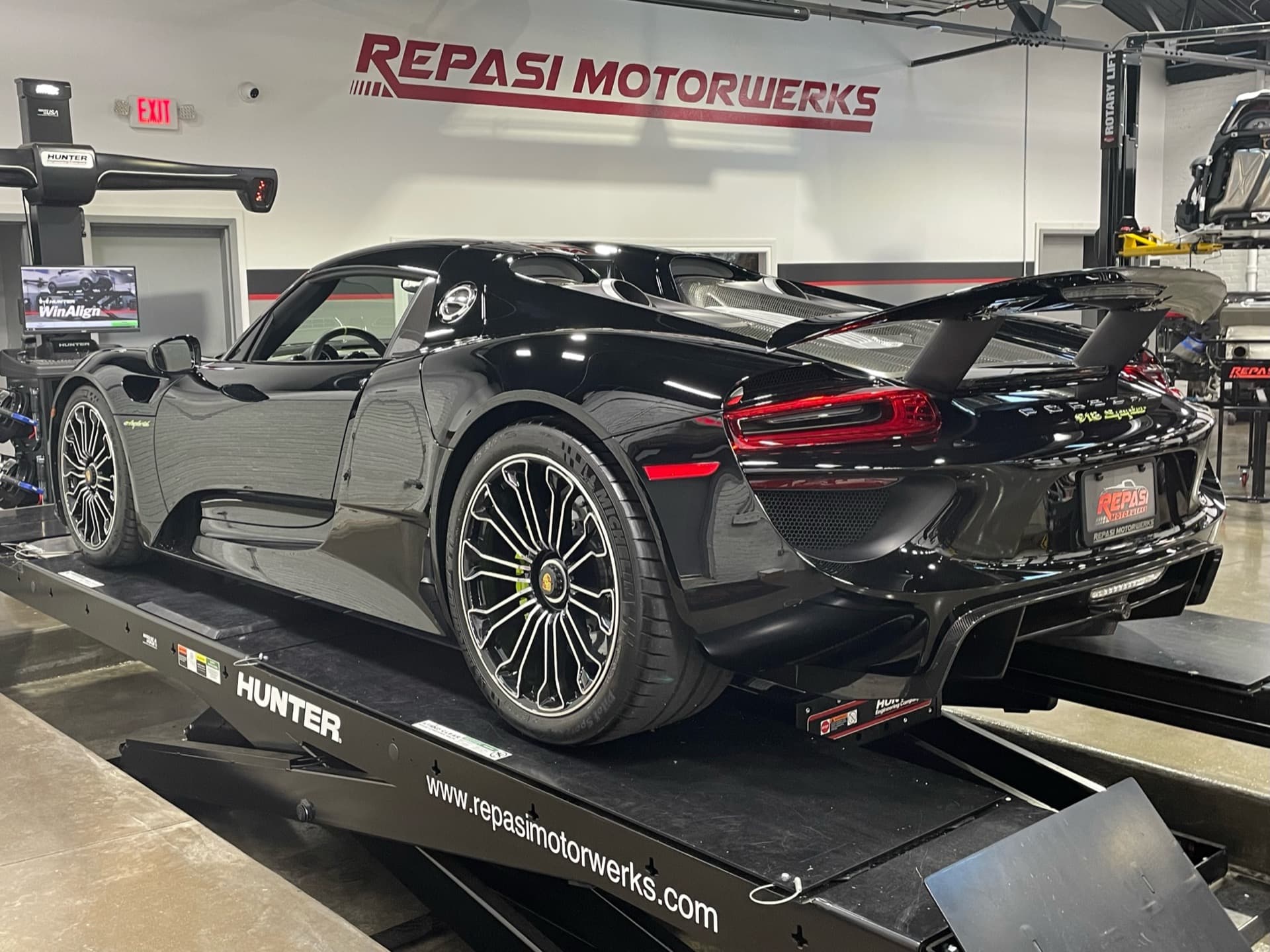
The 918 Spyder represents the pinnacle of Porsche engineering—a V8 hybrid hypercar that defined a generation. At Repasi Motorwerks, we're one of the few independent specialists qualified to maintain these extraordinary machines. Our technicians understand both the high-strung naturally aspirated V8 and the sophisticated hybrid systems.
Gold Meister Certified · PIWIS Factory Diagnostics · Stratford, CT
Our 918 Expertise
- One of few independent 918-qualified shops
- 4.6L V8 and hybrid system expertise
- Weissach Package specialists
- High-voltage hybrid system certified
- PIWIS factory diagnostics required for 918
918 Services We Provide
Annual Service
Comprehensive inspection of V8 and hybrid systems. Oil change, brake inspection, and battery health monitoring.
Brake Service
PCCB carbon ceramic brake inspection and pad replacement. Regenerative braking system calibration.
Hybrid Battery Service
High-voltage battery health monitoring, cooling system maintenance, and cell balancing.
Suspension Service
Active suspension system inspection. Magnesium component care for Weissach models.
PDK Service
Seven-speed PDK transmission fluid and filter service. E-motor integration inspection.
918 Major Services
In-depth service procedures for the most critical 918 maintenance and repair work.
High-Voltage Battery Service
Specialized
918 Battery Architecture
The 918 Spyder uses a 6.8 kWh lithium-ion battery pack operating at approximately 312 volts nominal. The battery is liquid-cooled through a dedicated cooling circuit separate from the V8 engine cooling. Battery health monitoring involves checking individual cell voltages for balance, measuring total capacity against the original specification, and inspecting the cooling system for proper flow and temperature regulation. As a limited-production hypercar, battery module availability requires advance sourcing — we coordinate parts logistics well before service begins.
- 6.8 kWh lithium-ion pack at 312V nominal with dedicated liquid cooling circuit
- Cell balancing procedure performed through PIWIS to equalize voltage across all modules
- Capacity testing measures usable energy against factory specification to quantify degradation
- High-voltage safety procedures: full HV disconnect, insulation resistance testing, and PPE protocol required for any battery access
Cooling System and Thermal Management
The 918's battery cooling circuit uses a non-conductive coolant to prevent electrical hazards. The circuit includes a dedicated radiator, electric pump, and temperature sensors that feed data to the Battery Management System (BMS). Degraded cooling performance leads to thermal throttling that reduces electric motor output and can accelerate cell degradation. We inspect the entire cooling loop during battery service, including the pump, radiator core, coolant lines, and temperature sensor accuracy.
- Non-conductive coolant specific to HV battery circuits — standard engine coolant cannot be used
- Electric pump flow rate tested to verify adequate circulation at all operating temperatures
- Radiator core inspected for debris, damage, and airflow restriction
- BMS fault code review via PIWIS to identify any historical thermal events or cell imbalance warnings
V8 Engine-Out Inspection
Engine-Out
The 918 V8: Racing-Derived Powerplant
The 918's 4.6-liter naturally aspirated V8 is derived from the RS Spyder LMP2 racing engine. It produces 608 horsepower at a 9,150 RPM redline — one of the highest-revving production V8s ever made. The engine uses a flat-plane crankshaft, dry-sump lubrication with multiple scavenge stages, and a top-exit exhaust system. Engine-out inspection is recommended at scheduled intervals or when the car reaches mileage milestones, allowing full assessment of the timing system, valve train, dry-sump oil system, and all sealing surfaces that are inaccessible with the engine installed.
- Flat-plane crank V8 with 9,150 RPM redline requires precise valve train clearances and timing chain condition assessment
- Dry-sump system: oil tank inspection, scavenge pump condition, and oil line integrity verification
- Top-exit exhaust system: heat shielding inspection and manifold gasket condition
- Engine mount assessment: high-RPM vibration and hybrid system torque loads stress the mounting points
Integrated Hybrid System Access
Removing the 918's V8 provides access to the rear electric motor (95 kW) that is integrated with the seven-speed PDK transmission. This motor drives the rear wheels in conjunction with or independently of the V8. During engine-out service, we inspect the e-motor mounting, cooling connections, and high-voltage wiring harness for any signs of deterioration, chafing, or thermal damage. The PDK transmission itself is inspected for fluid condition and clutch wear values are read through PIWIS.
- Rear e-motor (95 kW) mounting and coupling inspection at the PDK interface
- High-voltage wiring harness routed through the engine bay inspected for chafe points and connector integrity
- PDK fluid condition assessed and clutch pack adaptation values read through PIWIS
- All engine bay cooling line connections inspected and replaced if deterioration is found
Hybrid Cooling System Overhaul
System
Multiple Cooling Circuits
The 918 Spyder uses separate cooling circuits for the V8 engine, front electric motor (115 kW), rear electric motor, battery pack, and power electronics. Each circuit has its own coolant specification, pump, and radiator. The V8 circuit uses standard engine coolant, while the battery and power electronics circuits require non-conductive coolant to prevent electrical faults. A complete cooling overhaul addresses all circuits simultaneously, replacing coolant, inspecting pumps and radiators, and verifying temperature sensor accuracy across the entire thermal management system.
- V8 engine circuit: conventional coolant with water pump, thermostat, and front-mounted radiators
- Battery cooling circuit: non-conductive coolant with electric pump and dedicated radiator
- Front e-motor cooling: separate circuit managing the 115 kW motor that drives the front axle
- Power electronics cooling: inverter and DC-DC converter thermal management with its own coolant loop
Service Procedure
Cooling system service on the 918 requires PIWIS factory diagnostics to run pump activation tests, read temperature sensor data, and perform air bleed procedures on each circuit independently. We vacuum-fill each circuit to eliminate air pockets that can cause hot spots and reduced cooling performance. Every hose connection is inspected for security and condition, and the coolant expansion tanks are checked for level and pressurization integrity.
- Each cooling circuit flushed and vacuum-filled independently with the correct coolant specification
- PIWIS-controlled pump activation tests verify flow rate in each circuit
- Temperature sensor cross-check: comparing sensor readings against infrared measurements for accuracy
- Coolant hose and connector condition assessed at every junction point in the system
PCCB Brake Service
Specialized
918 Brake System Specifics
The 918 uses Porsche Carbon Ceramic Brakes (PCCB) with regenerative braking integration. The brake-by-wire system blends regenerative braking (recovering energy to the battery) with conventional hydraulic friction braking. This system requires PIWIS calibration after any brake hardware service to ensure proper regen/friction blending. The PCCB rotors and pads follow similar inspection criteria to other Porsche PCCB systems, but the regenerative system adds diagnostic complexity.
- Brake-by-wire system blends regenerative and friction braking — PIWIS recalibration required after pad or rotor service
- PCCB ceramic rotors inspected for thermal cracking, delamination, and thickness wear
- Pad compound must be compatible with ceramic rotors — incorrect compounds damage the rotor surface
- Regenerative braking system health verified through PIWIS: regen torque output, motor function, and energy recovery efficiency
PDK & E-Motor Integration Service
Specialized
918 Hybrid Drivetrain
The 918's drivetrain integrates a seven-speed PDK transmission with a 95 kW rear electric motor and a 115 kW front electric motor for all-wheel drive. The PDK manages both the V8 power and the rear e-motor torque through the same clutch packs. The front e-motor drives the front axle directly, providing torque vectoring capability and pure-electric front-wheel drive in E-Drive mode. Five drive modes (E-Drive, Hybrid, Sport Hybrid, Race Hybrid, Hot Lap) each recalibrate the power split and shift strategy.
- Seven-speed PDK fluid and filter service at factory intervals — shared lubrication with the rear e-motor coupling
- Front e-motor: direct drive to front axle with its own cooling circuit and power electronics
- Drive mode calibration verified through PIWIS — each mode adjusts torque split, shift points, and regen strategy
- High-voltage connector inspection at all motor-to-inverter junction points
What Distinguishes 918 Drivetrain Service
Unlike conventional PDK service, the 918 requires simultaneous attention to mechanical transmission components and electric motor integration. Clutch pack wear is influenced by both V8 torque delivery and e-motor torque assist. Software updates affect how power is distributed across all three power sources. Every drivetrain service includes a PIWIS software version check to ensure the hybrid control system is running the latest calibration.
- Clutch wear values read through PIWIS account for both V8 and e-motor torque contributions
- Software version verification and update to latest hybrid calibration during every service
- E-motor insulation resistance testing to verify electrical isolation of high-voltage components from the chassis
- Driveshaft and CV joint inspection for the front axle drive system
Common 918 Issues & Solutions
Every model has its common issues. Here's what we see and how we address them.
High-Voltage Battery Degradation
Regular battery health monitoring. Cell balancing and cooling system maintenance.
Cooling System Complexity
Multiple cooling circuits require careful attention. Coolant flush with proper procedures.
Software Updates Required
Regular PIWIS connection for software updates essential for hybrid system optimization.
PCCB Rotor Wear
Carbon ceramic brake inspection for thermal cracking. Rotor replacement when indicators show.
918 Service Intervals
Factory-recommended maintenance schedule to keep your 918 performing at its best.
Annual / 6,000 miles
- Oil and filter change
- Hybrid system health check
- Brake inspection
- Software updates
- Multi-point hypercar inspection
Every 2 years / 12,000 miles
- Spark plugs
- Brake fluid flush
- High-voltage system inspection
- Battery cell balancing
Every 4 years / 24,000 miles
- All coolant circuits flush
- PDK fluid and filter
- Complete suspension inspection
- Comprehensive hybrid system service
Why Your 918 Needs a Specialist
The 918 Spyder is not a car for general mechanics. With a naturally aspirated V8 producing over 600 horsepower combined with dual electric motors and sophisticated battery technology, it requires technicians who understand both traditional high-performance engines and modern hybrid systems. We're honored to maintain these rolling works of art.
918 Service FAQs
- Where can I get my Porsche 918 Spyder serviced?
- The 918 Spyder requires a facility with Porsche-certified high-voltage training, PIWIS III diagnostic capability, and experience with the hybrid V8 drivetrain. Only a handful of independent shops have the necessary training and equipment. The high-voltage battery system operates at over 300 volts, making it critical that technicians follow proper lockout/tagout safety procedures.
- How long does the 918 Spyder hybrid battery last?
- The lithium-ion battery pack is designed to last the life of the vehicle under normal conditions, but real-world longevity depends on climate, charging habits, and storage. After 8 to 10 years, some degradation in electric-only range is normal. A full battery health assessment includes cell voltage balancing analysis, coolant flow testing through the dedicated battery cooling circuit, and capacity measurement against original factory specifications.
- What is the service interval for a Porsche 918 Spyder?
- Porsche recommends annual service or every 10,000 miles, whichever comes first. This includes engine oil and filter change, hybrid system diagnostic scan, brake fluid check, and a multi-point inspection of the cooling circuits. The 918 has three separate cooling loops — one for the V8 engine, one for the electric motors, and one for the battery pack — all of which must be checked independently.
- How much does Porsche 918 Spyder maintenance cost?
- Annual maintenance costs for a 918 typically range from $3,000 to $6,000 for routine service. Major services like PCCB brake replacement, hybrid battery conditioning, or engine-out inspections can run significantly higher. The rarity of the car (only 918 produced) means parts availability can be limited, and lead times for certain components may extend to several months.
- Can the 918 Spyder electric motors be serviced independently?
- Yes, the front and rear electric motors can be diagnosed and serviced separately from the V8 engine. The front axle motor provides additional traction and regenerative braking, while the rear motor is integrated with the PDK transmission. Both units require PIWIS III diagnostics for fault code reading and performance verification, and the high-voltage system must be properly isolated before any physical work is performed.
Ready to Schedule Your 918 Service?
Contact us today to schedule your appointment. Our Gold Meister certified technicians are ready to provide factory-level care for your Porsche 918 Spyder.
918 Service Areas
We serve 918 owners across CT, NY, NJ, MA, and PA.