356
Porsche 356 Service & Maintenance
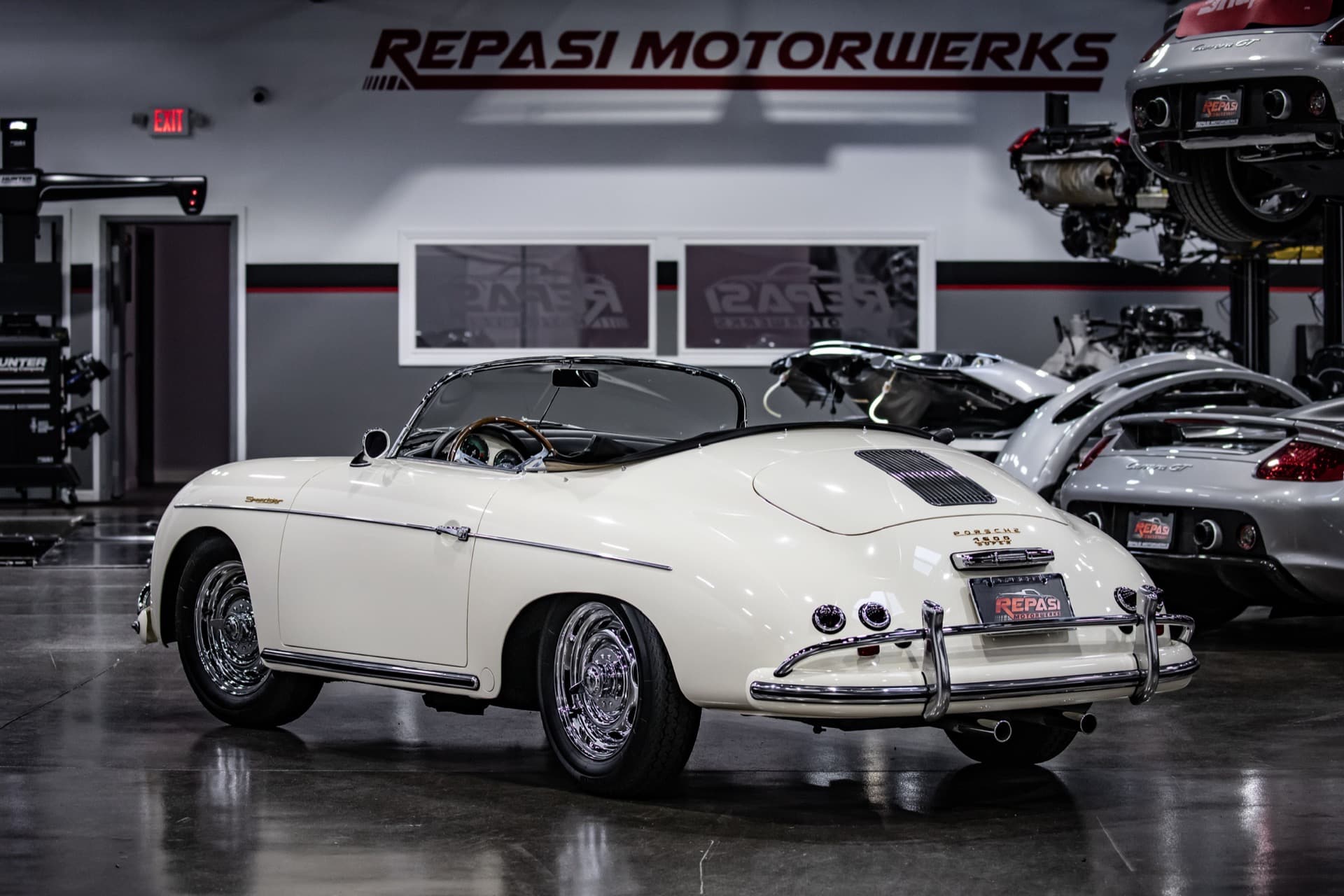
The 356 started it all—Ferdinand Porsche's vision of a lightweight sports car that would become a legend. At Repasi Motorwerks, we treat every 356 with the reverence it deserves, whether a barn-find project or a concours-winning Speedster.
Gold Meister Certified · PIWIS Factory Diagnostics · Stratford, CT
Our 356 Expertise
- Pre-A through 356C expertise
- Speedster and Convertible D specialists
- Carrera four-cam engine service
- Matching-numbers preservation
- Full restoration capabilities
356 Services We Provide
Engine Service
Pushrod and roller-bearing engine maintenance. Valve adjustment, oil service, and compression testing.
Transmission Service
Synchromesh and non-synchro gearbox service. Shift linkage adjustment and fluid changes.
Brake Service
Drum brake service and adjustment. Master cylinder and wheel cylinder rebuilds.
Electrical Service
6-volt system diagnosis and repair. Generator and regulator service. Wiring restoration.
Fuel System Service
Zenith and Solex carburetor rebuild. Fuel pump service and tank cleaning.
356 Major Services
In-depth service procedures for the most critical 356 maintenance and repair work.
Engine Rebuild (Pushrod & Four-Cam)
Engine-Out
356 Engine Types
The 356 used several engine variants across its production run. The vast majority are pushrod flat-fours (Type 546, 616, and 692 series) ranging from 1.1L to 1.6L displacement. The rare and valuable Carrera models used the Type 547 four-cam (Fuhrmann) engine — a dual-overhead-cam racing-derived design with roller-bearing crankshaft that produces significantly more power but is far more complex to service. A 356 engine rebuild requires period-correct knowledge of bearing types (plain vs roller), case designs, and assembly procedures specific to the era.
- Pushrod engines (Type 616/546): plain bearing crankshaft, removable cylinders, and simple valve train — robust and rebuildable
- Four-cam Carrera engines (Type 547): roller-bearing crankshaft, DOHC per bank, shaft-driven camshafts — requires specialist knowledge
- Case half machining: bearing saddle alignment and case register fit verified during every rebuild
- Cylinder and piston fit: proper piston-to-cylinder clearance is critical — new pistons and cylinders matched as sets
Rebuild Standards
A proper 356 engine rebuild follows the same fundamental principles as later air-cooled rebuilds but with era-specific considerations. Bearing clearances, cylinder sealing, and valve train geometry must be set to the original specification for the engine type. We use period-correct gasket materials and hardware where possible, and document every measurement for the car's records. For matching-numbers cars, the original case and crankshaft are retained and machined to specification rather than replaced.
- Crankshaft inspection: journal grinding and polishing to factory undersize specifications if worn
- Camshaft inspection: lobe profile measured against specification — reground or replaced if worn
- Oil pump: early pumps inspected for gear wear — pump capacity affects oil pressure at operating temperature
- Assembly documentation: every measurement recorded for the car's provenance file
Transmission Rebuild
Specialized
356 Gearbox Variants
The 356 used several transmission designs. Early Pre-A models used non-synchronized (crash-box) gearboxes that require double-clutching for smooth shifts. Later 356A, B, and C models used fully synchronized four-speed gearboxes. The synchronized transmissions share their basic architecture with early 911 gearboxes. Rebuild involves disassembly, synchro ring replacement (on synchronized models), bearing replacement, and reassembly with proper shimming for correct gear engagement.
- Non-synchro gearboxes (Pre-A): gear dog engagement surfaces inspected and lapped if damaged
- Synchronized gearboxes (356A/B/C): brass synchro ring replacement for smooth shifting
- Main shaft and cluster shaft bearings replaced with correct-specification replacements
- Shift fork inspection: worn forks cause imprecise engagement and pop-out of gear
Drum Brake Restoration
Specialized
356 Braking Systems
All 356 models use drum brakes — an important distinction from later Porsches. Drum brake service requires specific expertise that differs entirely from disc brake work. The drums must be measured for roundness and diameter (out-of-round drums cause pulsation), brake shoes must be arced to match the drum diameter for full contact, and the wheel cylinders must be rebuilt or replaced to ensure consistent hydraulic pressure. The master cylinder is a single-circuit design — any failure means complete loss of braking.
- Drum measurement: diameter and roundness verified — drums machined or replaced if out of specification
- Brake shoe arcing: shoes arced to match the specific drum diameter for maximum contact area
- Wheel cylinder rebuild: rubber seals replaced, bore honed if pitted — leaking cylinders cause brake fade
- Master cylinder rebuild: single-circuit design means complete brake loss if master cylinder fails — regular inspection essential
Carburetor Rebuild & Fuel System
Specialized
356 Fuel System Components
356 models use mechanical fuel pumps and carburetors — either Zenith 32 NDIX or Solex 40 PII depending on model and year. Carburetor rebuild involves complete disassembly, ultrasonic cleaning, replacement of all gaskets, float valve, and accelerator pump diaphragm, and re-jetting to the correct specification for the engine type and altitude. Proper carburetor synchronization between the two barrels (or two carburetors on dual-carb setups) is essential for smooth running and even cylinder fueling.
- Zenith 32 NDIX: single-throat carburetor used on standard 356 models — jet sizes specific to engine displacement
- Solex 40 PII: twin-throat carburetor used on later and higher-output 356 models
- Float level setting: incorrect float level causes rich or lean running — set with precision gauge
- Accelerator pump diaphragm: deteriorated diaphragm causes hesitation on acceleration — replaced during rebuild
Electrical System Restoration (6V)
System
6-Volt System Challenges
356 models use a 6-volt electrical system with a generator (not alternator) and mechanical voltage regulator. The 6-volt system provides less electrical capacity than modern 12-volt systems, making proper component condition critical. The generator must be in good condition to provide adequate charging, the voltage regulator must maintain correct output, and all wiring connections must be clean and tight — any resistance in a 6-volt system has double the impact on voltage drop compared to 12-volt systems.
- Generator output test: verify charging rate at idle and above — generators are rebuildable with new brushes and bearings
- Voltage regulator: mechanical points-style regulator requires periodic adjustment — electronic replacements available as reversible upgrades
- Wiring harness: original cloth-wrapped wiring deteriorates — inspection for chafe, corrosion, and brittle insulation
- 6V to 12V conversion available as a reversible modification for improved lighting and starter performance
Common 356 Issues & Solutions
Every model has its common issues. Here's what we see and how we address them.
Rust (Body and Pan)
Floor pan and battery box repair. Rocker and longitudinal structural restoration.
Carburetor Issues
Complete carburetor rebuild with proper jetting. Linkage adjustment for smooth operation.
Generator Failure
Generator rebuild or replacement. Regulator service and charging system diagnosis.
Wheel Bearing Wear
Front wheel bearing replacement. King pin and link pin service on early models.
356 Service Intervals
Factory-recommended maintenance schedule to keep your 356 performing at its best.
Every 1,500-3,000 miles
- Oil change (non-detergent for older engines)
- Valve adjustment check
- Brake adjustment
- Lubrication service
Every 6,000 miles
- Spark plugs
- Points and condenser
- Fuel filter
- Complete inspection
Every 12,000 miles
- Transmission fluid
- Brake fluid flush
- Wheel bearing repack
- Comprehensive service
Why Your 356 Needs a Specialist
356s are increasingly valuable and increasingly rare. They require technicians who understand pre-war engineering philosophies, can work with 6-volt electrical systems, and appreciate the craftsmanship of hand-built sports cars. We're honored to help preserve these pieces of automotive history.
356 Service FAQs
- How do I find a qualified mechanic for my Porsche 356?
- The 356 requires a shop with experience in vintage Porsche engines, specifically the pushrod flat-four and the rare four-cam Carrera engine. Key qualifications include familiarity with 6-volt electrical systems, Solex or Zenith carburetor tuning, and drum brake setup. The 356 community is small and knowledgeable — the 356 Registry is an excellent resource for finding reputable specialists in your region.
- What is the service interval for a Porsche 356?
- Original factory recommendations called for service every 3,000 miles, which reflected 1950s oil technology. With modern synthetic-compatible oils, most specialists recommend oil changes every 3,000 to 5,000 miles, valve adjustments every 6,000 miles, and a comprehensive inspection annually. Points ignition systems require adjustment every 6,000 miles unless upgraded to an electronic ignition conversion.
- How much does a Porsche 356 engine rebuild cost?
- A standard pushrod flat-four rebuild ranges from $8,000 to $15,000 depending on the engine variant and condition. The rare four-cam Carrera engine can cost $30,000 to $50,000 or more to rebuild due to the complexity of the dual-overhead-cam design and the scarcity of correct parts. Machine work on the magnesium case halves requires specialized knowledge to avoid cracking the material.
- Should I convert my 356 from 6-volt to 12-volt electrical?
- A 12-volt conversion improves headlight brightness, starter cranking power, and the ability to run modern accessories. However, it reduces originality, which affects value on concours-quality cars. For a driver-quality 356, a 12-volt conversion using a period-correct-looking alternator is a practical upgrade. For show cars, restoring the original 6-volt generator system to proper specification preserves authenticity and value.
- What drum brake maintenance does a 356 require?
- The 356's drum brakes require periodic adjustment for proper pedal feel and even stopping. Service includes inspecting shoe lining thickness, adjusting star wheel adjusters, cleaning drum surfaces, inspecting wheel cylinders for leaks, and lubricating the backing plate contact points. The hydraulic brake fluid should be flushed annually since the 356 system is particularly sensitive to moisture contamination.
Ready to Schedule Your 356 Service?
Contact us today to schedule your appointment. Our Gold Meister certified technicians are ready to provide factory-level care for your Porsche 356.
356 Service Areas
We serve 356 owners across CT, NY, NJ, MA, and PA.