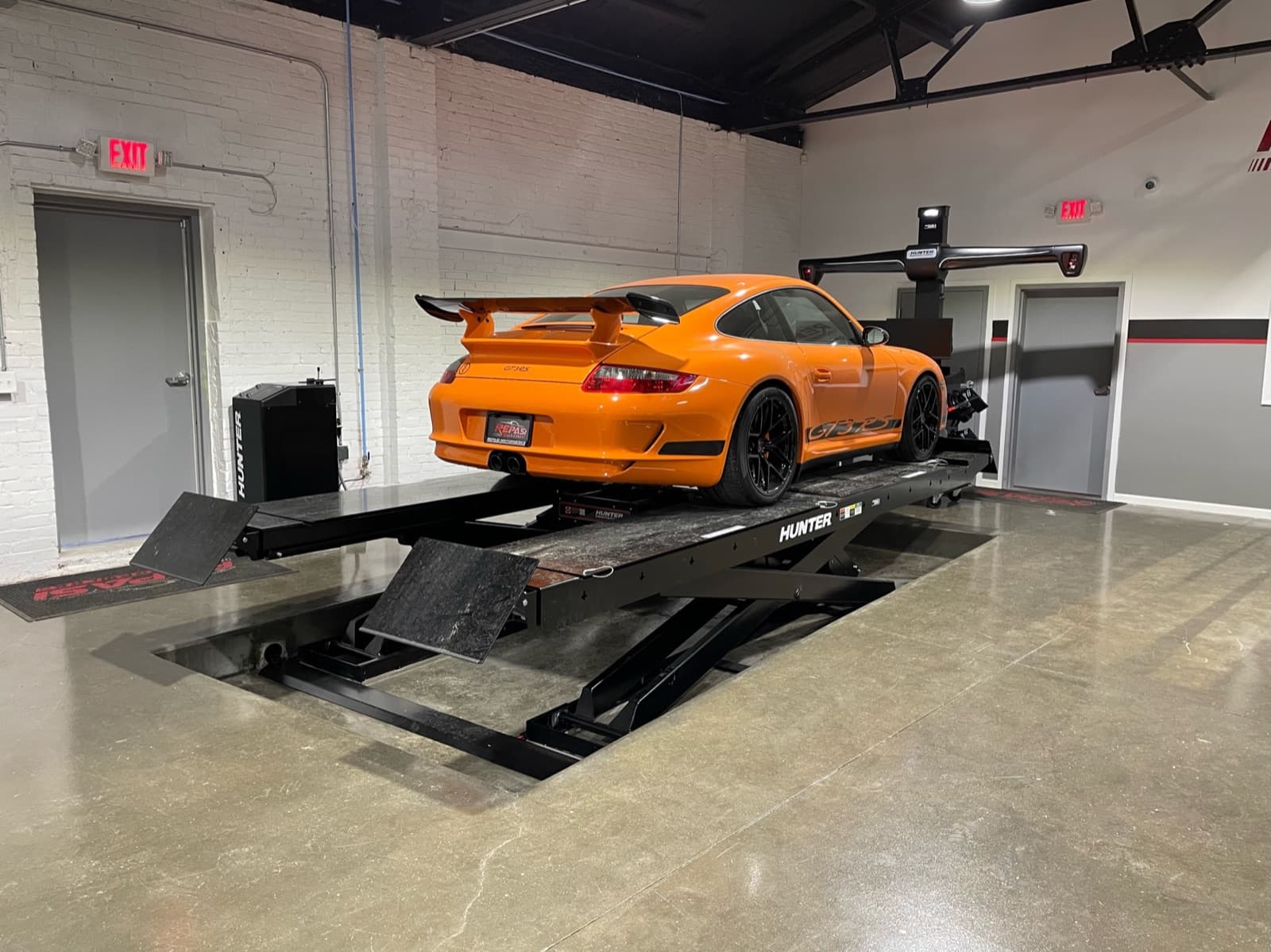
Hunter HawkEye Elite Laser Alignment
Porsche Wheel Alignment in Stratford, CT
Porsche alignment specifications are precise for a reason — they're calibrated to each model's weight distribution, suspension geometry, and PASM settings. Our Hunter HawkEye Elite alignment system measures to 0.01-degree accuracy, and our Gold Meister technician understands the interaction between alignment angles, PASM modes, and tire wear on every Porsche model.
Gold Meister Certified · PIWIS Equipped · OEM Specifications
Why This Matters on a Porsche
Porsche alignment specifications differ significantly from most vehicles. The 911's rear-engine weight bias requires specific rear toe settings to maintain stability. PASM-equipped cars have different ride heights (and therefore alignment angles) between Normal and Sport modes. GT3/GT3 RS models have adjustable camber plates from the factory. We understand these nuances and set your alignment accordingly — not just to spec, but to how you actually drive your car.
Model-Specific Details
911 (997-992)
Rear-biased weight distribution. Factory rear toe: slight toe-in for stability. PASM: check ride height mode before aligning.
GT3/GT3 RS
Factory adjustable camber plates. Track setup: -2.5° to -3.5° front camber. Street: -1.5° to -2.0° front.
Cayenne/Macan
Air suspension models: set to normal ride height before aligning. Heavier tire wear if alignment is off.
Boxster/Cayman
Mid-engine balance allows aggressive alignment without compromising daily driveability.
Panamera
Air suspension standard on most models. Alignment affects both handling and air ride leveling.
Air-Cooled (964/993)
No electronic suspension. Alignment is purely mechanical — shim adjustments on some models. Critical for even tire wear.
Types of Alignments
Factory Specs
Alignment set to Porsche's factory specifications for balanced tire wear and predictable handling. Accounts for PASM ride height mode and model-specific weight distribution.
Performance Setup
Increased negative camber (-1.5° to -2.5° front) for improved cornering grip on spirited drives. Slightly more inner tire wear in exchange for significantly better turn-in response.
Track Setup
Maximum performance alignment (-2.5° to -3.5° front) for track days and HPDE events. Optimized for grip at speed. Not recommended for daily driving due to accelerated inner tire wear.
Signs Your Porsche Needs an Alignment
- Vehicle pulls to one side (common after Connecticut pothole season)
- Uneven tire wear on inner or outer edge (expensive N-rated tires wearing prematurely)
- Steering wheel off-center when driving straight
- After installing new tires, coilovers, or suspension components
- After lowering your Porsche (coilovers or springs change geometry)
- PASM mode change feels different than expected (ride height affects alignment angles)
- Before track season or after a track day (curbs and aggressive driving shift settings)
What's Included
- Four-wheel alignment to Porsche factory specifications
- Performance alignment setups (increased negative camber)
- Track day alignment settings
- PASM-aware adjustments
- Before/after alignment printout
- Lowered vehicle alignments (coilovers, springs)
- Post-suspension work alignment verification
- Alignment checks (measurement only)
Our Equipment
Hunter HawkEye Elite
Our Hunter HawkEye Elite uses high-definition cameras and laser precision to measure camber, caster, toe, and thrust angle to within 0.01 degrees. It stores Porsche factory specifications for every model and year.
PIWIS III Integration
For models with PASM (Porsche Active Suspension Management), we verify ride height and damper settings via PIWIS III before aligning. Alignment specs change between Normal and Sport modes — we set your alignment to match your driving preference.
Dealer vs. Independent
Porsche dealers charge $350-$500 for a four-wheel alignment. We provide the same Hunter-calibrated alignment with the same factory specifications for less, with the added benefit of a technician who understands performance setups and track configurations. If you want more negative camber for canyon roads or a dedicated track alignment, we can accommodate that — most dealers only set to factory spec.
Comprehensive Inspection
Before aligning, we inspect suspension components for wear — worn ball joints, bushings, and tie rod ends make alignment adjustments pointless. We'll identify any components that need replacement before we waste your time (and money) on an alignment that won't hold.
Why Choose Repasi Motorwerks
- Hunter HawkEye Elite — 0.01-degree precision
- Before/after printout showing exactly what was adjusted
- Factory specs, performance setups, or track configurations
- PASM-aware alignment — we account for ride height modes
- Experience with lowered, coilover, and air-suspension Porsches
- Gold Meister technician performs the alignment — not a general tech
Frequently Asked Questions
- How often does a Porsche need an alignment?
- Porsche doesn't specify a fixed alignment interval, but we recommend checking alignment annually, after any suspension work, after hitting a significant pothole, and at every tire replacement. Track-driven cars should be aligned before each season and checked mid-season.
- What's the difference between a factory alignment and a performance alignment?
- Factory alignment optimizes for even tire wear and all-around handling. A performance alignment adds negative camber (typically -1.5° to -2.5° front) for improved cornering grip at the cost of slightly increased inner tire wear. Track alignments go further (-2.5° to -3.5° front) and are not recommended for daily driving.
- Does PASM affect my Porsche's alignment?
- Yes. PASM changes ride height between Normal and Sport modes, which changes alignment angles. We verify your PASM setting via PIWIS III before aligning and set the alignment to match your preferred driving mode. If you mostly drive in Sport mode, we align in Sport mode.
- Can you align a lowered Porsche?
- Yes. We regularly align Porsches with coilovers, lowering springs, and aftermarket suspension. Lowered cars often need eccentric bolts or adjustable control arms to achieve proper alignment angles — we can install these components if needed.
Related Articles
Ready to Schedule Your Porsche Alignment?
Contact us to schedule your Porsche alignment. We'll provide a before/after printout and set your alignment to factory spec, performance, or track configuration—your choice.