
The service interval reminder in your Porsche just crossed 12,000 miles. The dealer says you're fine. The internet forum says change it every 5,000. Your neighbor with a BMW says Porsche and BMW use the same oil standard so it should be the same.
None of these are quite right, and the gap between "technically within spec" and "what actually protects your engine" matters more than most owners realize.
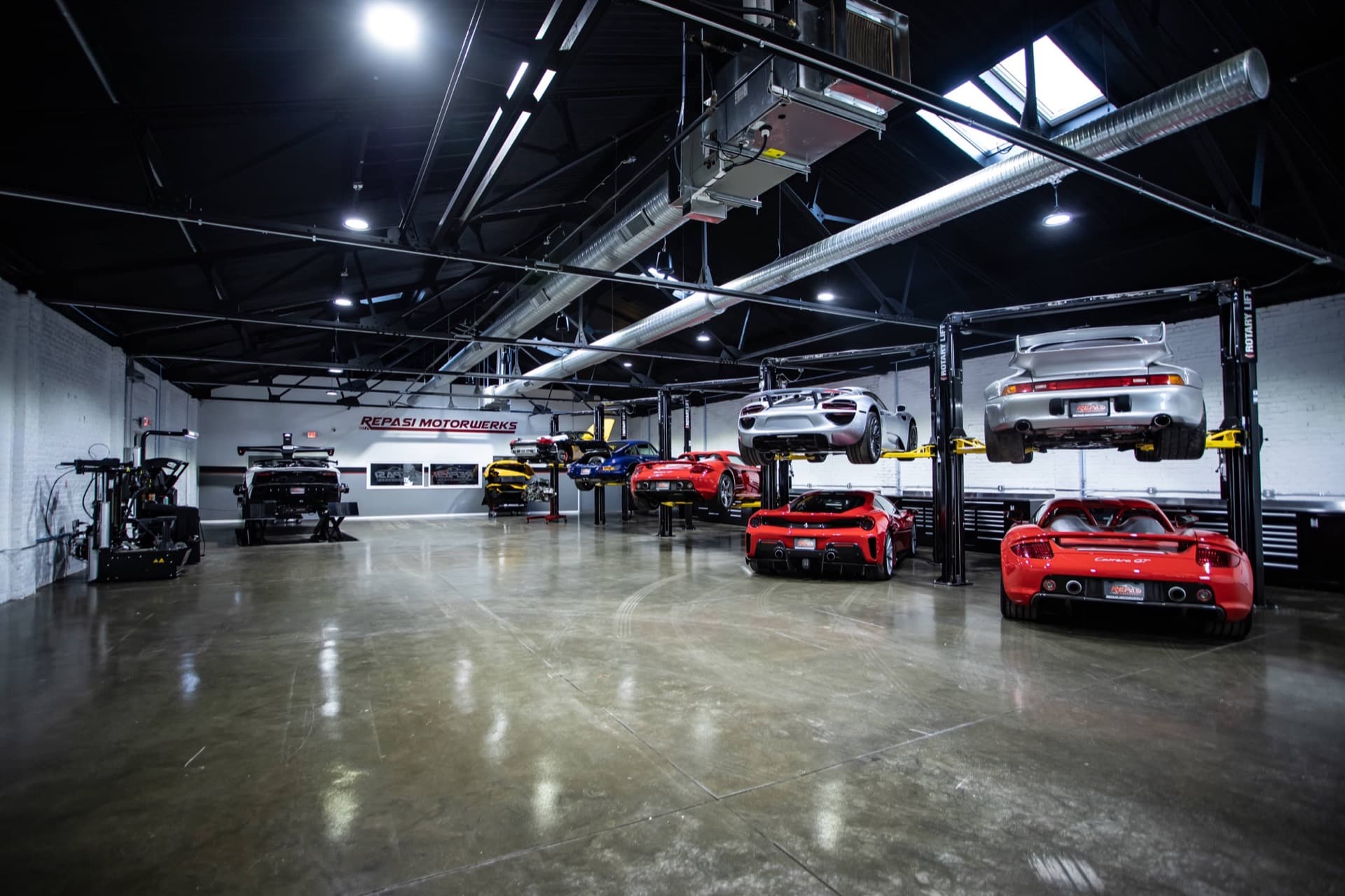
We change oil on Porsches every week at our shop in Stratford, Connecticut. We also see what happens inside engines that were stretched past their intervals, run in conditions the factory spec didn't anticipate, or filled with oil that met the label requirement but not the spirit of it. This guide gives you the actual picture by model.
Why Porsche Oil Intervals Differ From BMW and Mercedes
The comparison to BMW comes up constantly, and it is worth addressing directly. BMW's LL-01 spec and Porsche's A40 spec share some surface similarities — both are full synthetic longlife oils — but they are engineered for different applications and different engines.
BMW developed its longlife service intervals partly as a marketing and ownership cost reduction strategy. The LL-01 standard accommodates extended intervals but was built around specific engine architectures, driving cycle data, and European roads.
Porsche's A40 spec is more stringent in certain thermal and shear stability parameters. Porsche engines, particularly the air-cooled-to-water-cooled transition generation and the current flat-sixes, run at higher sustained temperatures than many BMW engines. They also rev higher more frequently in enthusiast use. The oil needs to maintain its film strength under sustained high-temperature load in a way that BMW LL-01 does not necessarily demand.
The deeper issue is that Porsche's published intervals assume something close to European driving patterns: longer sustained highway runs, moderate ambient temperatures, and regular full operating temperature cycles. A car that mostly does short trips around Fairfield County, Connecticut — especially in winter when the engine rarely fully warms before you park again — is doing exactly the kind of driving that breaks down oil faster without accumulating the mileage that triggers a service reminder.
Mercedes uses a different approach again — their MB 229.5 and 229.51 standards have their own chemistry requirements. These are not interchangeable with Porsche A40 and should not be treated as equivalent.
Model-Specific Oil Change Intervals
911 (996 and 997, water-cooled)
Factory interval: 12,000-15,000 miles or once per year, whichever comes first.
What we recommend in CT: Every 7,500-8,000 miles or once per year. These engines, particularly the M96 and M97, are known to consume oil between changes. Monitor your oil level between services. The IMS bearing situation on the M96 is a separate concern, but keeping clean oil in these engines is fundamental maintenance. Extended intervals allow oil degradation that accelerates wear on bearings already under stress.
Oil spec: Porsche A40 specification. Common choices: Mobil 1 0W-40 ESP Formula, Liqui-Moly Leichtlauf High Tech 5W-40. Match the viscosity to your climate — 0W-40 is preferable in Connecticut winters.
911 (991, all variants)
Factory interval: 20,000 miles or 2 years for 991.1; similar for 991.2.
What we recommend in CT: Every 10,000-12,000 miles for street-driven cars, 5,000-7,500 miles for cars that see track days. The 9A1 engine in the 991.1 has documented bore scoring on cylinders 4-8, and while oil change intervals are not the only factor, maintaining clean oil is part of protecting these cylinders.
Oil spec: Porsche C30 for later 991.2 variants. Confirm with your VIN — Porsche shifted specifications during the 991 production run.
911 (992)
Factory interval: 20,000 miles or 2 years.
What we recommend in CT: 10,000-12,000 miles for normal street use. The 992 uses a revised cooling and lubrication system that addresses some 991.1 concerns, but the same logic applies: Connecticut roads, temperatures, and driving patterns are not the basis for the factory service schedule.
Oil spec: Porsche C30. Do not substitute A40 in 992s that specify C30 — the newer engines have different tolerances and the spec reflects that.
Boxster and Cayman (986, 987)
Factory interval: 12,000-15,000 miles.
What we recommend in CT: 7,500 miles or once per year. The M96/M97 concerns apply to the mid-engine cars just as they do to the 911. These cars also tend to see more aggressive driving than the typical Cayenne, which means thermal cycling is real. Same A40 spec as the same-era 911.
Boxster and Cayman (981, 982, 718)
Factory interval: 20,000 miles or 2 years.
What we recommend in CT: 10,000-12,000 miles. The 2.0T and 2.5T turbocharged engines in the 718 run hotter than the naturally aspirated 2.7/3.4/3.8 engines they replaced. Turbo heat soak after shutoff degrades oil that is sitting in the turbo chargers and nearby lines. Keep these engines on a tighter interval.
Oil spec: Porsche C30 for most 718 variants. Verify for your specific model year.
Cayenne and Panamera
Factory interval: 15,000-20,000 miles depending on engine variant and generation.
What we recommend in CT: 10,000 miles for most owners. These vehicles often see the worst of short-trip driving — school runs, commutes, errands — which is exactly the use case that degrades oil without adding mileage. The V8 engines in the Cayenne Turbo and early Panamera are particularly sensitive to oil quality.
Oil spec: A40 for V6 variants, verify with the factory spec chart for V8 and hybrid variants.
Carrera GT
Factory interval: 10,000 miles or once per year.
What we recommend: Once per year minimum, regardless of mileage, and before and after any track event. The 5.7-liter V10 in the Carrera GT is an extraordinarily engineered engine, but it is also a low-production engine with specific lubrication demands. Most Carrera GTs are driven sparingly — some cover fewer than 500 miles per year. Annual oil changes ensure the oil film chemistry is fresh even when the car sits. Do not skip this because the car barely moved.
Oil spec: Mobil 1 0W-40 or Porsche-specified full synthetic meeting A40. The Carrera GT's V10 has specific chain tensioner and bearing clearance requirements that make oil quality non-negotiable.
The 12,000-Mile Myth and Why CT Roads Make It Unreliable
Porsche's published intervals — especially the 20,000-mile figures on newer cars — are based on something called a "variable service interval" algorithm that monitors driving conditions and adjusts the reminder accordingly. What the algorithm cannot directly account for is a Porsche spending November through March mostly doing 8-mile round trips in cold weather.
Cold-start oil is thick and slow to circulate. Full operating temperature — the point at which condensation burns off and oil viscosity stabilizes — requires about 15-20 minutes of driving for most Porsches. A commuter doing a 20-minute round trip twice a day may never fully thermally cycle the engine before the oil cools again.
This kind of driving accelerates fuel dilution of the oil (tiny amounts of unburned fuel contaminate the oil on cold starts), promotes moisture contamination, and prevents the detergent package from doing its cleaning work efficiently. The result is oil that looks fine on a mileage counter but is chemically spent.
Connecticut winters intensify this. Temperatures regularly drop below 20°F, which means longer cold-start periods and slower warm-up. Road salt introduces contamination. Short trips compound. The factory interval was not designed for this.
Oil Spec by Engine: What the Labels Mean
Porsche A40: The legacy spec for most air-cooled and water-cooled Porsches through the mid-2010s. Full synthetic, 0W-40 or 5W-40 viscosity. Look for this certification on the bottle, not just claims of compatibility.
Porsche C30: The newer spec for post-2013 turbocharged engines. Lower SAPS (sulfated ash, phosphorus, sulfur) content to protect catalytic converters and particulate filters. Do not use A40 where C30 is specified — the lower SAPS chemistry matters for emissions equipment longevity.
0W-40 vs 5W-40: Both are acceptable A40 viscosities. In Connecticut winters, 0W-40 provides better cold-start flow at temperatures that can drop below 0°F. In warmer months, the difference is negligible. We stock 0W-40 year-round for all-season compatibility.
ACEA rating: Porsche A40 corresponds to ACEA A3/B4. Porsche C30 corresponds to ACEA C3. These ratings appear on oil containers and confirm the chemistry standard.
OEM Filter vs Aftermarket
Use an OEM Porsche oil filter or an equivalent from Mahle or Mann — the same suppliers who manufacture for Porsche. The filter bypass valve, media quality, and anti-drainback valve in OEM filters are spec'd for Porsche engine tolerances.
We have seen aftermarket filters from unknown brands that use undersized media, weak bypass springs, and thin metal construction. On a $150,000 GT3, saving $8 on an oil filter is not a rational trade.
The filter housing O-ring on many Porsche engines also deserves attention at every oil change. These O-rings can stick to the housing, cause leaks, or leave the old ring behind when the filter is removed. Always confirm the old O-ring came out with the old filter before installing the new one.
Signs You Are Overdue
Your Porsche's oil change reminder is one input. Here are others:
Color on the dipstick. New oil is amber to golden. Slightly darkened oil is normal — it means detergents are working. Very dark or black oil that's lost its transparency is telling you the additive package is depleted.
Burning smell. A faint burning oil smell after spirited driving can be normal burn-off on hot exhaust components. A persistent burning smell at idle or during normal driving suggests oil is degrading on hot surfaces, often because it has lost its thermal stability.
Oil consumption between changes. A Porsche consuming more than half a quart per 1,000 miles on an engine that used to be stable is worth investigating. Increased consumption can indicate ring wear, valve seal degradation, or a PCV system issue — not just a reason to top off.
Creamy residue on the dipstick or oil cap. This indicates coolant contamination, which is a different and more urgent problem than simply overdue oil. Do not simply change the oil and hope — diagnose the source.
Schedule Your Oil Service at Repasi
We use Porsche-specified fluids and OEM filters on every oil service. We also check your oil level and condition at every visit, and we will flag if the interval you're running is not appropriate for how you actually use the car.
Book your oil change online or call us at (203) 257-0987. We work on all Porsche models and we know these engines well enough to notice when something is off before it becomes a problem.